What Are Supercycles of Light? Advanced Cannabis Lighting Explained

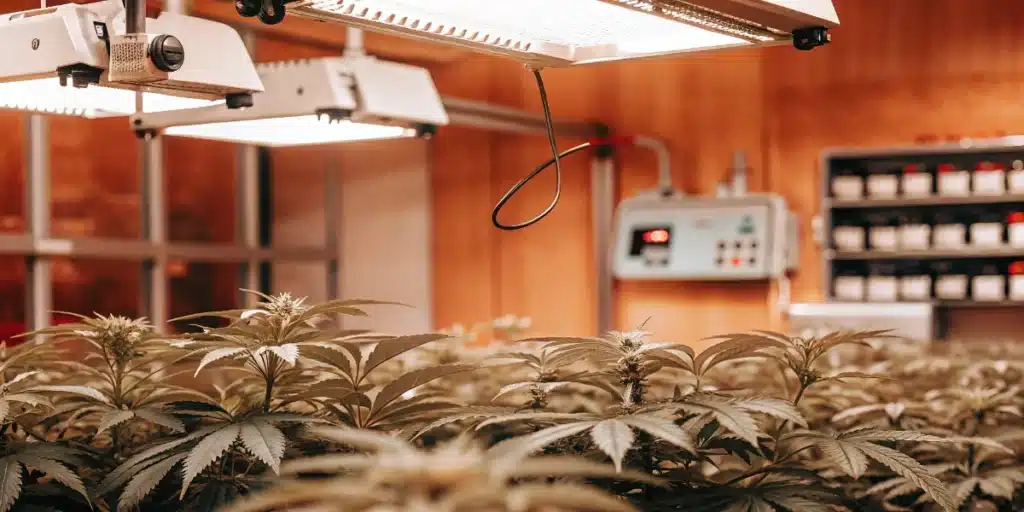
Supercycles of light are experimental lighting schedules that stretch the grow room “day” beyond the normal 24 hours by extending both the light and the dark period — for example 13 hours on / 13 hours off (a 26-hour cycle), 14/14 (28 hours), or 20/20 (40 hours). Unlike the standard 18/6 and 12/12 schedules, supercycles change the length of the plant’s daily rhythm rather than the amount of light it receives. They remain an experimental technique with limited scientific validation, best suited to experienced growers working with stable genetics in a tightly controlled environment.
The science first: why any of this works
To understand supercycles, you need to understand what actually triggers flowering.
Recommended Strains

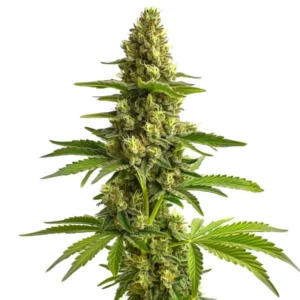
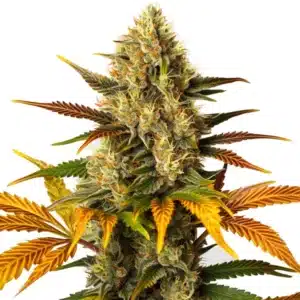
Wedding Cake

|
THC | 17% - 23% (Medium) |

|
Type | Feminized |

|
Yield | High |

|
Phenotype | 60% Indica / 40% Sativa |

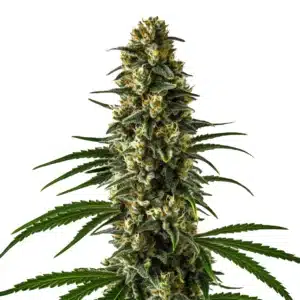
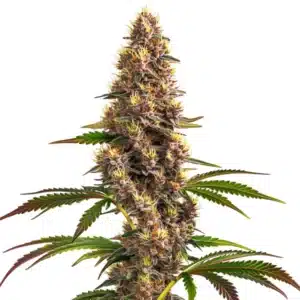
Gelato
|
|
THC | 27% (High) |
|
|
Type | Feminized |
|
|
Yield | High |
|
|
Phenotype | 50% Indica / 50% Sativa |
Cannabis is a short-day plant — more accurately, a long-night plant. Flowering is not induced by shortening the light period but by lengthening the uninterrupted dark period. When the dark period exceeds a cultivar-specific critical threshold (roughly 10 to 12 hours for most drug-type cultivars), the plant’s phytochrome system signals the transition to flowering. This threshold is called the inductive photoperiod, and it varies measurably between cultivars.
This is the key to supercycles: a 13/13 schedule provides 13 hours of uninterrupted darkness, comfortably past the critical threshold. The plant reads it as a “short day” and flowers — even though the calendar day it is living on is 26 hours long.
It also explains why interrupting the dark period with even brief light exposure can delay flowering or push plants back toward vegetative growth. In any extended-cycle experiment, light-tightness matters more than usual.
Promos & Deals

The arithmetic most articles skip
Here is something rarely stated clearly: the common supercycle schedules are all 1:1 ratios, so they do not increase the light your plants receive per calendar day.
Run the numbers on a 13/13 cycle. The full cycle is 26 hours, of which 13 are lit. Over a real 24-hour day that works out to 12 hours of light — precisely the same as a conventional 12/12. The same is true for 14/14 and 20/20.
| Schedule | Cycle length | Light per calendar day |
| 12/12 (standard flowering) | 24 h | 12 h |
| 13/13 supercycle | 26 h | 12 h |
| 14/14 supercycle | 28 h | 12 h |
| 20/20 supercycle | 40 h | 12 h |
So supercycles are not a way to give plants more light. What they change is the rhythm — fewer, longer light-and-dark periods spread across the same calendar time. Any benefit growers report comes from that altered rhythm, not from added daily light integral (DLI). Keep that in mind when evaluating claims.
The three common supercycle schedules
13/13 (26-hour cycle). The most widely used and most moderate option. It clears the critical dark threshold with margin while keeping the cycle reasonably close to a natural day, which makes environmental control simpler.
14/14 (28-hour cycle). A longer variation. Because the cycle drifts further from a 24-hour rhythm, temperature and humidity swings become harder to keep consistent — your lights-on period will fall at a different clock time every cycle, which matters if your climate control is tied to ambient room conditions.
20/20 (40-hour cycle). The most aggressive configuration and firmly experimental. It demands precise, fully independent environmental control and close monitoring. This is not a beginner technique.
The evidence-backed alternative: extended photoperiods
If your actual goal is more light and potentially more yield — rather than experimentation for its own sake — there is a related approach with far stronger scientific support: extending the photoperiod within a normal 24-hour day.
Research has directly challenged the assumption that 12 hours is optimal. In a controlled study of ten drug-type cultivars grown under photoperiods from 12 to 15 hours, flowering initiation occurred in all cultivars at every photoperiod up to 14 hours, with delays in initiation ranging from none at all to roughly four days depending on the cultivar. Under 15 hours some cultivars initiated flowering but the floral tissue failed to develop further.
Unlike a 1:1 supercycle, a schedule such as 13/11 or 13.5/10.5 genuinely raises the DLI, and higher DLI is the most reliable lever for increasing yield. One documented greenhouse strategy is to run 12/12 for the first six to eight days to secure a full flowering response, shift to roughly 13.5/10.5 for the following four to five weeks of floral expansion, then return to 12/12 for ripening.
The caveat is significant: cultivar response varies considerably. Some cultivars show peak floral biomass around 12.5 to 13 hours; others flower later or less reliably as the photoperiod extends. Commercial growers are advised to determine the inductive photoperiod for each specific cultivar they run rather than assuming a single number works across a catalog.
Benefits, limitations and honest expectations
Why growers experiment. Modern LED systems, programmable timers and automated climate control make alternative schedules practical to test in a way they simply were not before. Some growers cite scheduling flexibility and a better understanding of how their cultivars respond.
What the evidence supports. There is currently limited peer-reviewed research confirming that supercycles reliably improve yield or quality. Reports from growers are largely anecdotal. Extended photoperiods on a 24-hour day, by contrast, have measurable research behind them.
The practical limitations. Longer cycles complicate environmental management, because lights-on drifts around the clock and no longer aligns with ambient day and night. Darkness is not idle time — it is when key metabolic and hormonal processes occur — so cutting into it carries real risk. And because results vary by cultivar, a single trial tells you about one plant in one environment, not about the technique in general.
If you do run a trial, change one variable at a time, keep a control group on 12/12 where possible, and log environmental data throughout. Otherwise you cannot attribute any difference to the light schedule.
Supercycles vs. traditional schedules
| Schedule | Primary use | Evidence base |
| 18/6 | Vegetative growth | Established standard |
| 20/4 | Extended vegetative growth | Established |
| 12/12 | Flowering | Established standard |
| 13/11 – 13.5/10.5 | Flowering with higher DLI | Supported by published research |
| 13/13, 14/14, 20/20 | Experimental extended cycles | Largely anecdotal |
Traditional schedules remain the preferred choice for most professional operations because they are predictable, easy to manage and well documented. Advanced techniques can complement solid cultivation practice — they cannot substitute for it.
Genetics: the variable that decides your result
Every study above points to the same conclusion: cultivar response is the dominant variable. Two plants under an identical schedule can behave very differently depending on their genetic background and critical photoperiod.
This is why stable, well-documented genetics matter so much in lighting experiments. If your plants are genetically inconsistent, you cannot tell whether a result came from the light schedule or from plant-to-plant variation — the experiment tells you nothing.
Blimburn Seeds cultivars selected by indoor growers for consistent, predictable development include:
- Gelato — complex terpene profile, dense flowers, modern hybrid genetics.
- GG4 — strong resin production and robust structure.
- Bruce Banner — vigorous hybrid with balanced performance.
- Blue Dream — a classic valued for adaptability and consistency.
- Wedding Cake — aroma, flower quality and premium appearance.
- Girl Scout Cookies — one of the most influential modern genetics, prized for flavor and breeding value.
Frequently Asked Questions
What are supercycles of light?
Supercycles are experimental lighting schedules that extend the grow cycle beyond 24 hours by lengthening both the light and dark periods — such as 13/13 (a 26-hour cycle) or 14/14 (28 hours). They alter the plant’s environmental rhythm rather than the amount of light delivered per calendar day.
Why does a 13/13 schedule make plants flower?
Because flowering in photoperiod cannabis is triggered by the length of uninterrupted darkness, not the length of the light period. Thirteen hours of darkness exceeds the critical threshold (around 10–12 hours for most cultivars), so the plant reads the cycle as a short day and initiates flowering.
Do supercycles give plants more light?
No — not at a 1:1 ratio. A 13/13 cycle delivers 13 hours of light every 26 hours, which averages to 12 hours per calendar day, identical to 12/12. If your goal is a higher daily light integral, an extended photoperiod on a 24-hour day (such as 13/11) is the approach that actually achieves it.
Can supercycles increase cannabis yields?
There is limited scientific evidence that they do. Reports are mostly anecdotal, and outcomes depend on genetics, light intensity, nutrients, temperature, humidity and overall plant management. Research support is considerably stronger for extended photoperiods within a 24-hour day.
Are supercycles better than 18/6 or 12/12?
For most growers, no. Traditional schedules remain the established, predictable standard. Supercycles are an experimental technique for cultivators who want to study plant responses under tightly controlled conditions, not a general replacement.
Is a 13/13 cycle suitable for every cultivar?
No. Critical photoperiod varies between cultivars, and response to alternative schedules varies with it. Stable genetics with predictable growth characteristics are essential when testing any advanced lighting method.
Do supercycles work with autoflowers?
Not meaningfully. Autoflowering varieties flower according to age rather than photoperiod, so manipulating the light-to-dark relationship does not control their transition. Supercycle experiments apply to photoperiod cultivars.
What equipment do I need to run a supercycle trial?
Programmable timers capable of non-24-hour cycles, a reliable LED system, a fully light-tight space, temperature and humidity monitoring, adequate ventilation and stable independent climate control. Because lights-on drifts relative to the clock, climate control that depends on ambient room conditions will not hold steady.