Why the Federal Hemp THC Ban Is Bad News for Cannabis Genetics

The hemp industry in the United States has never been simple, but the new federal ban on hemp containing THC above 0.3%, including viable seeds capable of producing THC-dominant plants, marks one of the most disruptive regulatory shifts since the 2018 Farm Bill. This Federal Hemp THC Ban has pushed what once existed within a gray zone into sharp legal clarity—and for many stakeholders, for all the wrong reasons.
The new rules don’t just tighten hemp compliance. They directly target the seed sector, the backbone of genetic diversity and innovation in the cannabis industry. After years of progress developing unique cultivars, optimizing terpene expression, stabilizing cannabinoid ratios, and adapting plants to local climates, breeders now face a regulatory wall that threatens the future of cannabis genetics in the US.
Recommended Strains

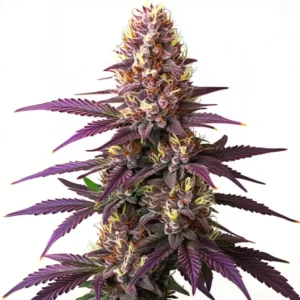
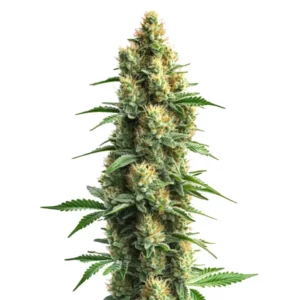
Cafe Racer

|
THC | 25% (High) |

|
Type | Feminized |

|
Yield | Medium |

|
Phenotype | 30% Indica / 70% Sativa |
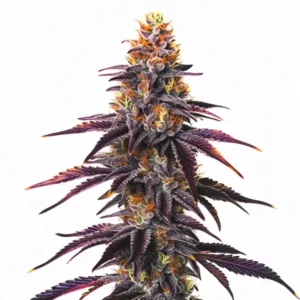
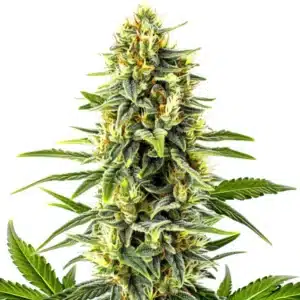
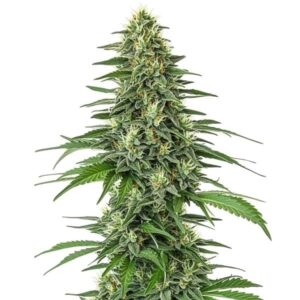
Runtz
|
|
THC | 19% - 22% (Medium) |
|
|
Type | Feminized |
|
|
Yield | Medium |
|
|
Phenotype | 50% Indica / 50% Sativa |
For cultivators, seed banks, breeders, and multi-state operators, this ban isn’t simply an inconvenience, it fundamentally changes how cannabis plants can be developed, distributed, and evolved. This article explores why the ban exists, how it works, and why its consequences may be more damaging than lawmakers realize.
Background. What Changed With the Federal Hemp THC Ban
From the 2018 Farm Bill to the 2025 spending bill
The 2018 Farm Bill federally legalized hemp by defining it as Cannabis sativa L. containing no more than 0.3% delta-9 THC on a dry-weight basis. Because seeds contain negligible THC, and because cannabinoid production requires plant maturity, seed trade exploded. Seed banks marketed THC-rich cannabis seeds as “hemp,” shipped nationwide, and operated legally on paper.
That loophole is now gone.
The new spending bill reinterprets hemp more broadly, banning any viable seeds that could grow into THC-producing plants. In other words:
If a seed can produce a high-THC plant, it is now marijuana under federal law, not hemp, regardless of the seed’s chemical profile.
The new legal definition and its consequences
Under the updated federal policy:
- Viable cannabis seeds from high-THC plants are illegal.
- Only seeds from certified 0.3% THC hemp are federally lawful.
- THCA is included, closing another loophole breeders relied on.
This instantly renders much of the national seed market federally illegal.
Deadlines and the one-year grace period
Businesses have until Nov. 13, 2026, but only for inventory management, not ongoing operations. Interstate seed trade will become far more dangerous after the cutoff.
Promos & Deals
Immediate Impact on Cannabis Genetics Trade
Seeds, once legal hemp, are now federally illegal
Before the ban, breeders and seed banks relied on a simple legal fact: cannabis seeds contain almost no THC. Now the law measures potential instead of chemical content.
This change means:
- Traditional cannabis seed banks must cease interstate operations.
- Retailers selling “souvenir seeds” risk federal prosecution.
- Large MSOs lose access to diverse genetics pipelines.
This is a tectonic shift, the genetics market once considered the safest part of cannabis is now one of the riskiest.
International and interstate trade disrupted
Seed banks importing genetics from Europe, Africa, Latin America, or Asia now face enormous compliance risks. Interstate shipping — once common through USPS, is now legally comparable to shipping marijuana across state lines.
The end of pheno-hunts via hemp seeds
Breeders have long used large pheno-hunts to discover stand-out genotypes. Thousands of seeds would be popped to locate a keeper mother plant.
Without legal seed acquisition:
- Smaller pheno-hunts
- Less innovation
- More genetic stagnation
- Fewer new cultivars entering the market
Broader Consequences for the Regulated Cannabis Industry
Supply chain disruption
Seed banks and breeders are the “R&D department” of the cannabis ecosystem. When innovation slows, the entire supply chain suffers.
Consequences include:
- Limited new strains for retail shelves
- Reduced differentiation for brands
- Slower response to consumer trends
- Increased homogenization of available genetics
Pressure on breeders and seed banks
Compliance costs, federal risk, and the fear of asset seizure will force many businesses to close or relocate. Smaller craft breeders, the heart of genetic innovation, are most vulnerable. Premium cultivars like Presidential OG highlight what’s at stake unique genetics that depend on these small breeders to survive and continue shaping the future of cannabis.
Shift to alternative propagation: clones & tissue culture
Some see a loophole:
The law bans seeds, not clones.
But clones:
- Are far more expensive to ship
- Require cold-chain logistics
- Are fragile compared to seeds
- Cannot be stored long-term like seeds
Tissue culture may scale, but not fast enough to save the genetics sector from disruption.
The Genetics Bottleneck. A Long History of Lost Diversity
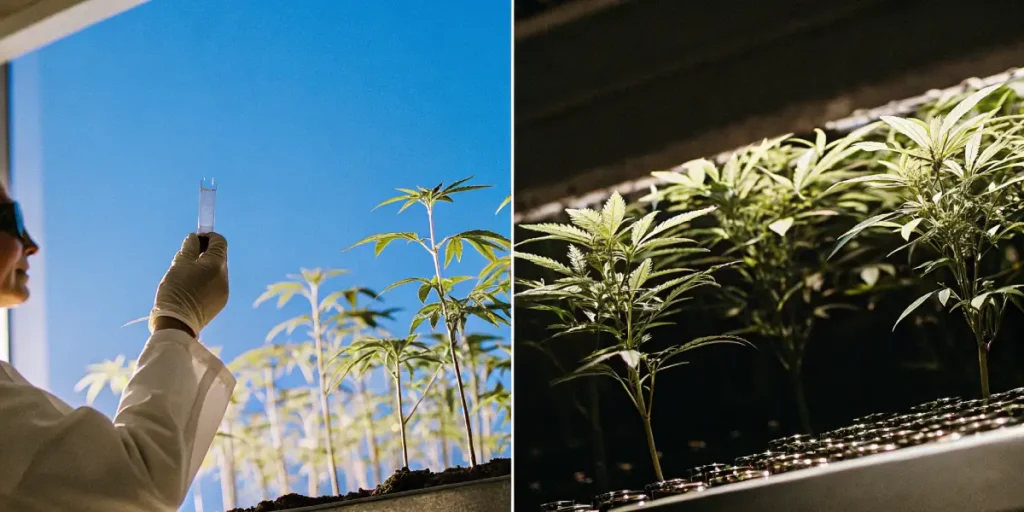
Decades of prohibition already damaged US hemp genetics
Hemp breeding programs were wiped out during the War on Drugs. By the time hemp was re-legalized in 2018, the US had:
- almost no diverse hemp genetic library
- minimal agronomic research
- no stable low-THC cultivars suited to American climates
Now, just as progress accelerated, federal policy is shutting the door again.
Foreign markets have a huge advantage
Europe, China, India, Russia, and parts of Africa have maintained robust hemp genetics for decades. Breeders there benefit from:
- legal continuity
- mature breeding programs
- stable certified varieties
- deep genetic archives
The US is falling further behind.
Breeding compliant low-THC varieties is already difficult
Creating high-yield hemp that stays under 0.3% THC is nearly impossible in hot climates. Many farmers have had to destroy entire fields. By restricting genetics even further, the government is making hemp cultivation less viable, not more compliant. For growers seeking more predictable and premium-quality genetics outside the hemp framework, strains like Do-Si-Dos x Zkittlez offer a reliable alternative with robust yields and stable performance.
Regulatory and Legal Ambiguities. What Remains Unclear
Are clones and tissue-culture banned too?
Federal agencies have not clarified whether non-seed propagation material is treated the same way as seeds. The ambiguity creates risk, especially for interstate clone shipments.
Enforcement uncertainty
Federal vs. state conflict will complicate matters. Some states may ignore the federal rule. Others may align tightly with it. Businesses in legal cannabis states could face raids simply for possessing untested seed stock.
Risk of pushing genetics back into the illicit market
When legal options disappear, illegal ones return. Breeders fear repeating the mistakes of prohibition:
- underground seed trade
- cash-only networks
- limited safety and transparency
- loss of agronomic testing and data
Economic and Industry-Wide Repercussions
Impact on seed banks and breeders
The economic shock will be severe:
- closures
- layoffs
- revenue collapse
- asset liquidation
- relocation to foreign markets
Many breeders are already contemplating moving their operations to Canada, Europe, or South America.
Impact on innovation and research
Without new genetics entering the market:
- cannabinoids and terpene profiles stagnate
- disease-resistant cultivars stop evolving
- climate-adapted varieties become limited
- medical research using new chemotypes slows
Cannabis becomes less resilient, less interesting, and less useful.
Loss of market value across the spectrum
Fewer genetics hurt:
- growers
- extractors
- product formulators
- retailers
- consumers
Everyone loses.
Possible Responses and Alternatives for the Industry
Switching to vegetative propagation
Clones, mother plants, and tissue culture may cushion the blow, but scaling these methods to replace seed-based operations will take years, and logistics remain complex. This challenge becomes even more pressing in the context of the Federal Hemp THC Ban, which adds regulatory pressure and forces growers to reconsider long-term genetic and propagation strategies. For those seeking reliable genetics despite these constraints, the Peyote Super Lemon Haze strain offers a stable, high-performing option that helps maintain quality and consistency in evolving regulatory environments.
Advocating for regulatory frameworks instead of bans
Industry groups should lobby for:
- THC testing of plants, not seeds
- licensing for seed businesses
- THC-threshold exceptions for breeding programs
- a genetics-research exemption under federal law
Prohibition is rarely smarter than regulation.
Diversifying genetics sources while there is time
Breeders should:
- collect and store seeds abroad
- preserve tissue culture libraries
- collaborate with foreign breeding programs
- manage their collections before the deadline
Those who adapt early will survive. Those who wait will lose their archive.
Long-Term Risks to Cannabis Diversity, Breeding, and Innovation
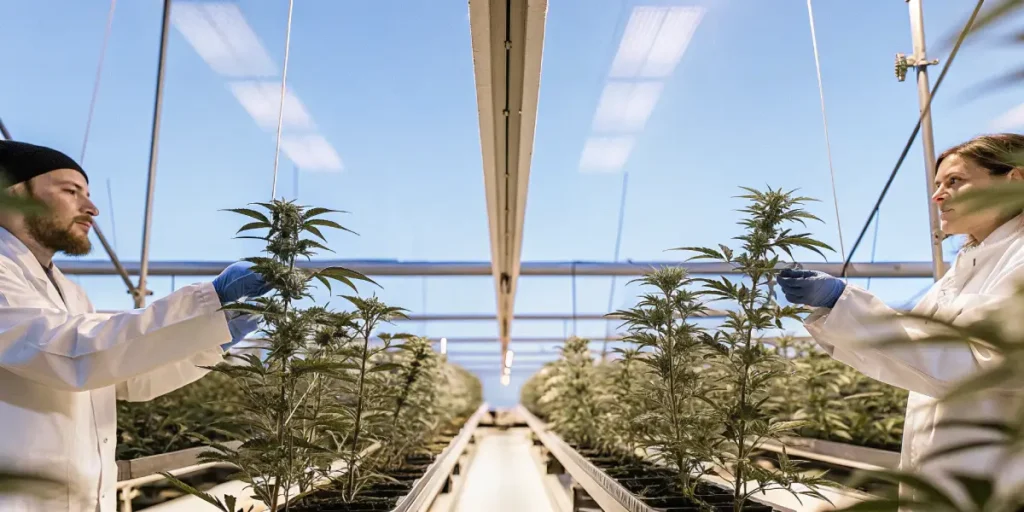
Genetic stagnation
Without a constant inflow of new traits:
- potency plateaus
- terpene diversity decreases
- disease pressure increases
- environmental stress tolerance declines
Genetic diversity is not a luxury — it is essential for crop health.
Loss of rare landrace genetics
Many irreplaceable cultivars , Afghan, Thai, Colombian, African landraces; may become inaccessible. Once lost, they are gone forever.
US falling behind global competitors
While other countries advance breeding programs, the US handicaps its own industry. The long-term result is predictable:
The US will rely on inferior genetics while global competitors dominate.
Why This Matters for Consumers, Patients, and the Ecosystem
Reduced strain diversity means fewer choices
Patients with specific cannabinoid or terpene needs will have fewer options. Consumers seeking novelty will be disappointed.
Increased black-market activity
When legal supply dries up, illegal supply fills the gap. Unregulated seeds increase:
- contamination risk
- pesticide exposure
- mislabeling
- genetic instability
Setback for medical and scientific progress
Cannabis research depends on genetic diversity. Restricting seeds restricts science, medicine, and innovation.