

Grow Diaries
Granddaddy Purple Grow Diary Growing Granddaddy Purple
Oct 23, 2025
HAR
15
Week
Week 15: Harvest Granddaddy Purple
Photos (2)
Grow details

Harvest weight
362 g

Plants harvested
2
Grower notes
Granddaddy Purple - Harvest
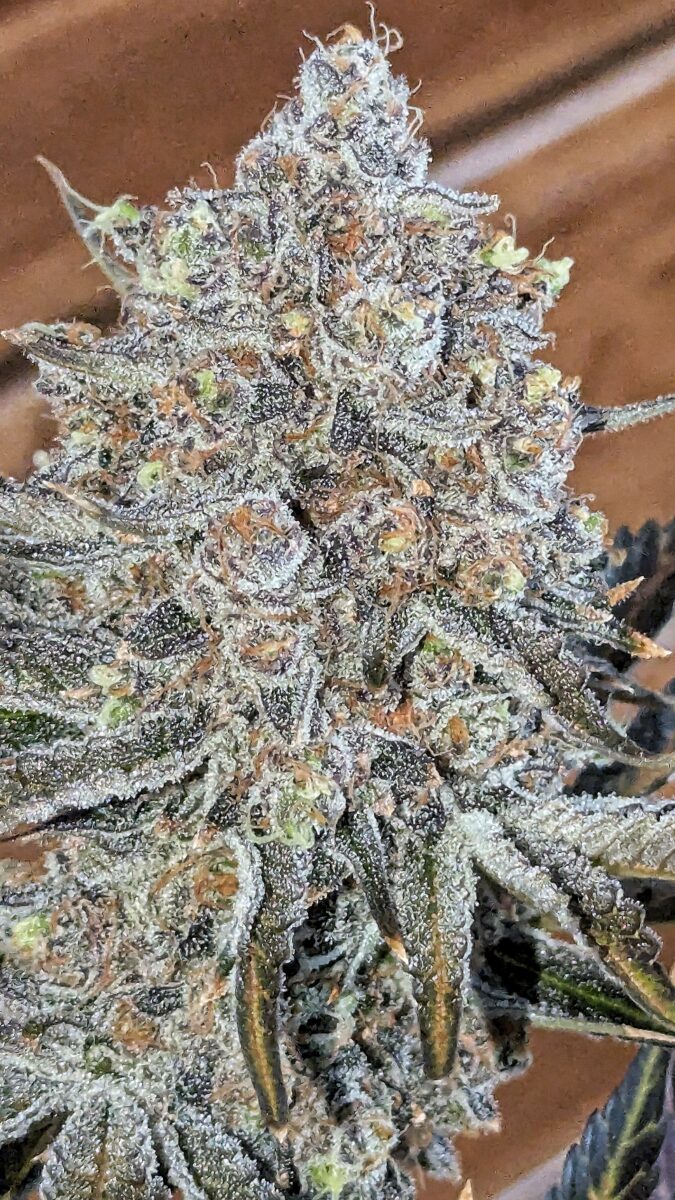
This week marked the conclusion of Granddaddy Purple’s grow cycle at 105 days post-emergence and 73 days in flower. Light intensity remained unchanged through harvest at 725 PPFD. Environmental conditions were kept stable, with daytime temperatures peaking near 74°F, nighttime lows around 66°F, and average relative humidity holding at 41%.
Final trichome analysis at harvest showed the following distributions:
GDP1 Clear: 13% Cloudy: 82% Amber: 5%
GDP2 Clear: 13% Cloudy: 83% Amber: 4%
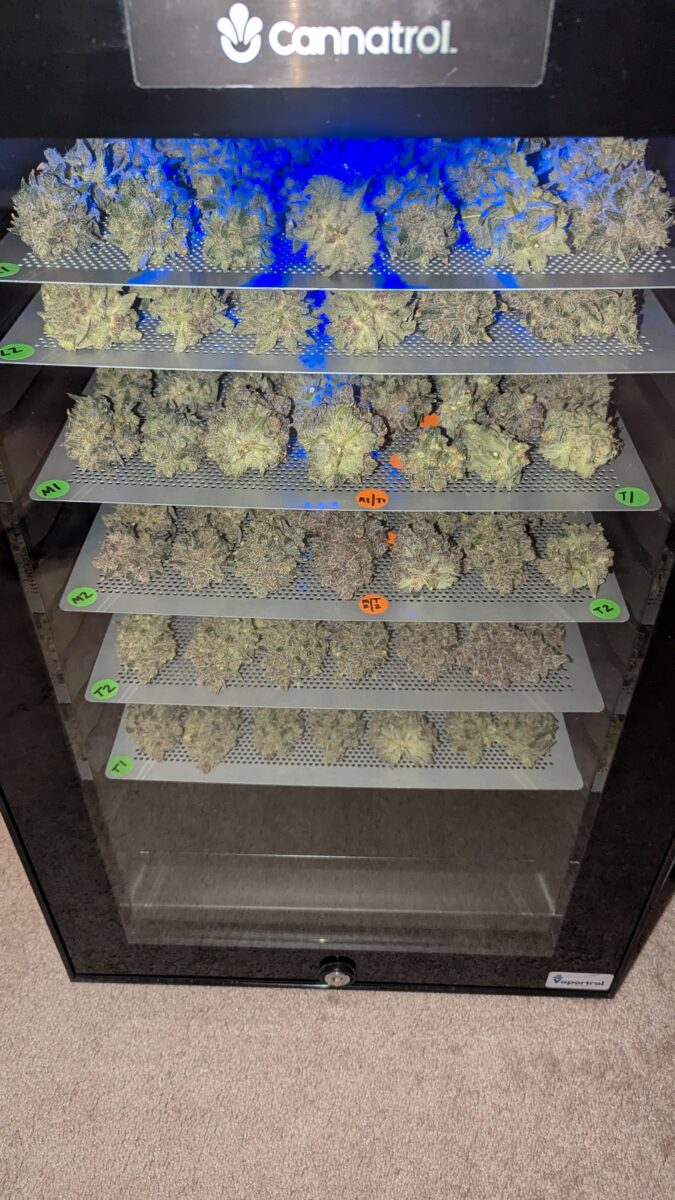
Harvest was performed methodically, working through the plant in sections to maintain structural stability. Branches were removed individually, given a light rough trim, and buds were reduced to manageable sizes prior to drying. Buds were placed into a Cannatrol and processed using the standard protocol: 4 days of dry followed by 4 days of cure followed by a 4 day hold cycle.
Finished buds were then transferred to Grove bags for short-term curing. After 2-3 weeks in Grove bags, the flower will be transferred into mason jars for long-term storage.
Final Dry Weight: 351.6 grams
Lifecycle Summary – Granddaddy Purple
- Emergence: 2 days from seed
- Seedling Stage: 9 days
- Vegetative Stage: 13 days
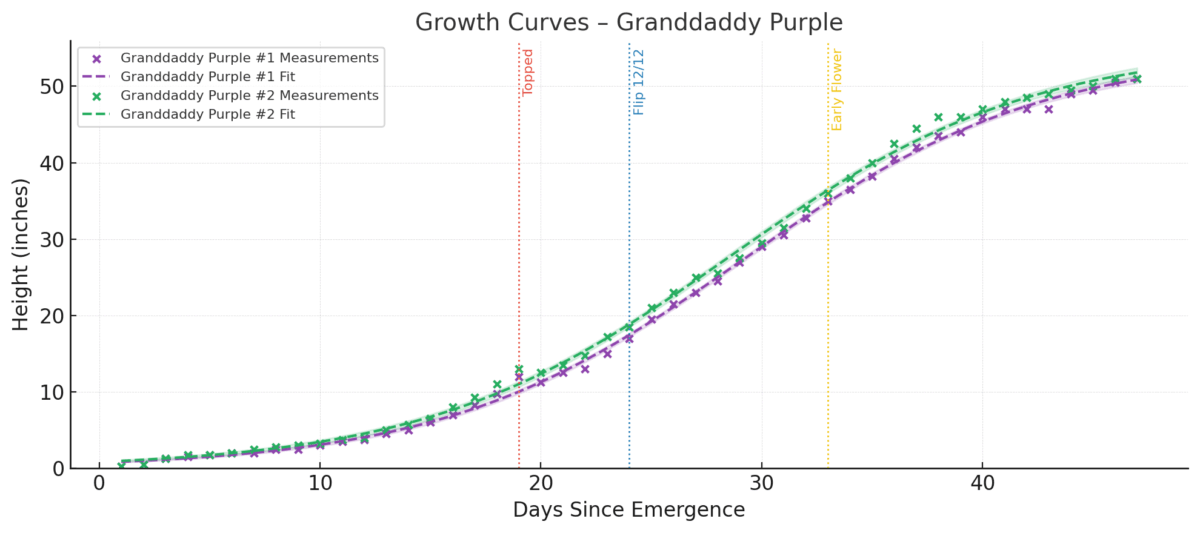
- Topped: Topped on Day 19 post-emergence
- Flip to Flower: Flipped on Day 24 post-emergence
- Transition Period: 8 days post-flip
- Flowering Stage: Began on Day 33 post-emergence; flowering lasted for 73 days
- Total Time (Seed to Harvest): 105 days
FLO
14
Week
Week 14: Flowering Granddaddy Purple
Photos (18)
Grow details

Plant height
51.5 in

Air humidity
43 %

Smell intensity
High

Day air temperature
74 °F

Night air temperature
67 °F

Lamp to plant distance
8 in

Pot size
3 gal

Solution pH
6

Nutrient strength (mS/cm)
0.23 mS/cm

Daily water per plant
4 L

Light schedule
12 h
Grower notes
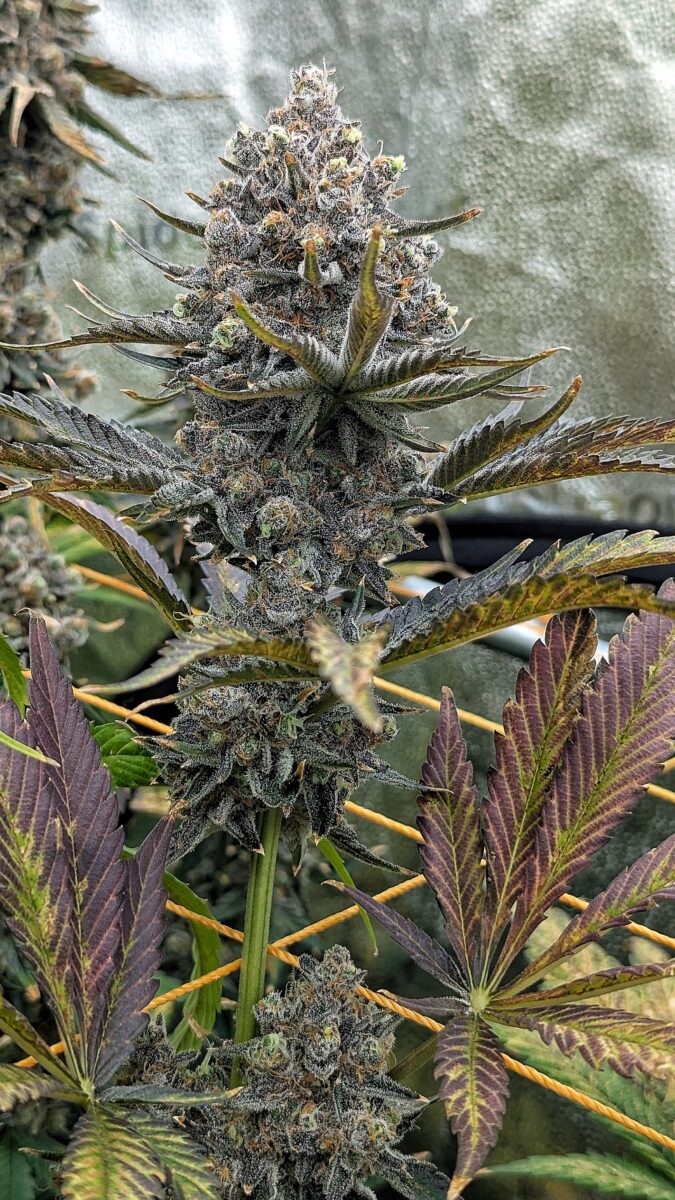
Granddaddy Purple - Week 10 of Flower (Flush)
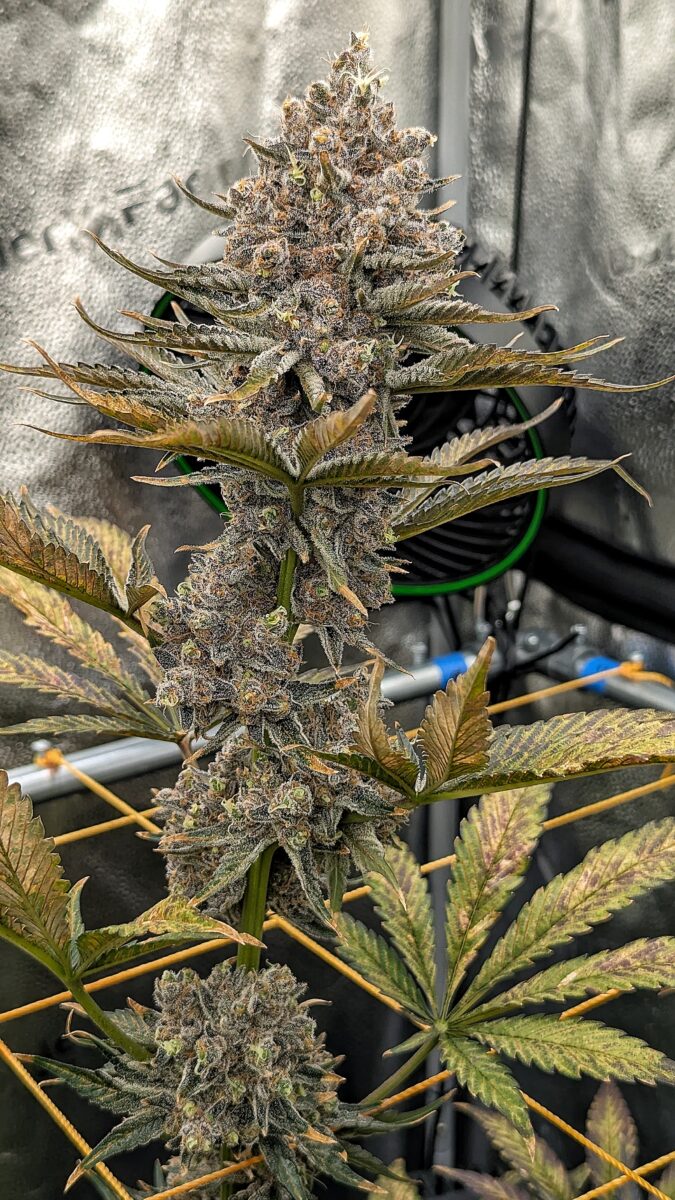
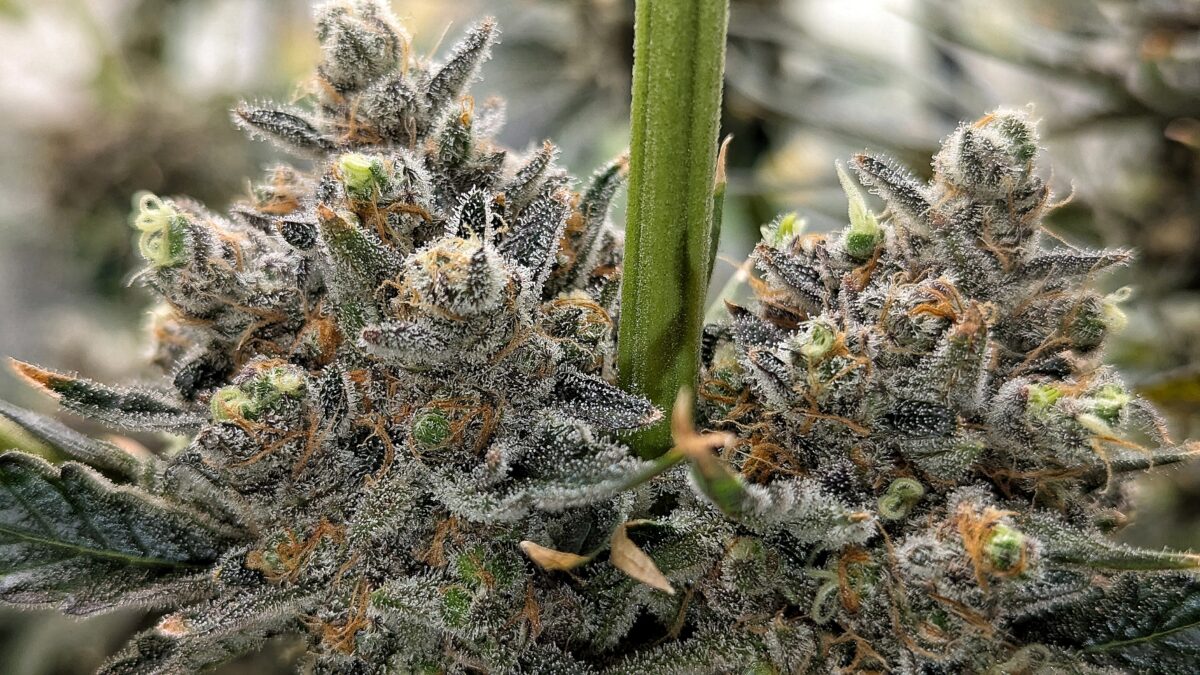
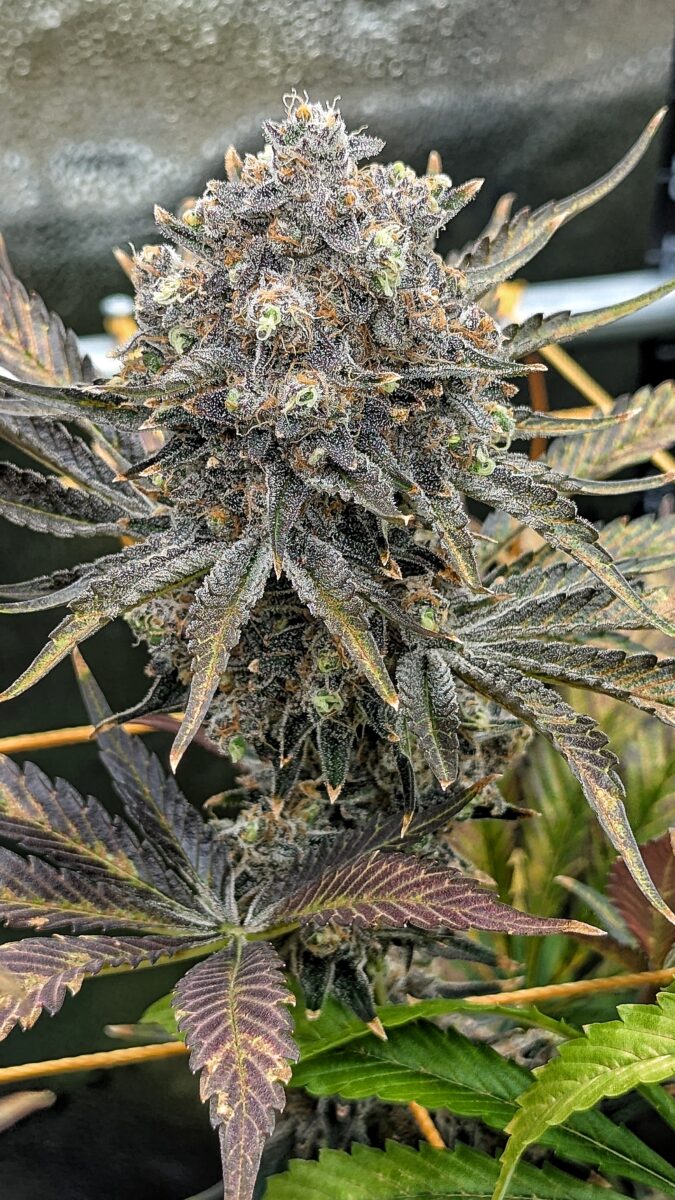
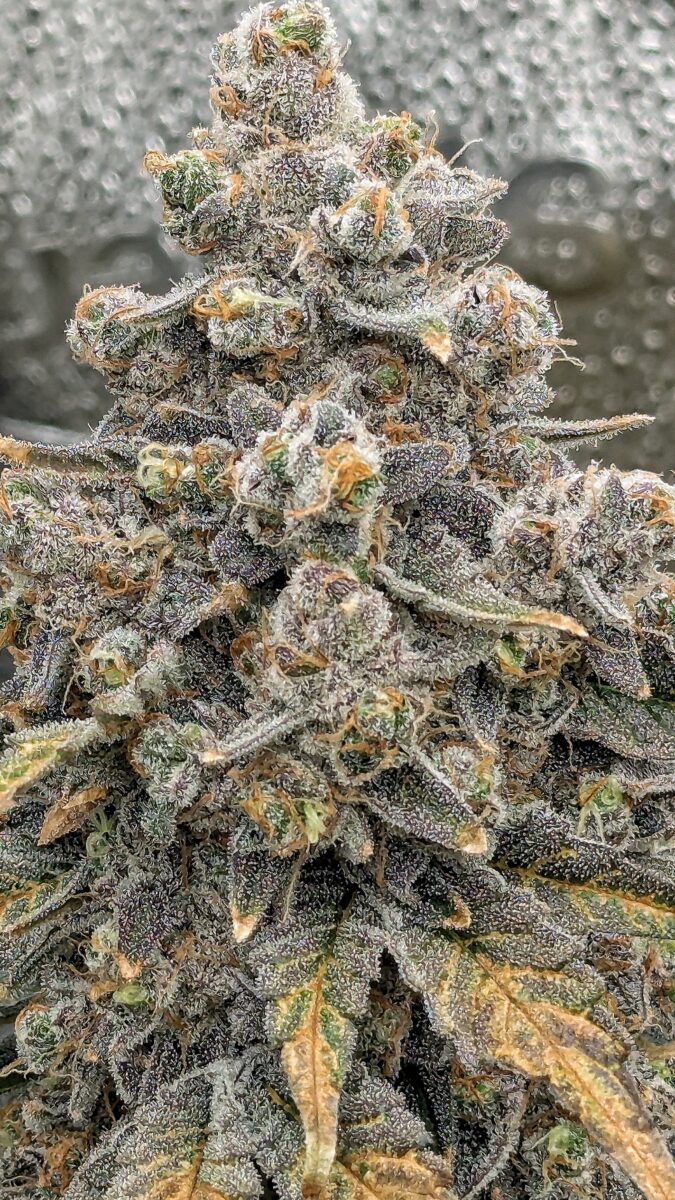
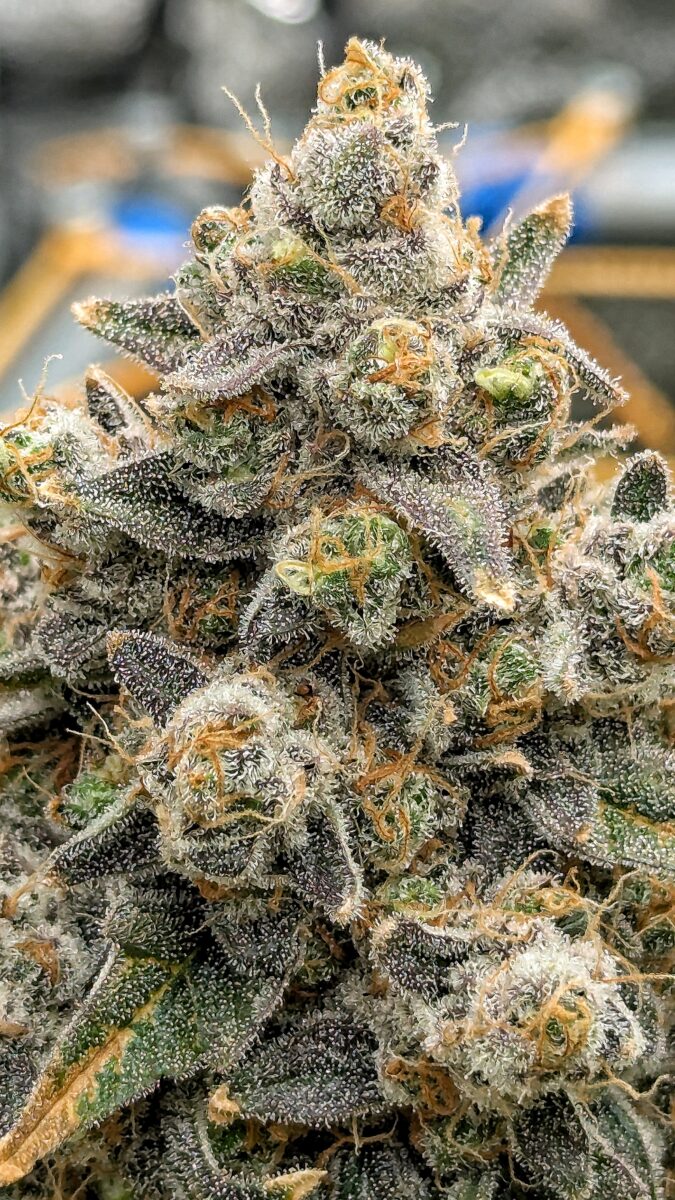
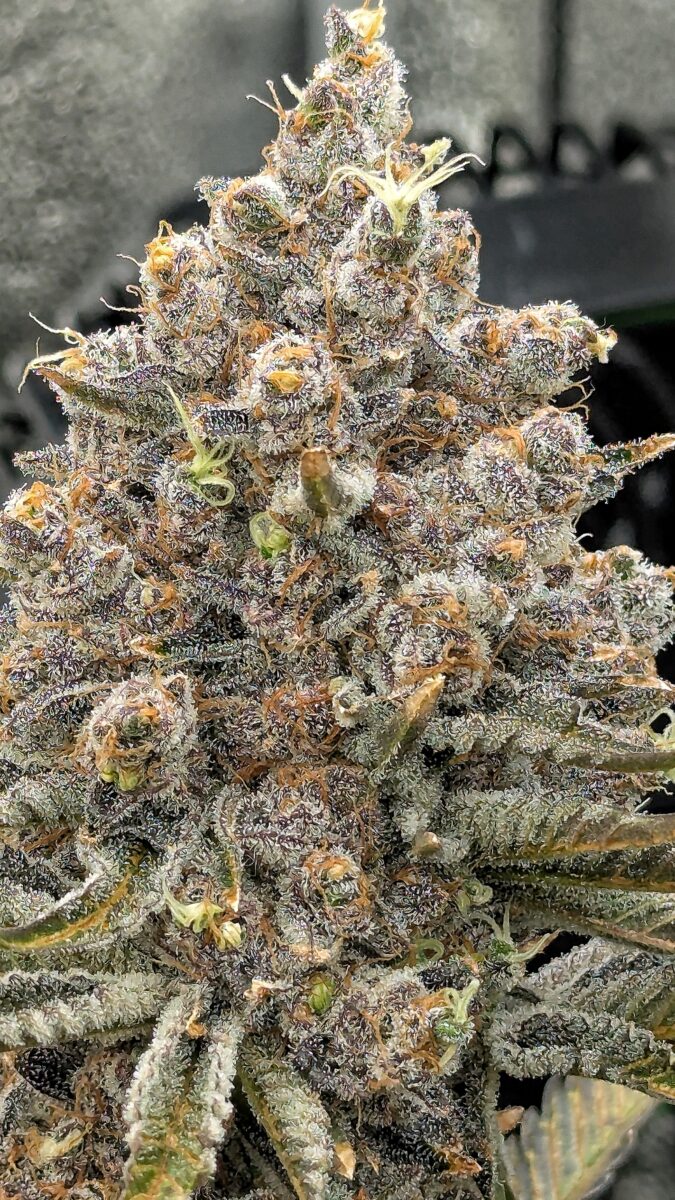
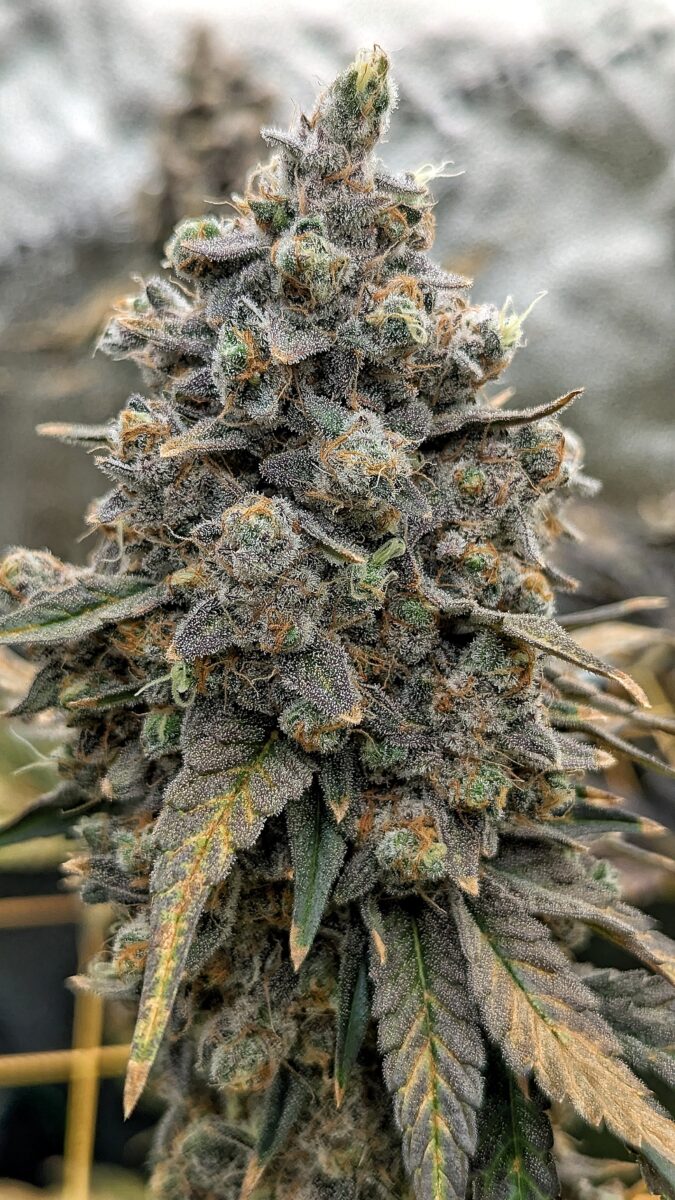
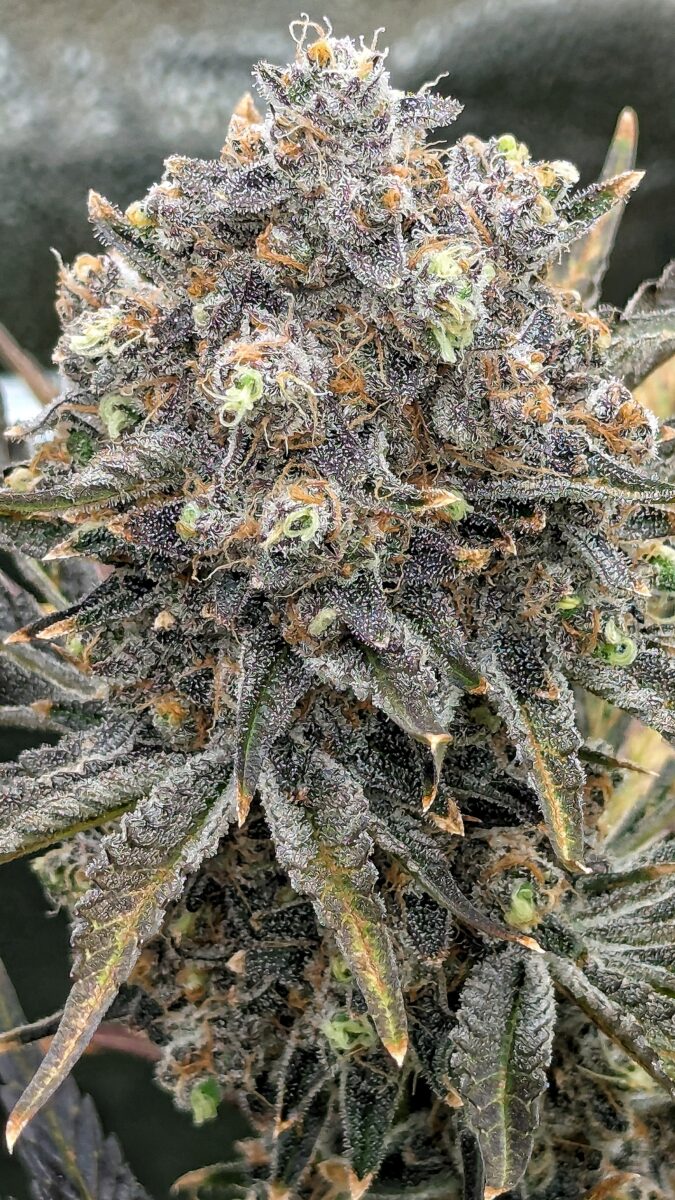
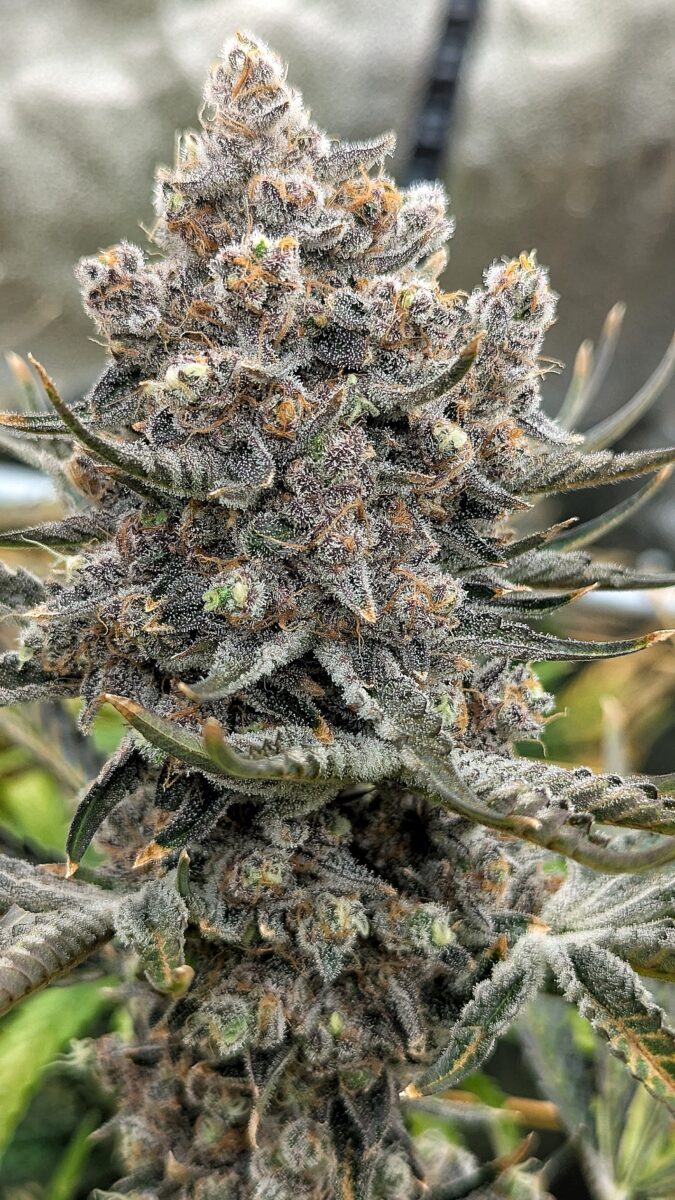
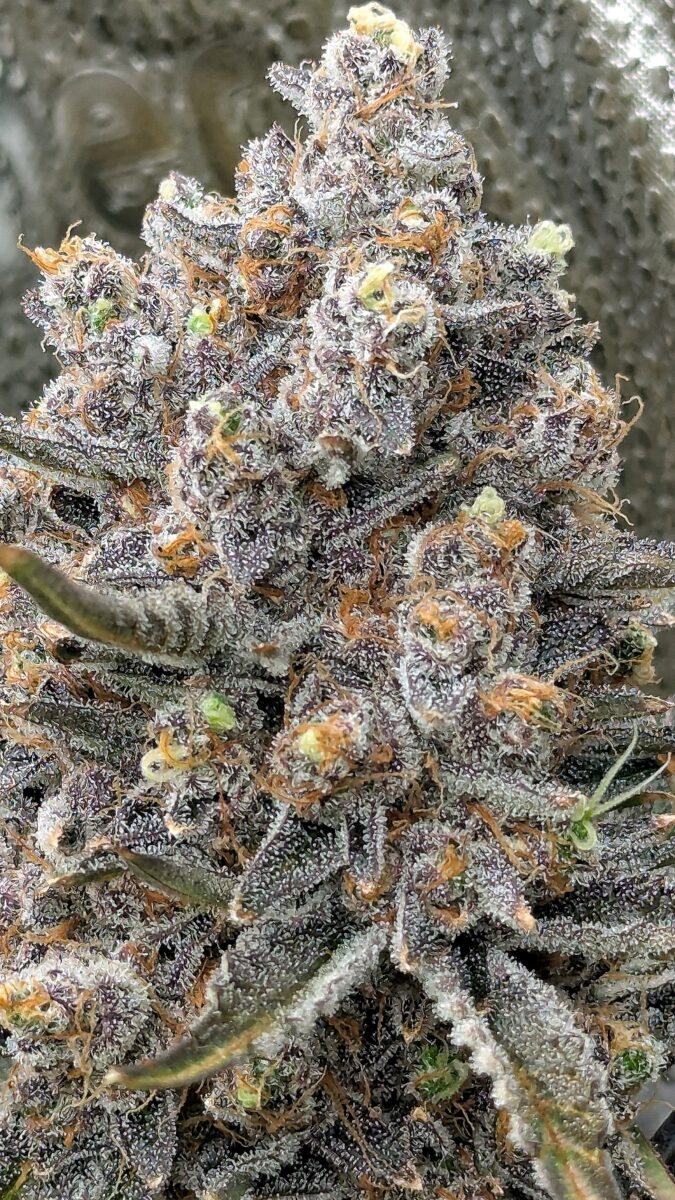
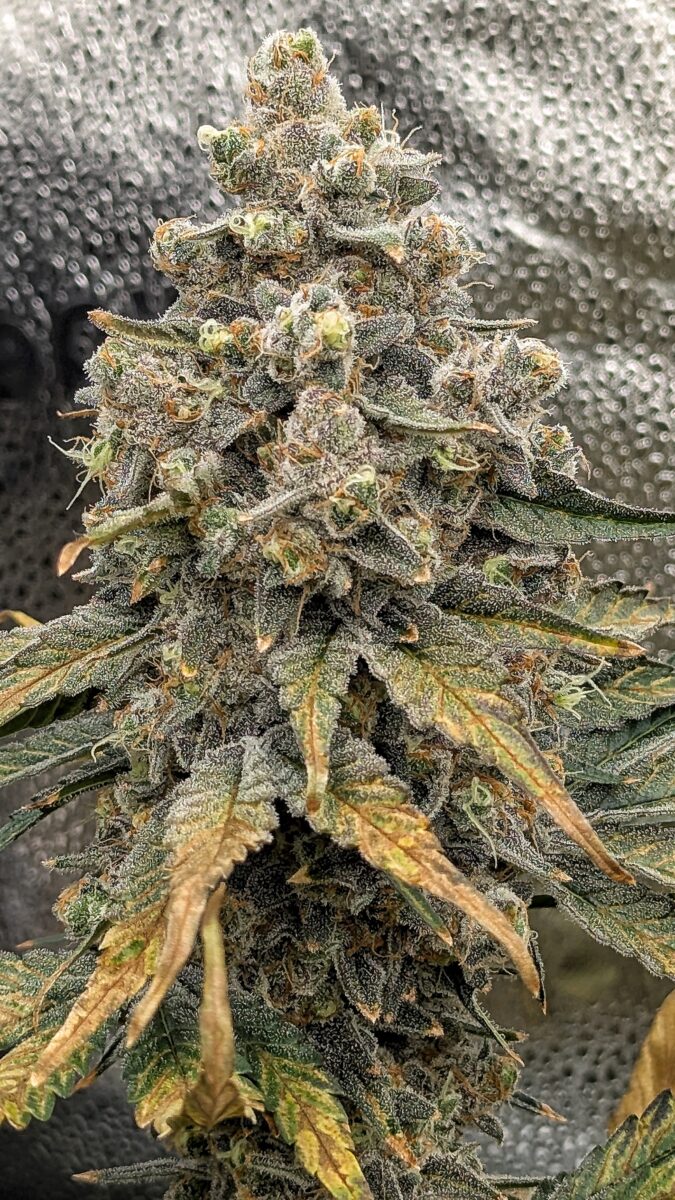
Week 10 marked the final ripening window for both GDP plants. Bud development had fully plateaued, calyxes stayed swollen and resin-heavy, and senescence progressed evenly across the canopy. Older fan leaves continued to fade while sugar leaves remained well-coated, consistent with a clean finish.
Lighting remained stable to avoid late-stage stress: ~725 PPFD at the canopy (DLI ~31), no UVA.
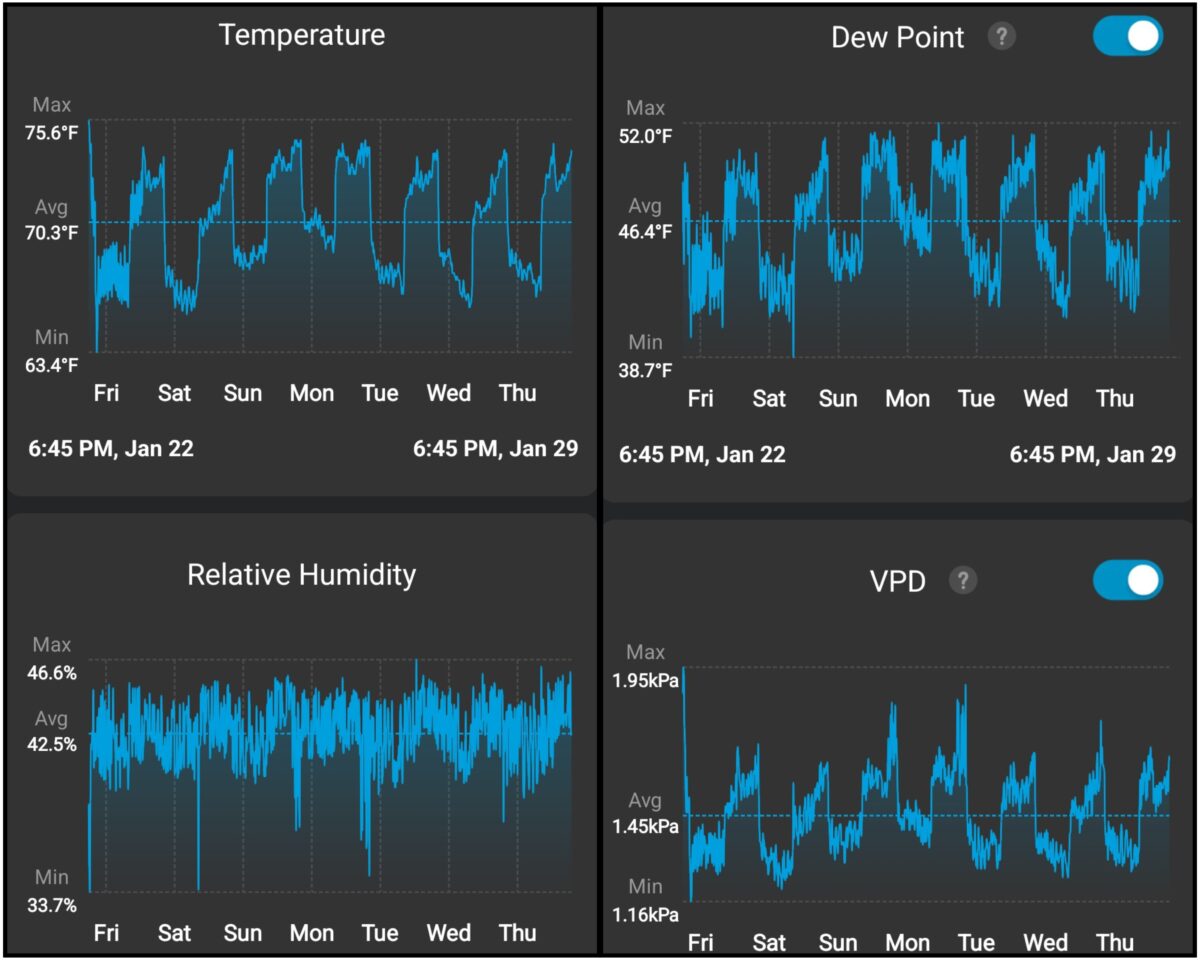
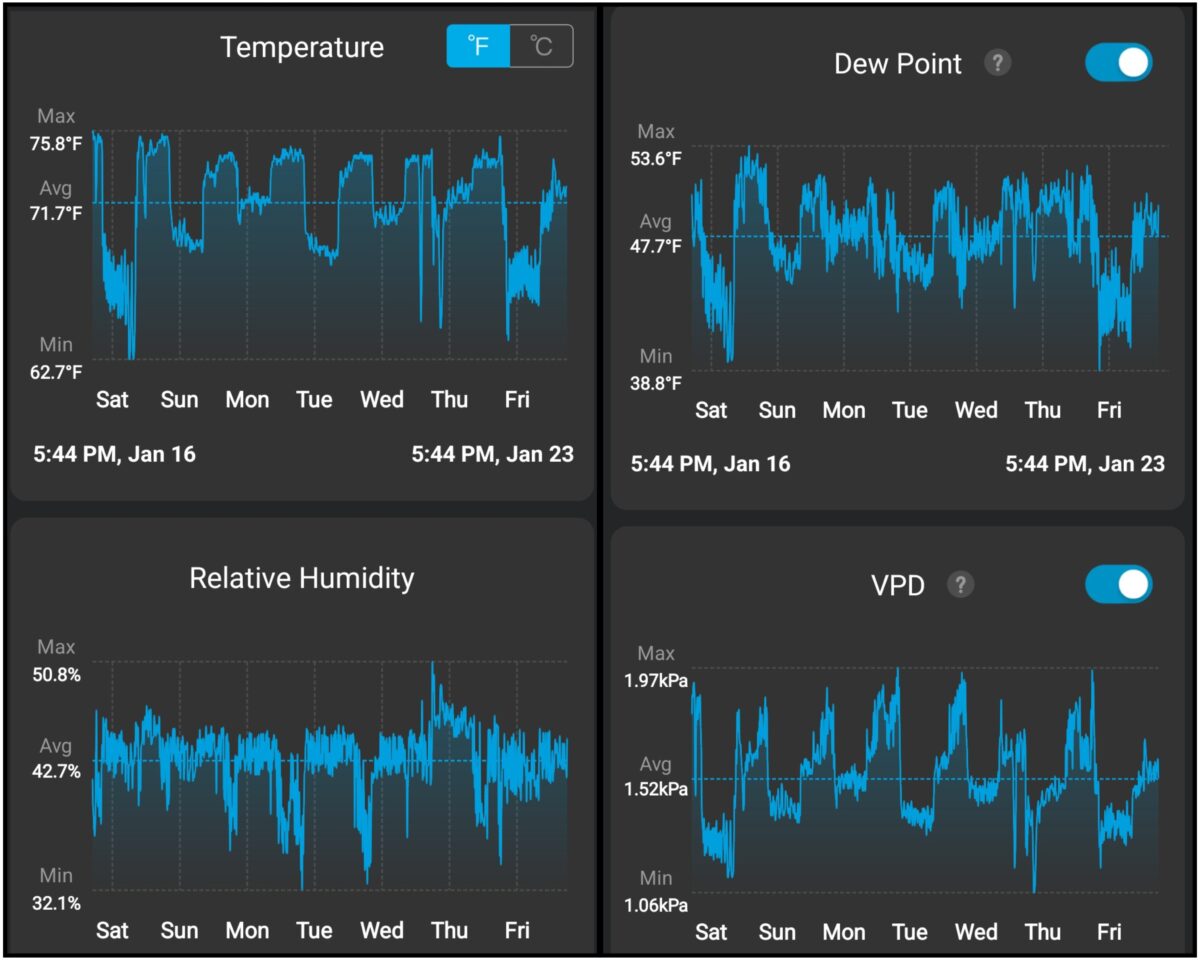
Environment stayed controlled and dry: ~71–74°F daytime, mid-60s°F nights, with RH generally ~40–45% both day and night.
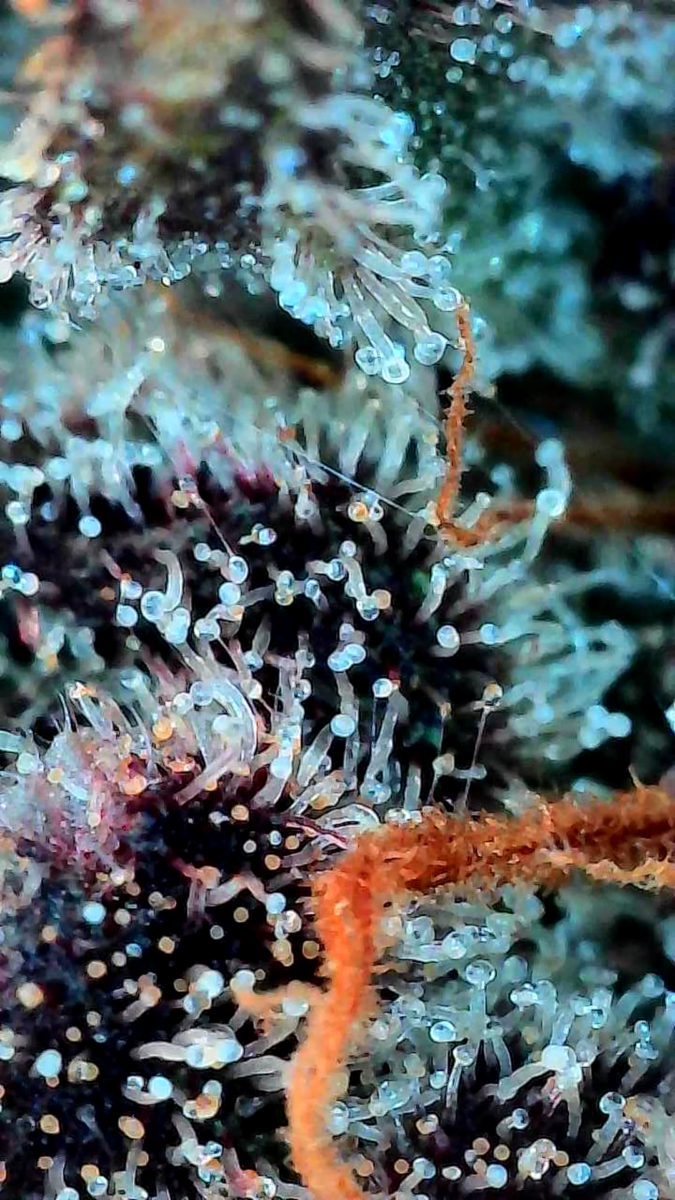
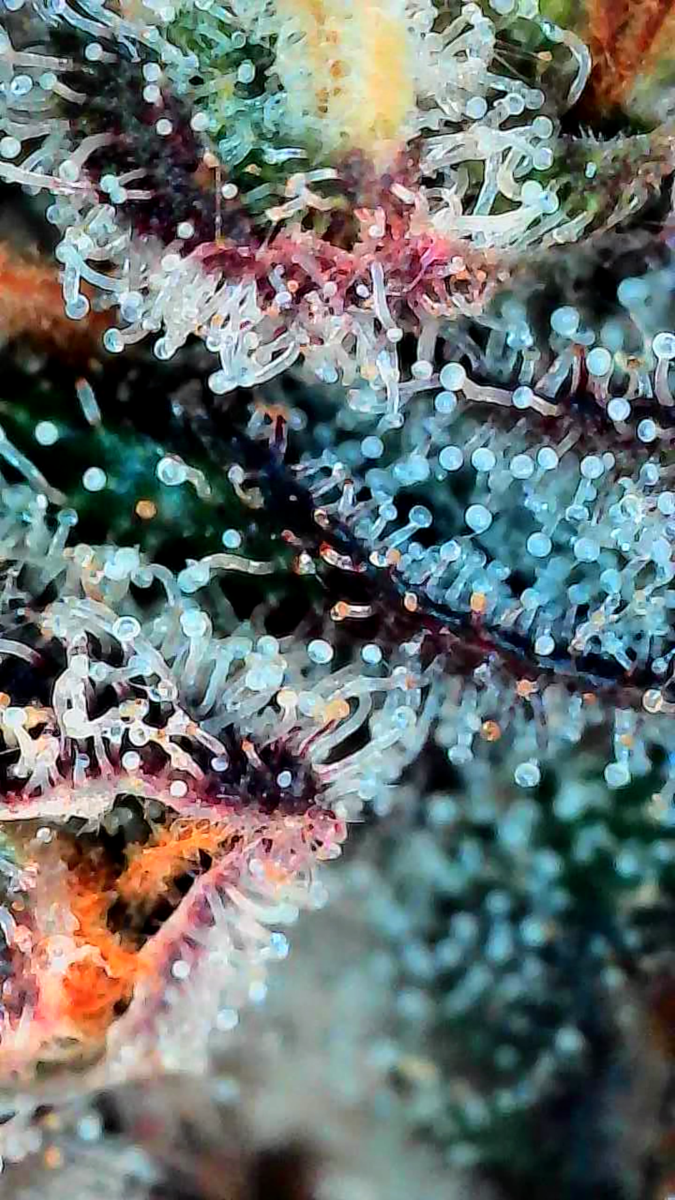
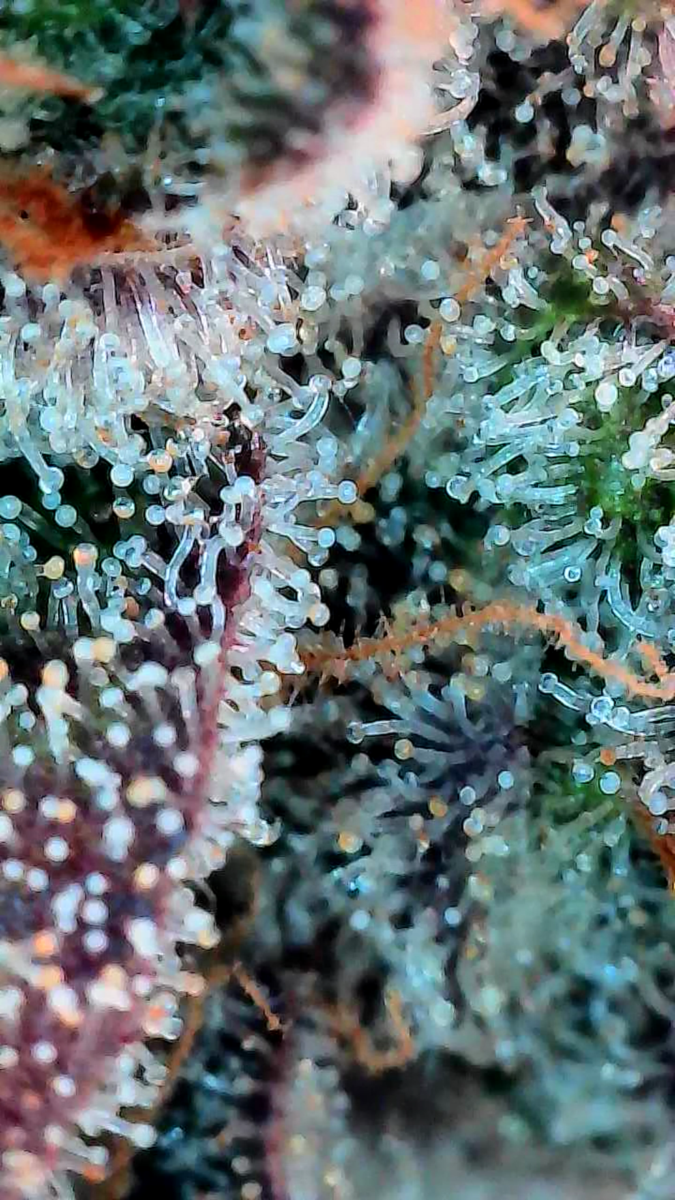
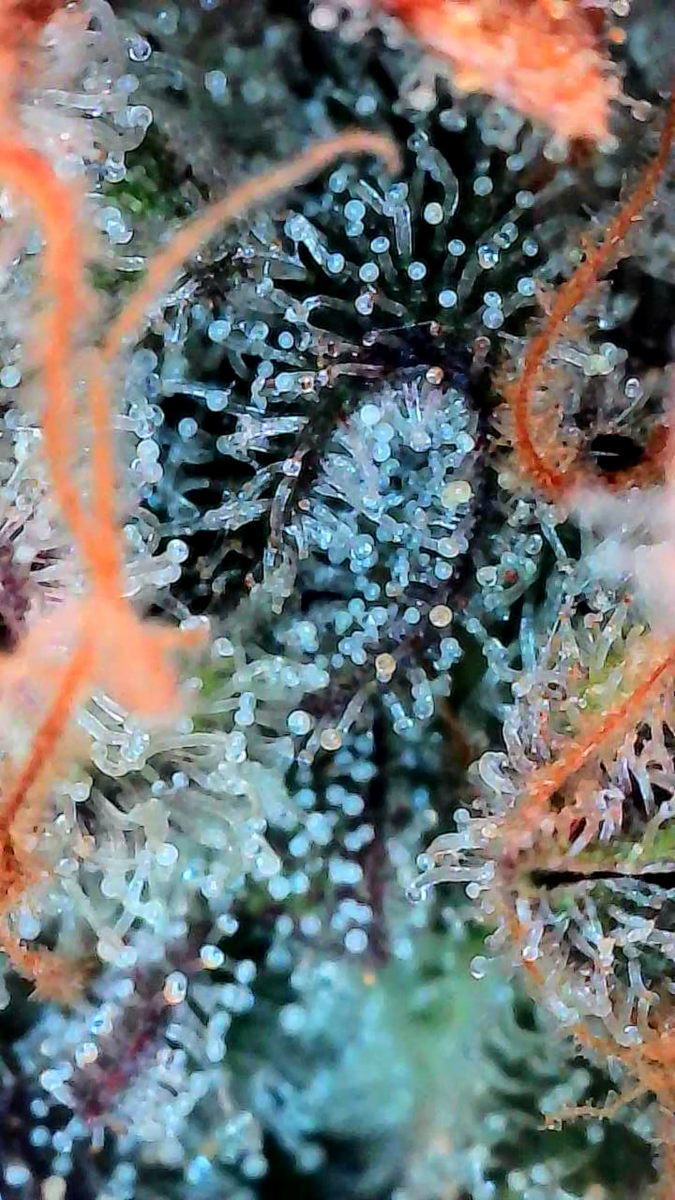
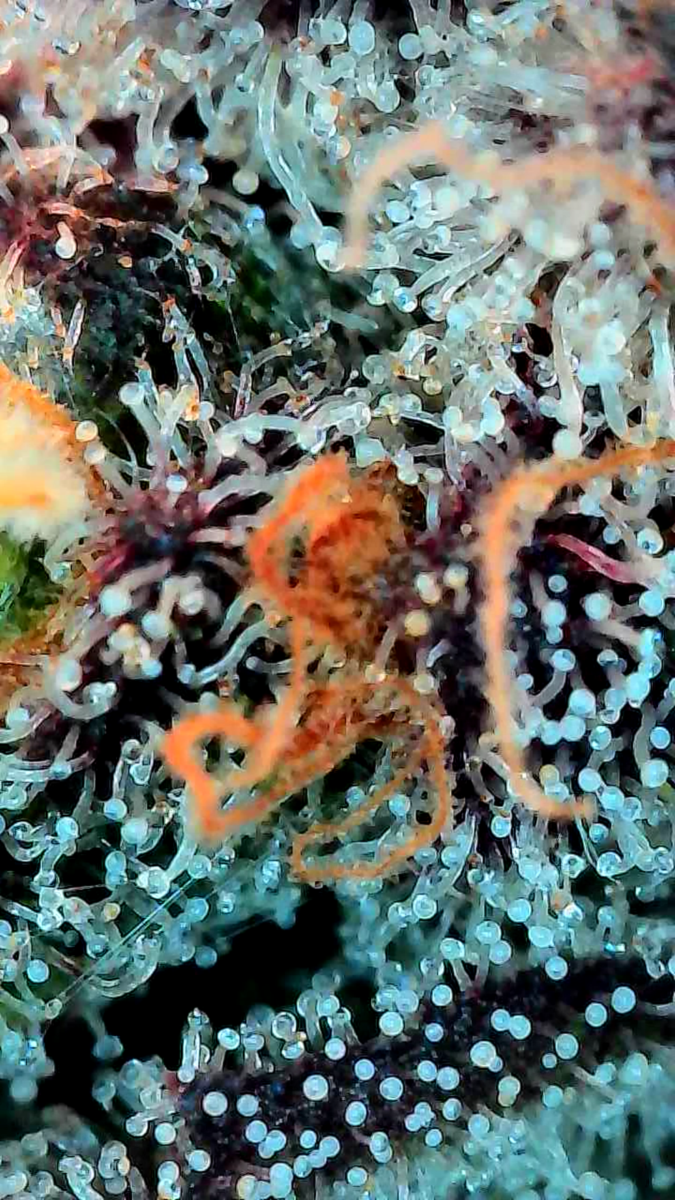
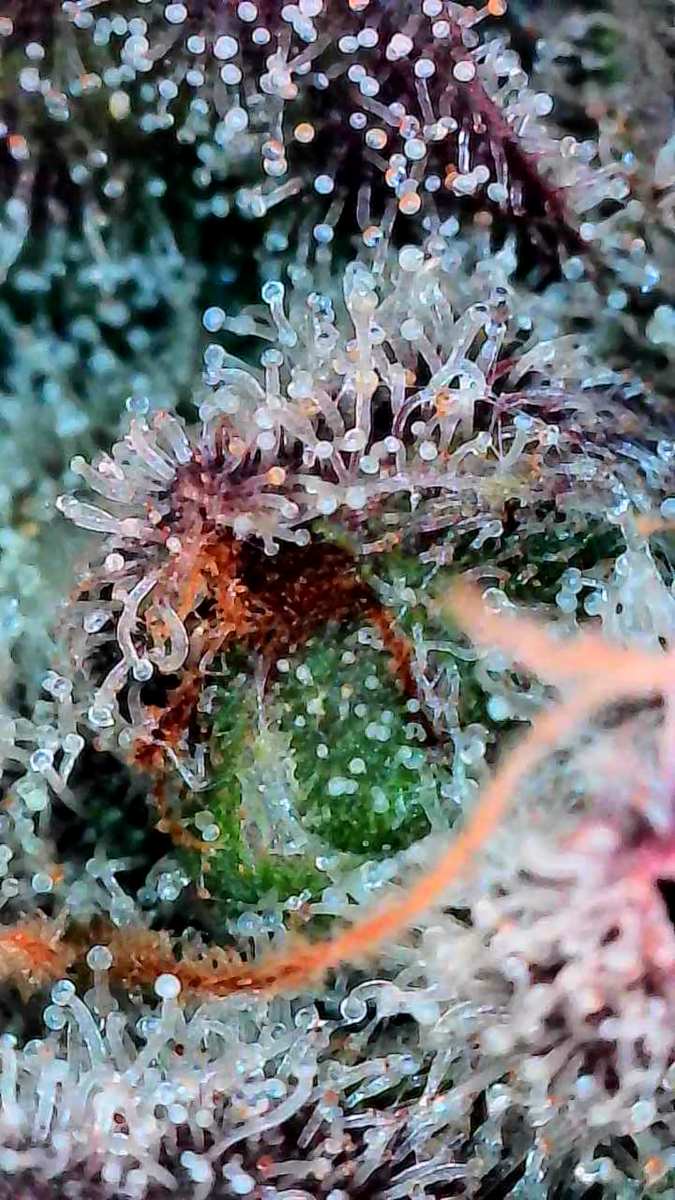
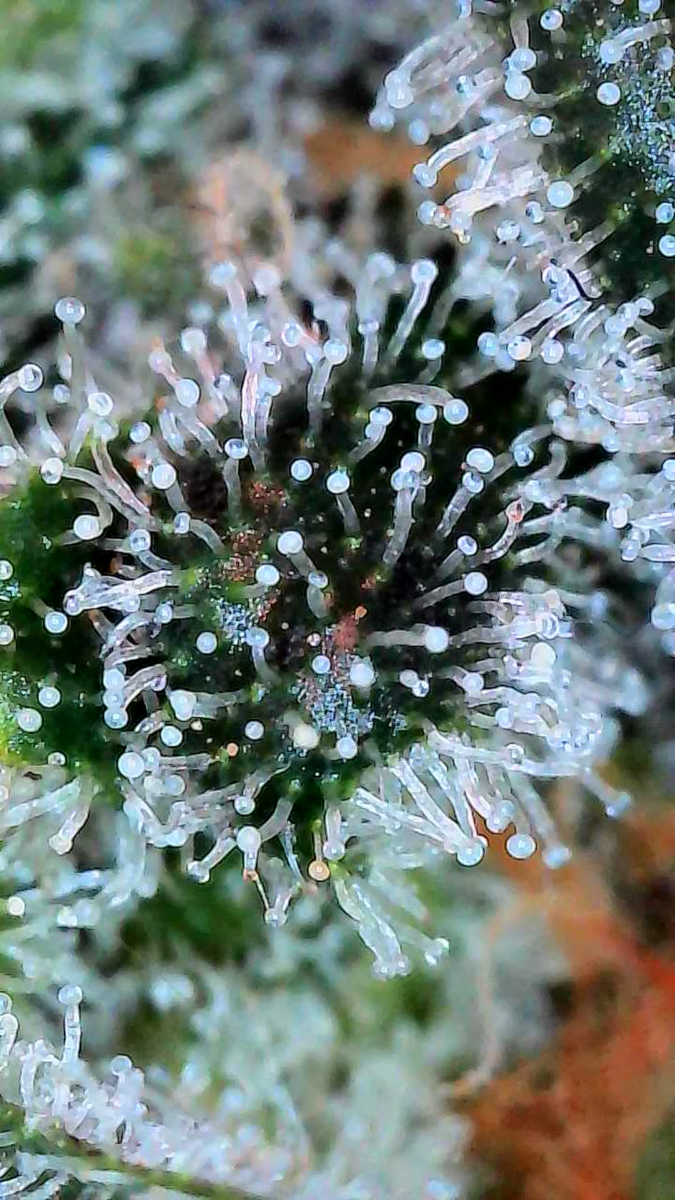
Trichome Analysis
Format (% clear / % cloudy / % amber)
GDP1:
Top: 8 / 88 / 4
Middle: 12 / 83 / 5
Bottom: 20 / 75 / 5
Overall: ~13 / 82 / 5
GDP2:
Top: 6 / 91 / 3
Middle: 12 / 85 / 3
Bottom: 22 / 73 / 5
Overall: ~13 / 83 / 4
Feeding was discontinued. Both plants received only plain, pH-adjusted water every other day (input 115-140 ppm, pH ~6.2), supporting natural fade heading into harvest.
Aroma remained fully expressed and stable - dark berry/grape up front with deeper earthy/skunky undertones and faint floral notes. Coloration peaked this week, with pronounced purples and late-autumn fade across remaining foliage and buds.
Next entry will cover harvest execution and final dry yield.
FLO
13
Week
Week 13: Flowering Granddaddy Purple
Photos (17)
Grow details
Plant height
51.5 in
Air humidity
43 %
Smell intensity
High
Day air temperature
74 °F
Night air temperature
69 °F
Lamp to plant distance
8 in
Pot size
3 gal
Solution pH
6
Nutrient strength (mS/cm)
0.8 mS/cm
Daily water per plant
4 L
Light schedule
12 h
Grower notes
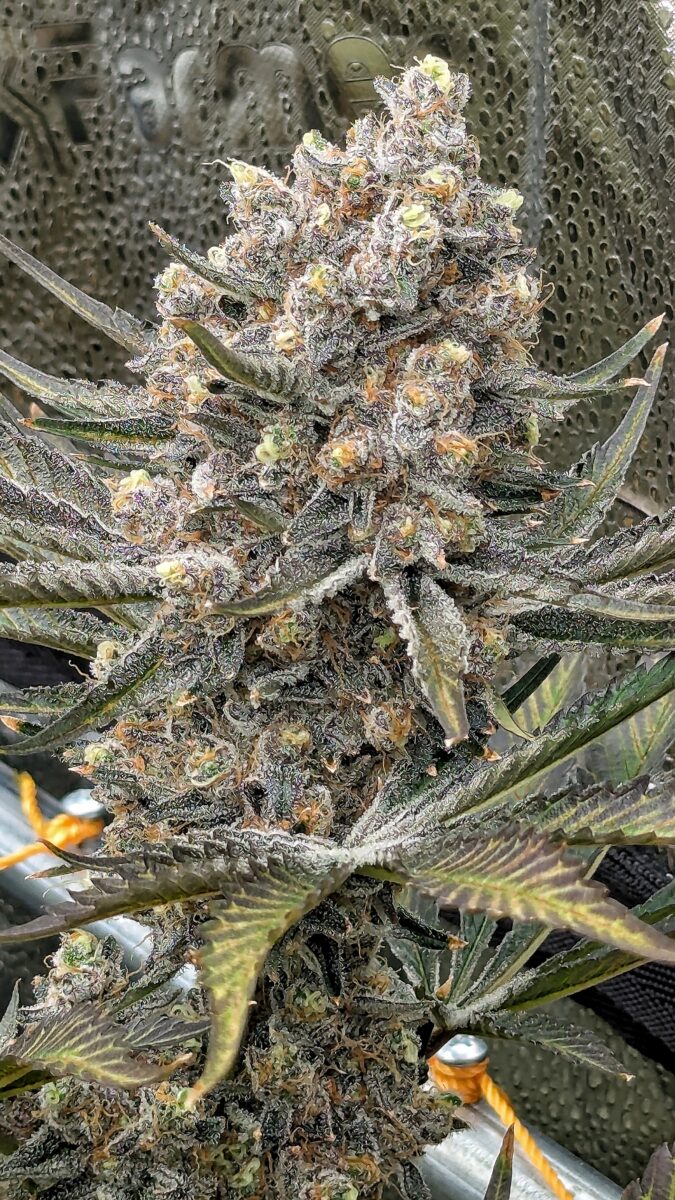
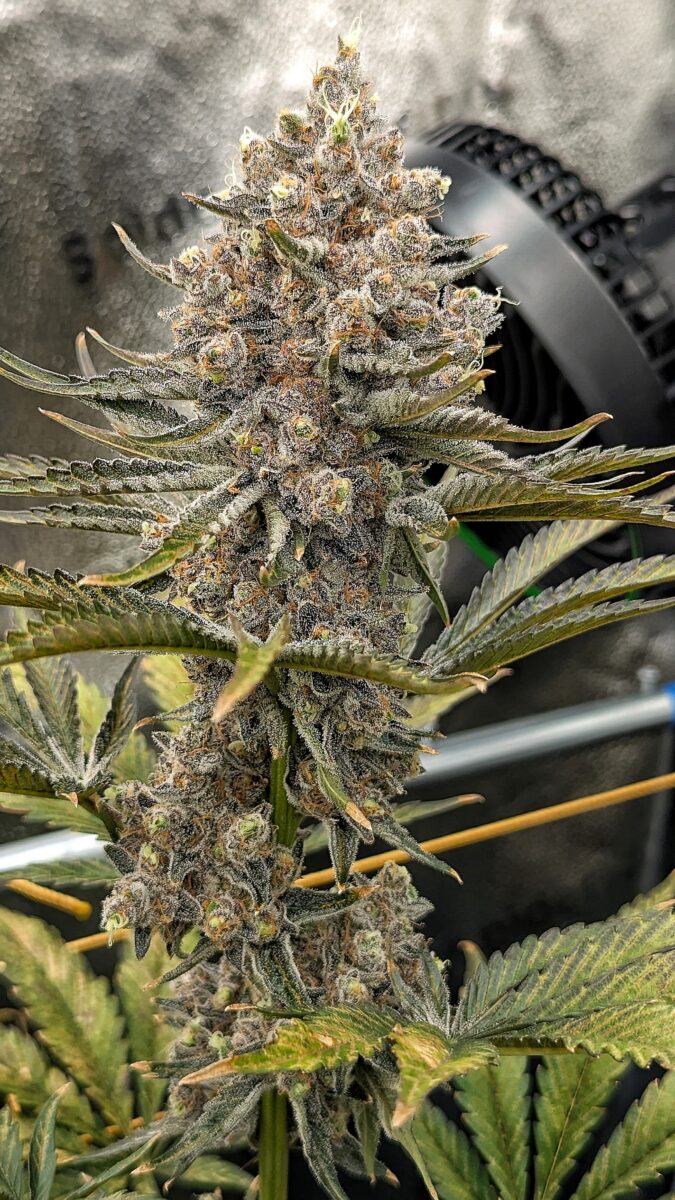
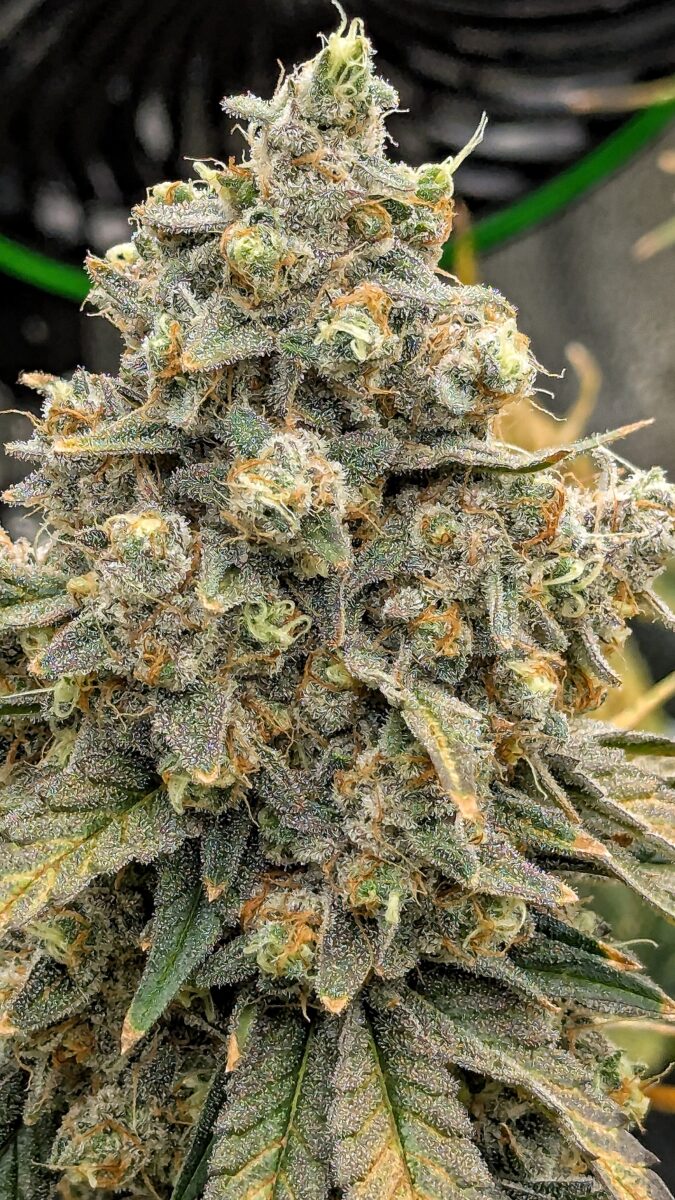
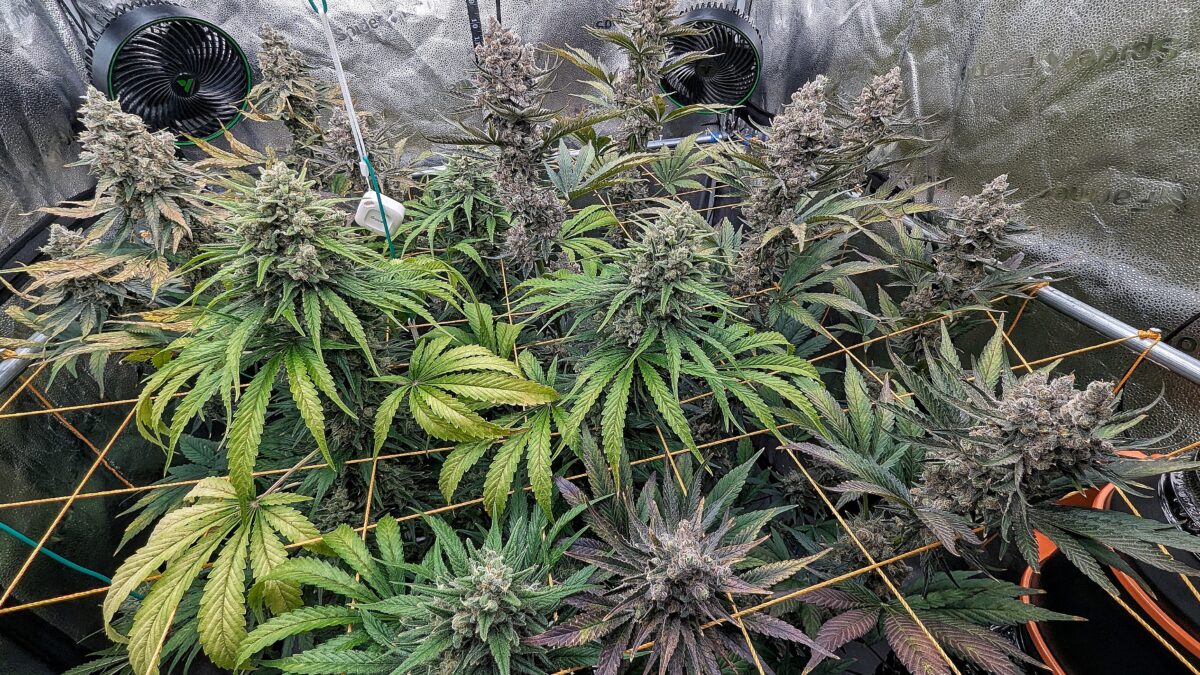
Granddaddy Purple – Week #9 of Flower (Ripening)
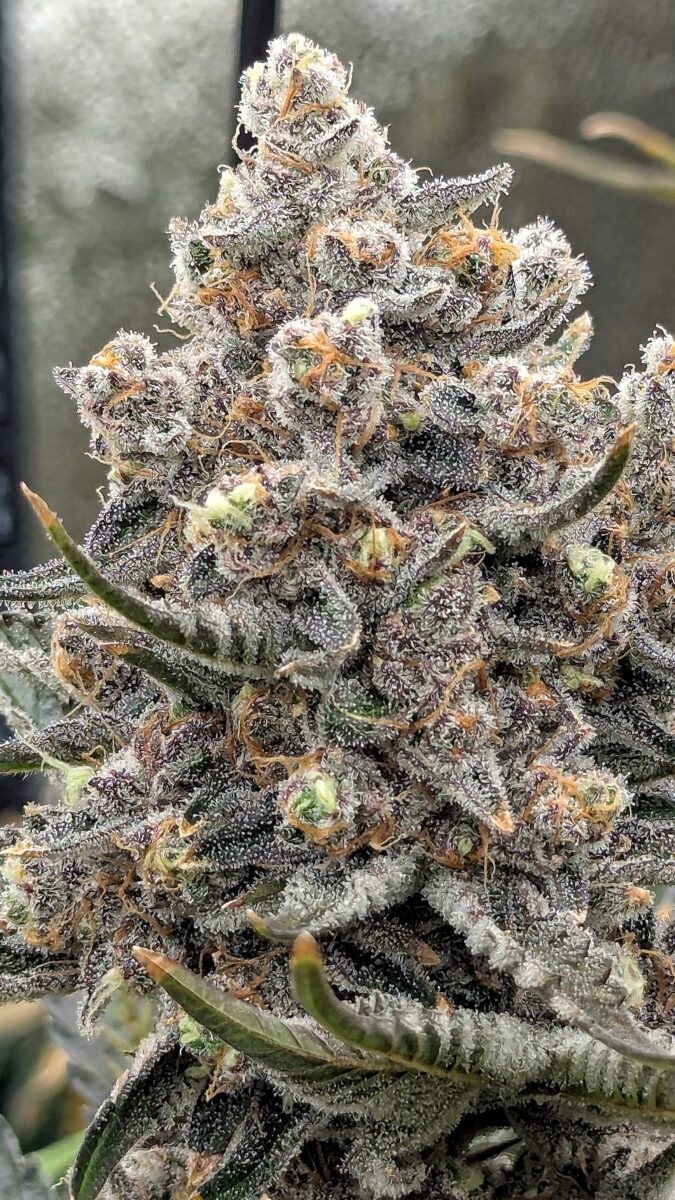
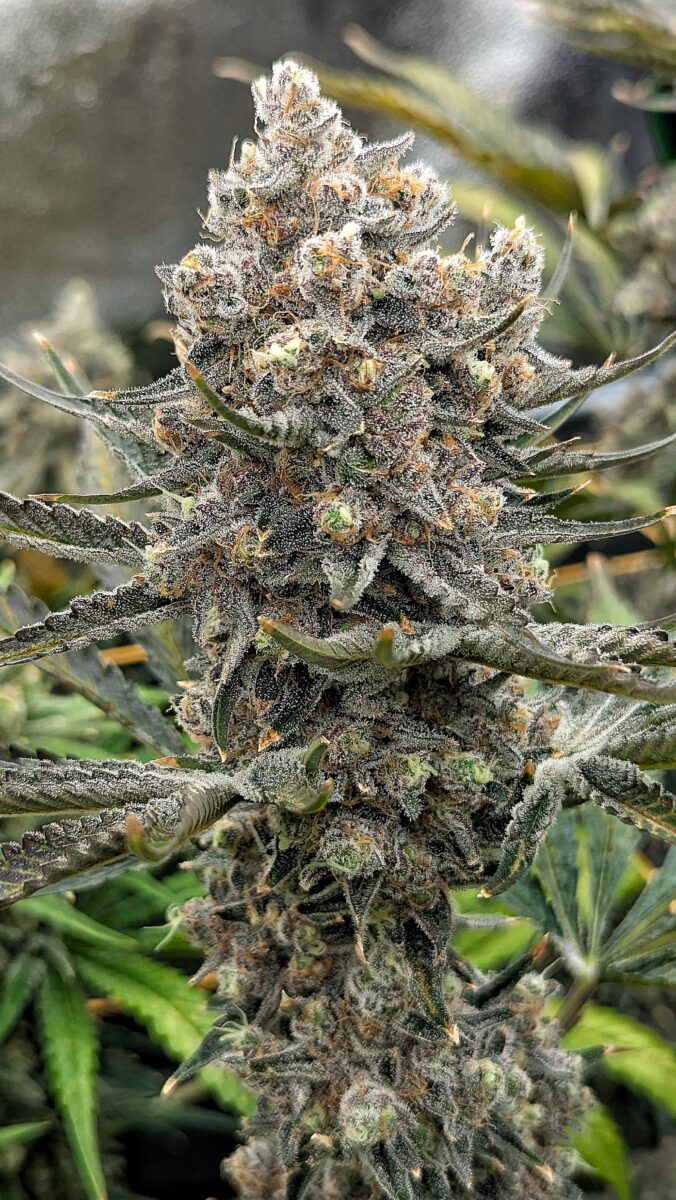
Week nine marked a clear transition from late flower into active ripening for Granddaddy Purple, with visual, aromatic, and trichome indicators all confirming steady progression toward harvest. Calyxes remained swollen and resin production dense, while senescence accelerated across older fan leaves-particularly in the upper canopy - consistent with nutrient reallocation and the plant’s natural finishing process.
Light management was a key focus this week. Early in the week, canopy PPFD was measuring higher than desired for this stage, reaching approximately 945–990. In response, intensity was gradually reduced first to the 825–850 range, and then further dialed back mid-week to approximately 725 PPFD. These adjustments were made to reduce late-cycle stress, preserve resin quality, and better align light levels with ripening physiology.
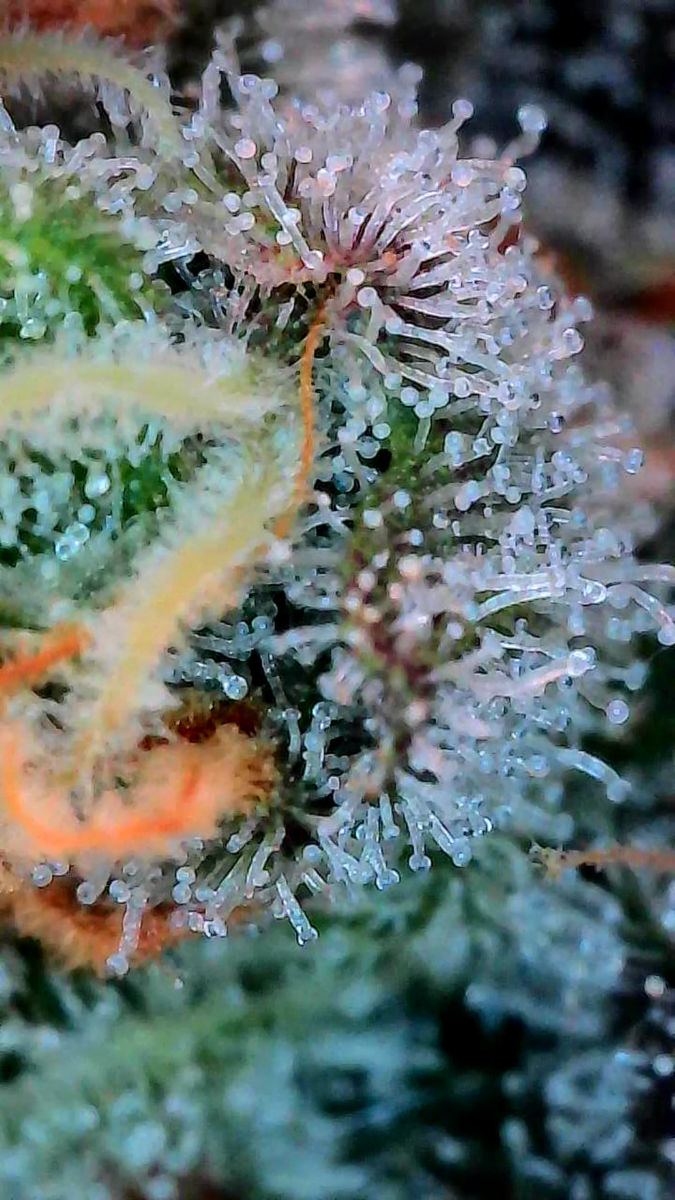
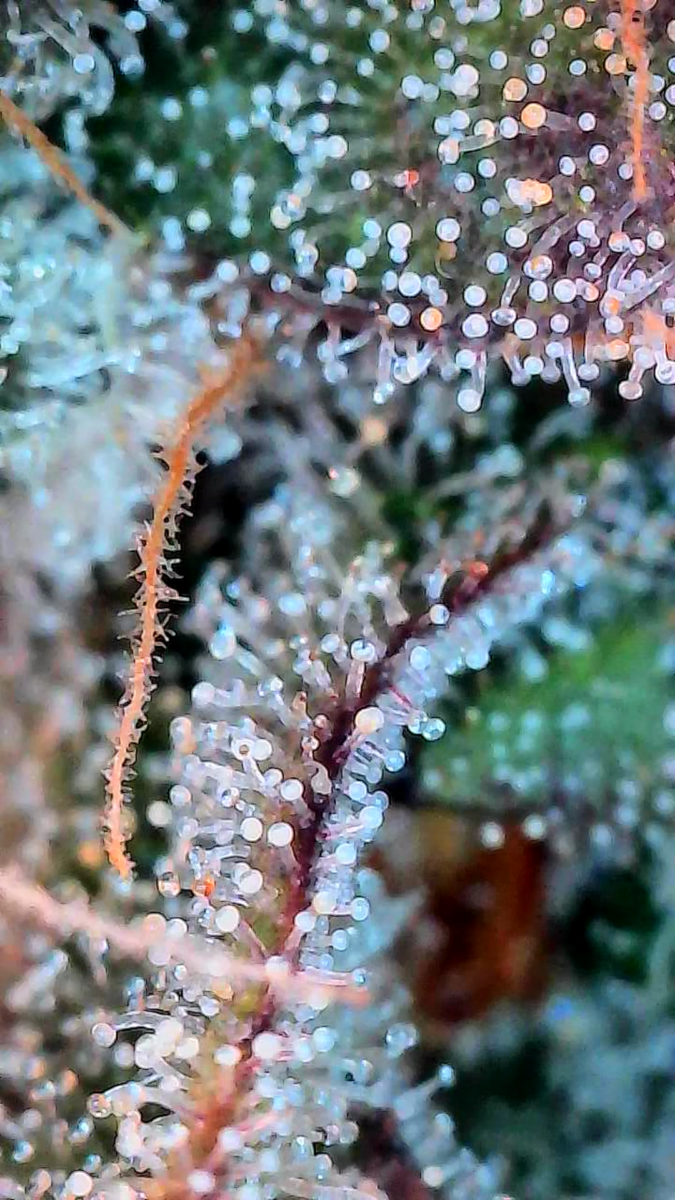
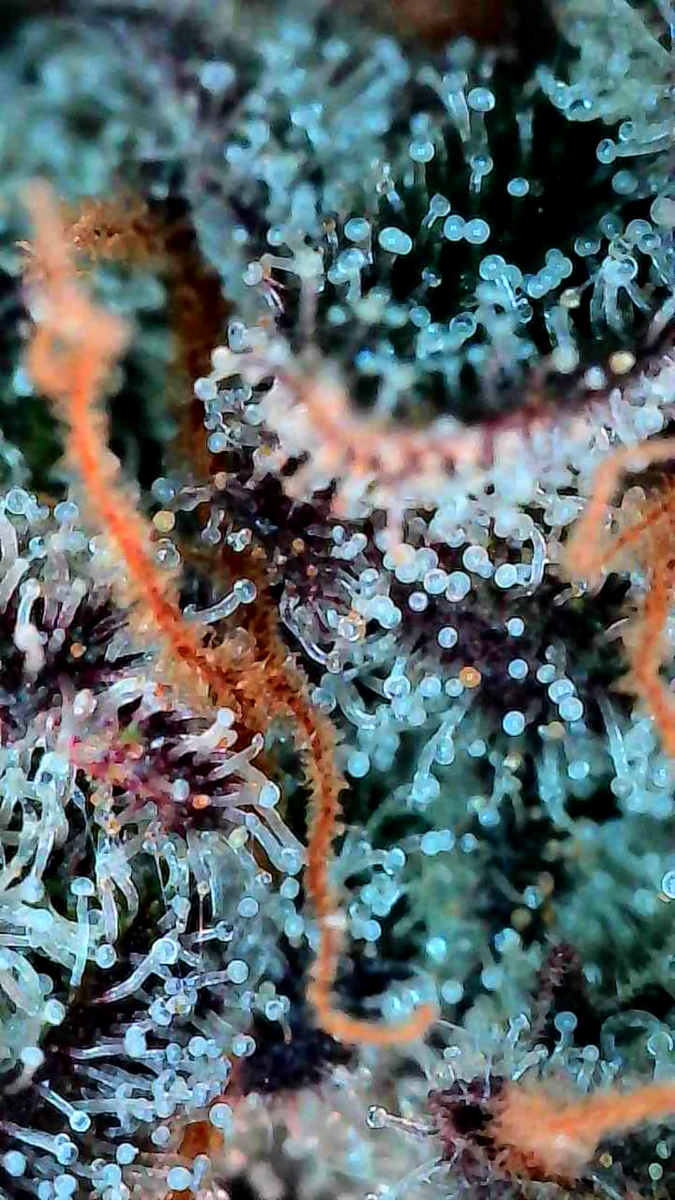
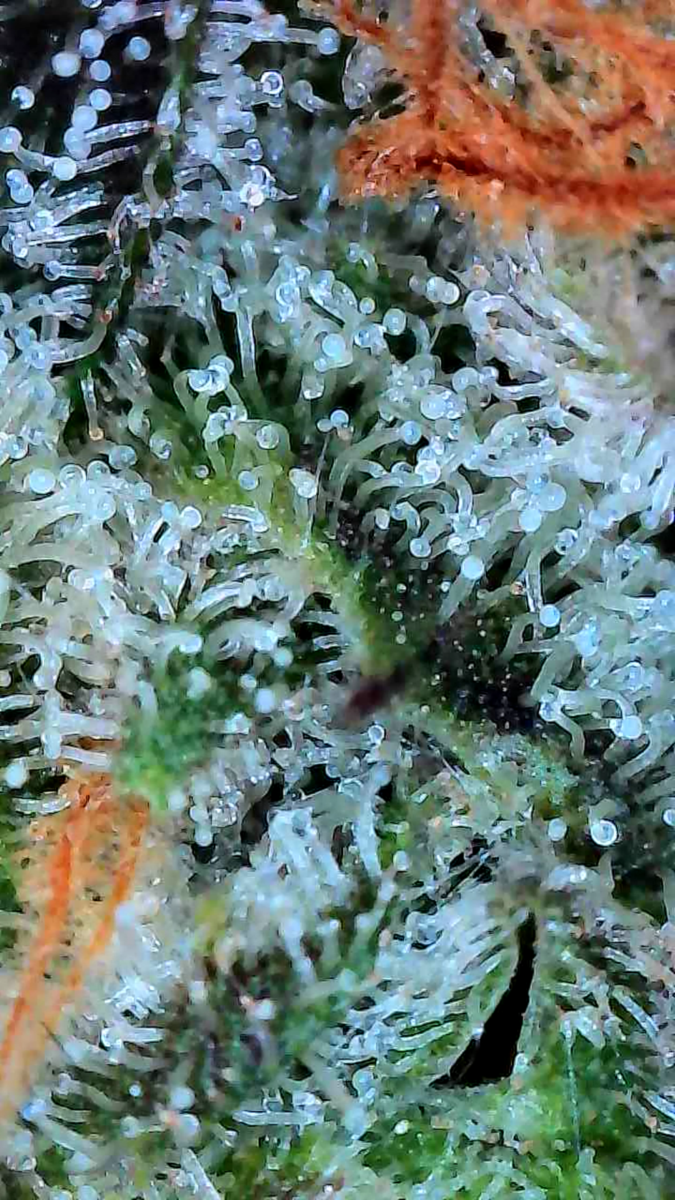
Mid-week trichome analysis confirmed that Granddaddy Purple had entered the harvest window, with distributions showing a dominant cloudy profile and a modest but increasing amber presence:
Trichome Analysis
Format ( % Clear / % Cloudy / % Amber )
GDP1: Top 6/84/10 · Bottom 21/81/7 · Overall 9/83/9
GDP2: Top 7/85/8 · Mid 9/82/9 · Bottom 18/74/8 · Overall 11/80/8
In conjunction with these findings and visible signs of ripening, the nutrient regimen was shifted fully into ripening. Two ripening feeds were applied this week-the first at medium strength (~440 ppm) and the second slightly reduced (~400 ppm). With senescence progressing and trichomes nearing the desired range, the plan is now to transition to plain, pH-adjusted water in preparation for harvest within the coming week.
UVA exposure was fully phased out during week nine, stepping down from approximately 45 minutes at the start of the week to 30 minutes, and ultimately to zero as all plants in the tent entered ripening. Environmental conditions remained stable, with temperatures ranging from approximately 63–76°F and average relative humidity holding near 43%, providing a dry, controlled finish well-suited to late flower.
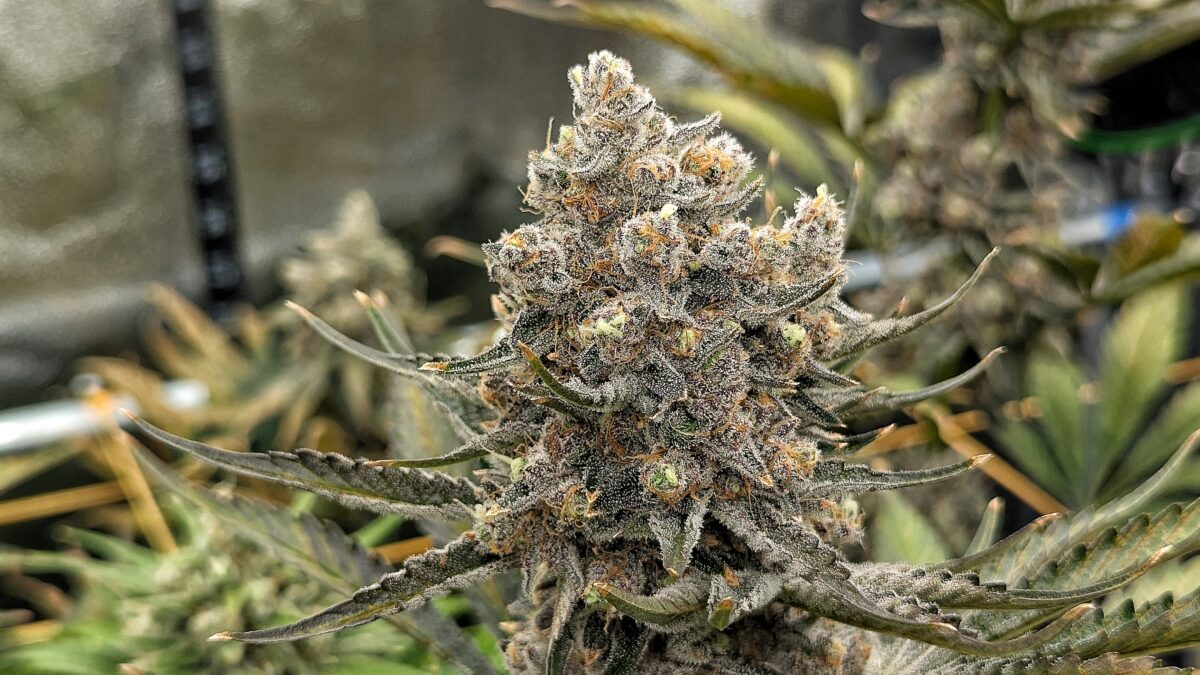
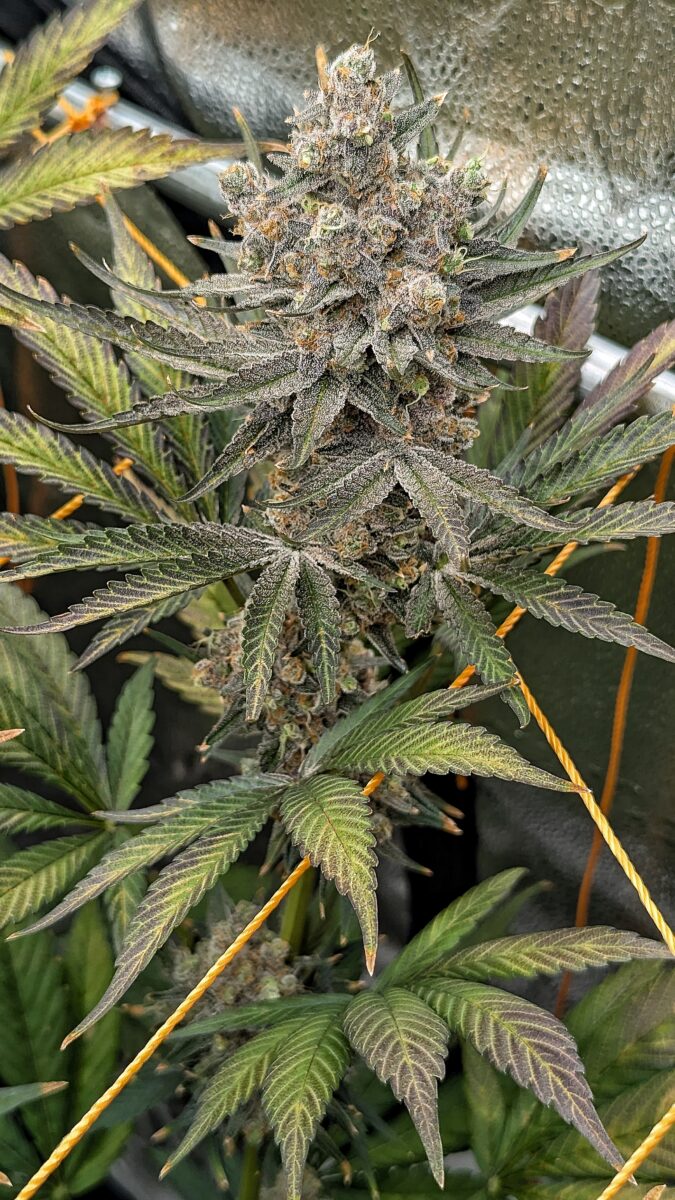
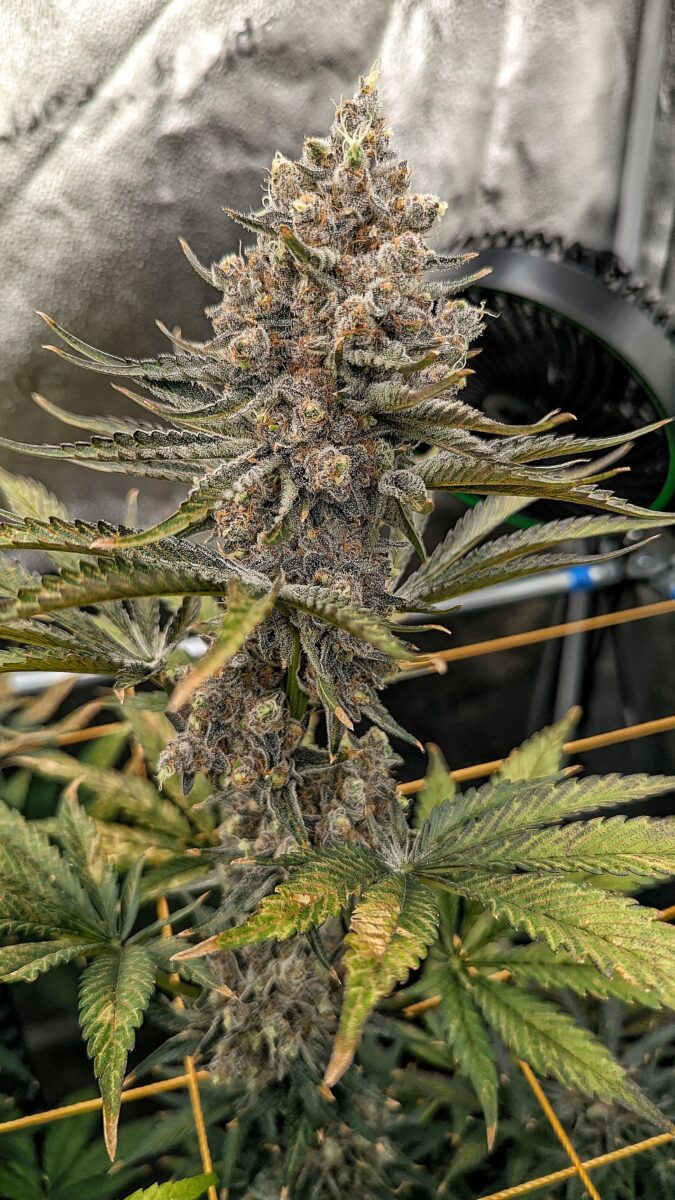
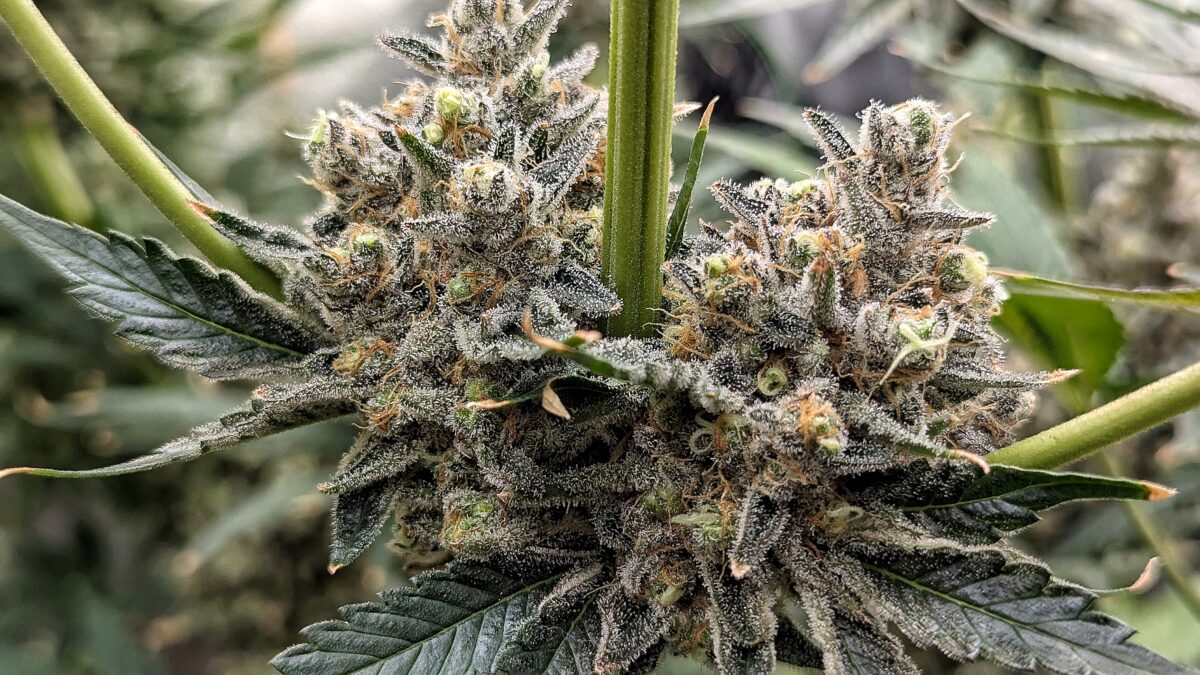
Visually, Granddaddy Purple has become increasingly striking. Deep red, blue, purple, yellow, and orange hues have spread across foliage and sugar leaves, giving the plant a pronounced autumnal appearance. Aromatically, the profile has sharpened noticeably, with layered notes of dark berry, coffee, skunk, and floral tones becoming more pronounced as ripening advances.
Overall, Granddaddy Purple is now firmly in its final phase. Current strategy is centered on maintaining environmental stability, completing the transition to plain water, and allowing trichomes to finish maturing naturally ahead of an anticipated harvest in the coming week.
FLO
12
Week
Week 12: Flowering Granddaddy Purple
Photos (8)
Grow details
Plant height
51.5 in
Air humidity
43 %
Smell intensity
High
Day air temperature
75 °F
Night air temperature
65 °F
Lamp to plant distance
8 in
Pot size
3 gal
Solution pH
6
Nutrient strength (mS/cm)
1.28 mS/cm
Daily water per plant
4 L
Light schedule
12 h
Grower notes
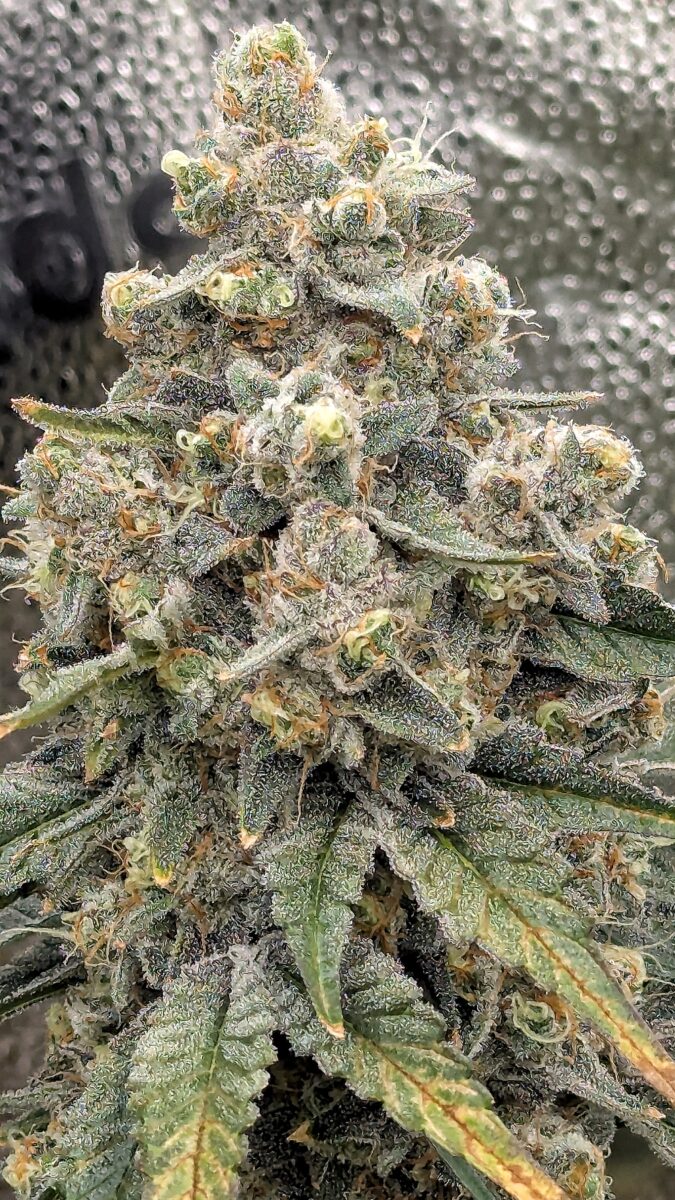
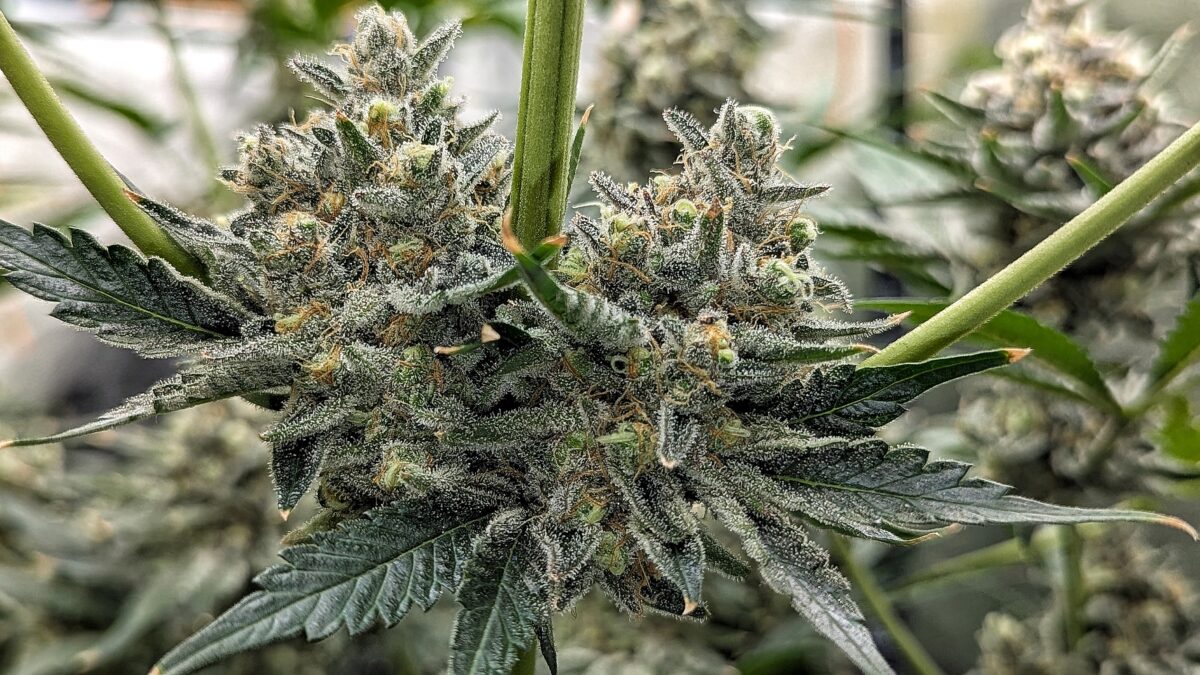
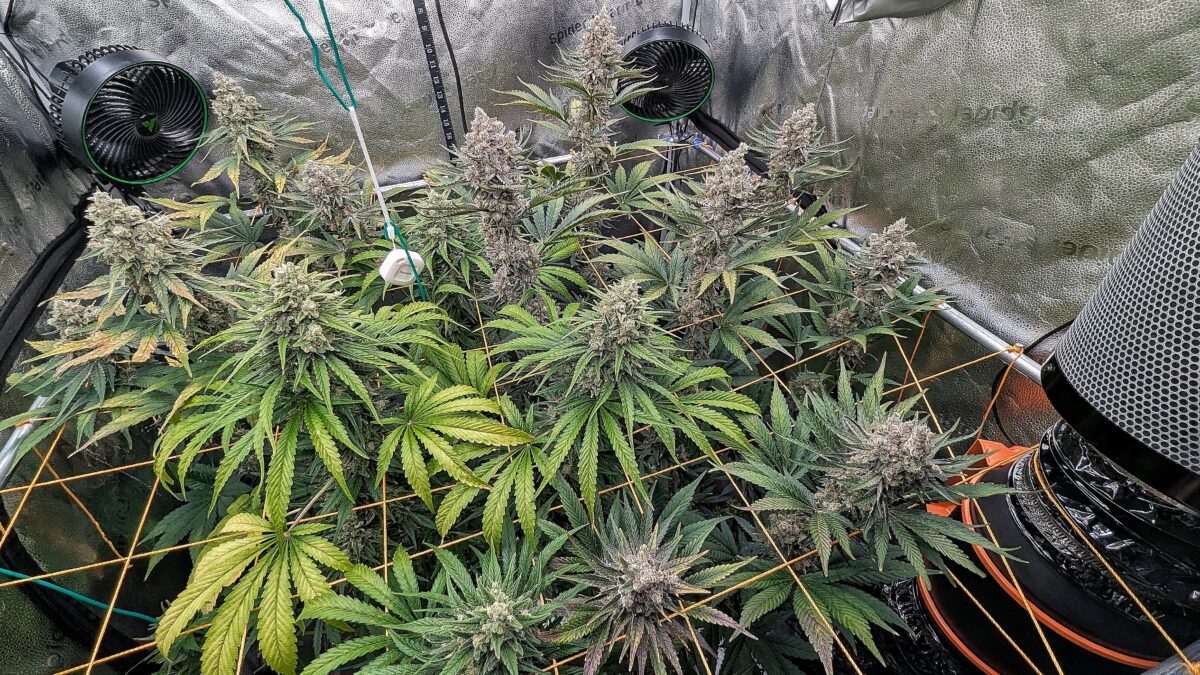
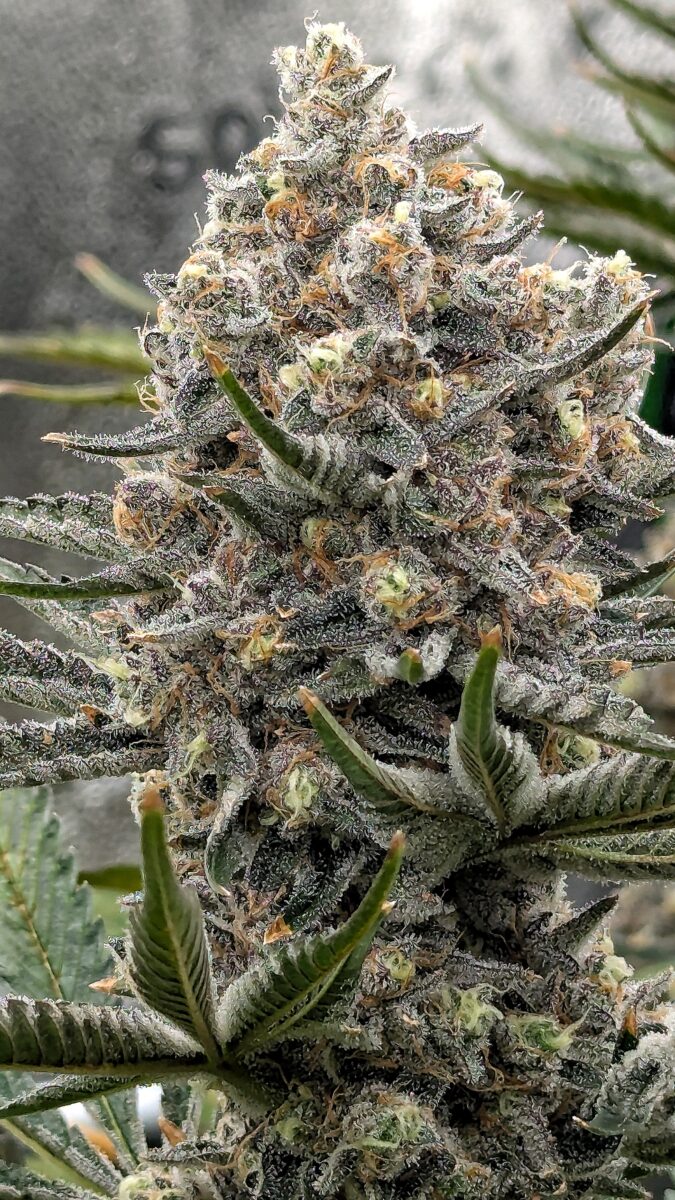
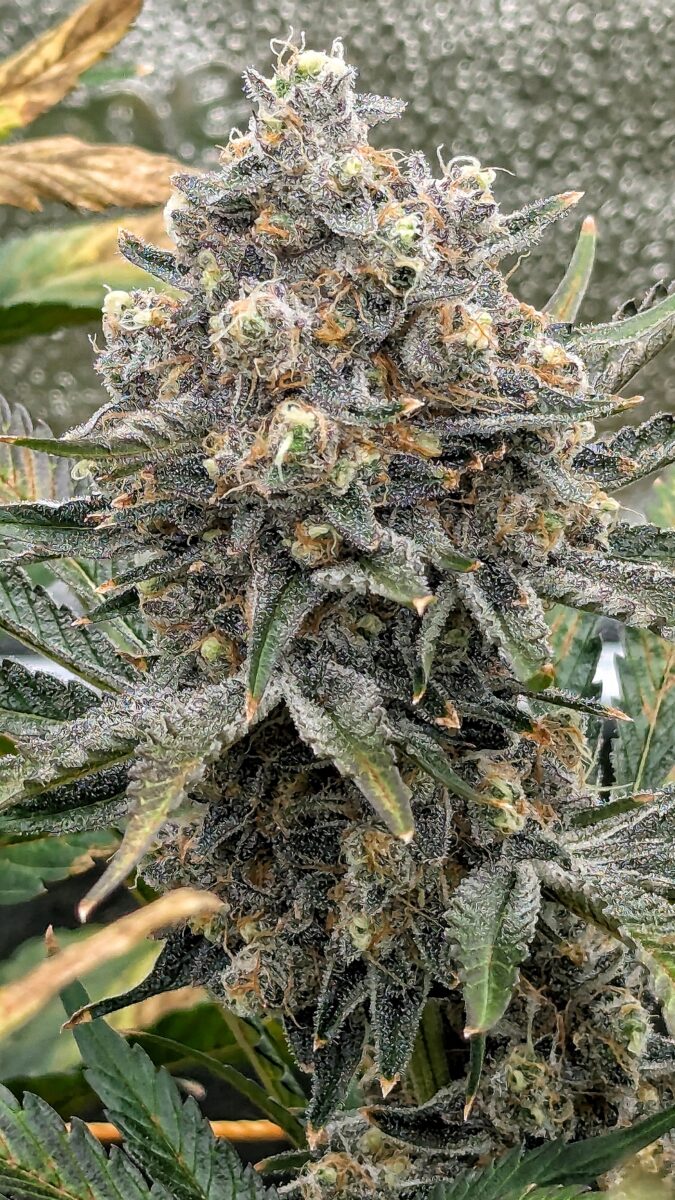
Granddaddy Purple – Week #8 of Flower (Late Flower)
Week eight of flower saw Granddaddy Purple firmly establish itself in the early stages of late flower, with continued calyx expansion, increasing resin density, and a clear progression of natural senescence across older fan leaves. Structural support remained effective throughout the canopy, requiring no additional reinforcement as flower mass continued to build.
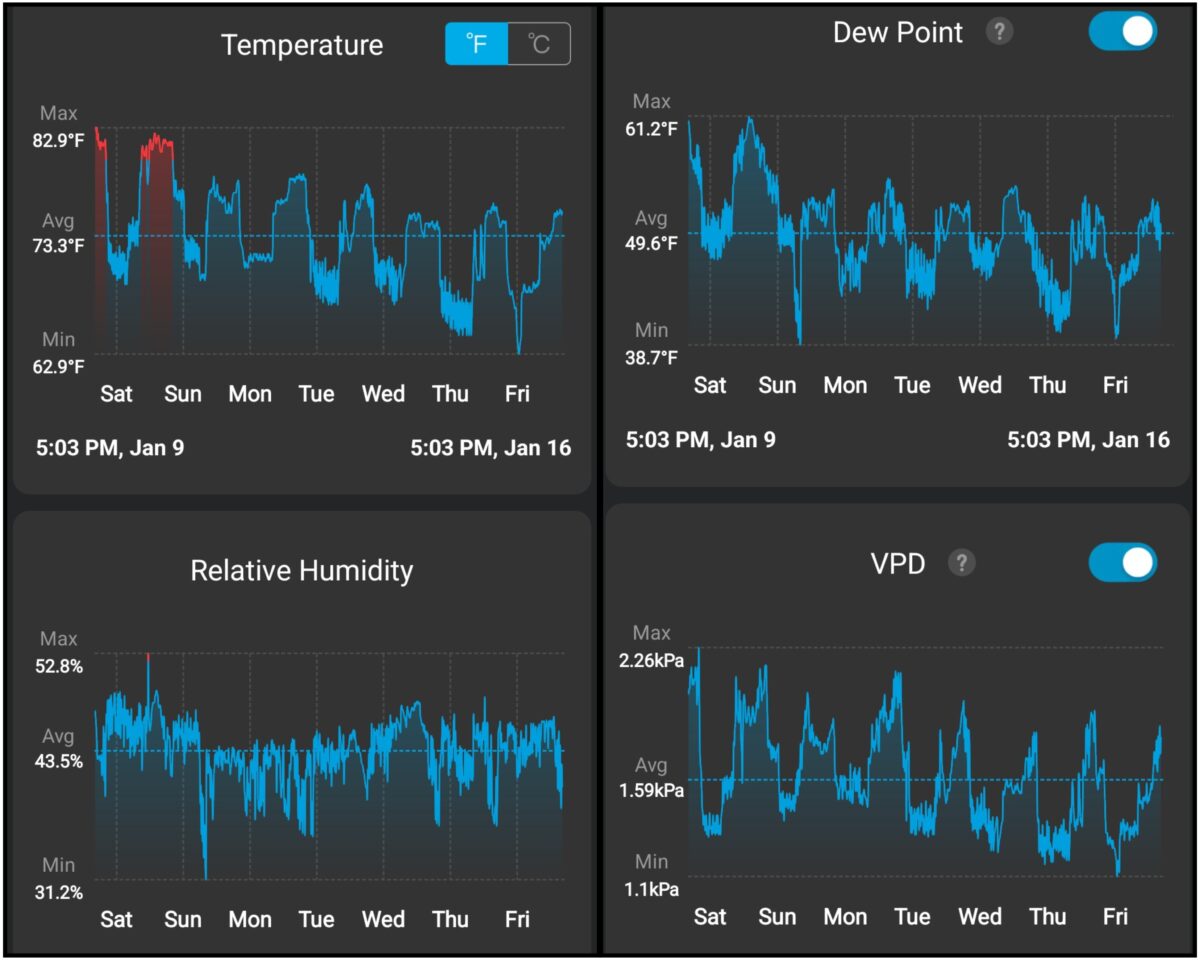
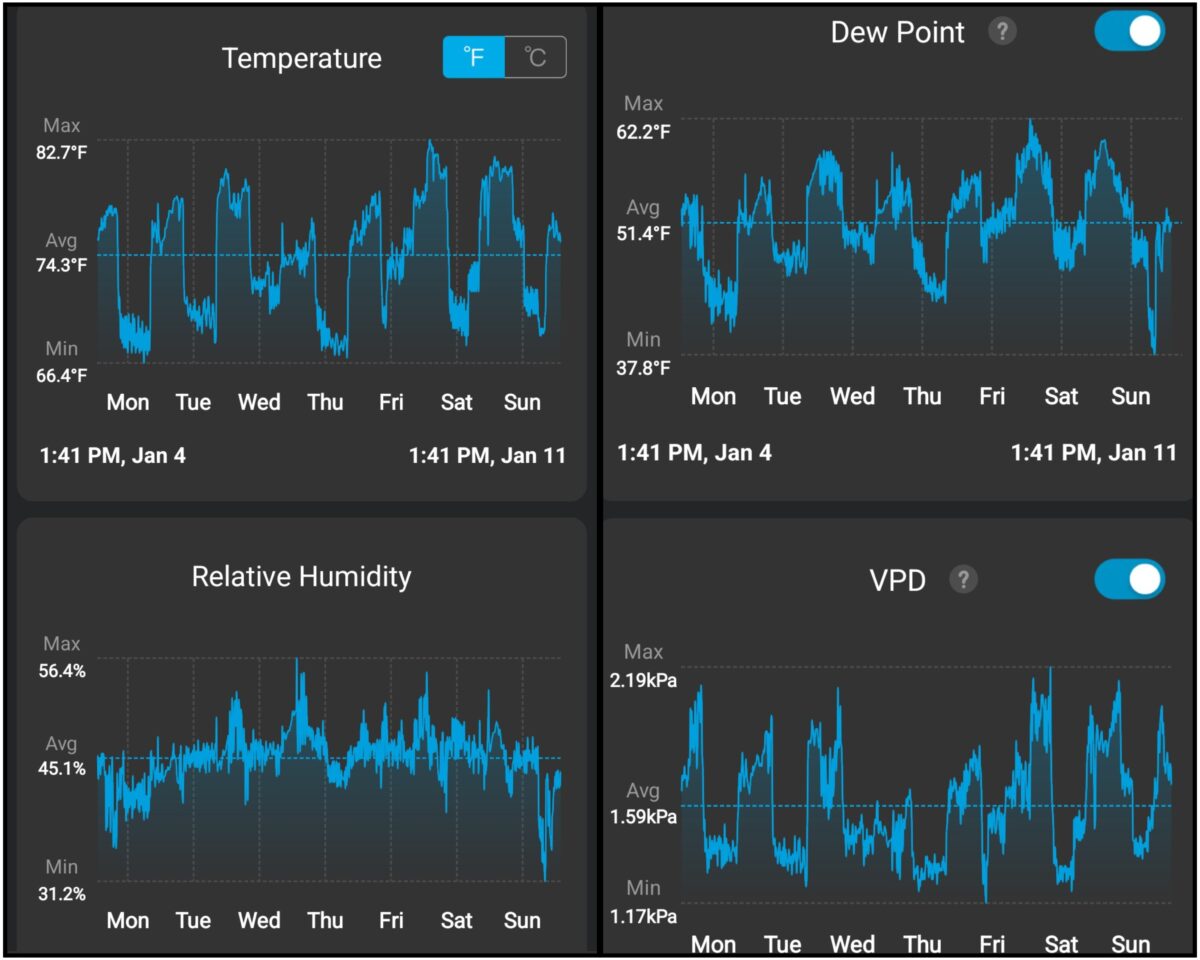
Environmental management was a primary focus this week. With multiple strains at different stages sharing the same tent, conditions were actively balanced to support ripening plants while allowing Granddaddy Purple to continue maturing without unnecessary stress. Daytime canopy temperatures generally held in the low-to-mid 70s°F, with relative humidity maintained in the low-to-mid 40% range. These conditions were selected to preserve resin integrity, maintain transpiration, and minimize any risk of excess moisture during late flower.
Light intensity remained stable, with canopy PPFD averaging between approximately 925 and 950, resulting in a DLI of roughly 40–42. This level continues to support flower development while avoiding excess intensity late in the cycle. UVA exposure was deliberately reduced over the course of the week, stepping down from approximately 120 minutes at the beginning of the week to about 45 minutes by week’s end. This reduction was made to accommodate a companion plant in active ripening and to prevent unnecessary stress during this stage of development.
Nutrient strategy continued its transition into late flower. Early in the week, feeding consisted of a blended 50/50 mix of mid- and late-flower nutrients at medium strength, delivering approximately 805 ppm. By the end of the week, Granddaddy Purple was fully transitioned to late-flower nutrients at medium strength, with feed strength reduced to approximately 640 ppm. This adjustment reflects the plant’s shifting nutritional demand as senescence advances, while still providing sufficient support for continued flower maturation. The plan is to maintain light late-flower feeding through at least the coming week.
Watering remained consistent, with irrigation volumes adjusted as needed to periodically achieve moderate runoff while avoiding excess moisture retention in the medium. Uptake has remained steady, and no signs of nutrient stress, lockout, or imbalance were observed.
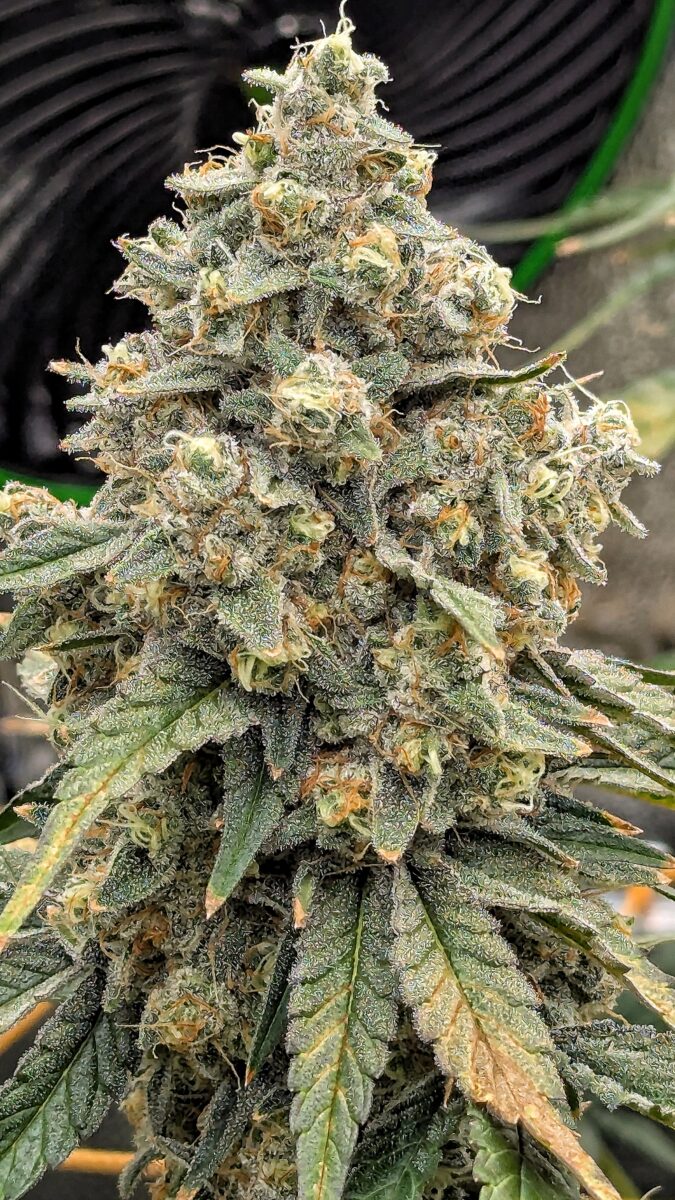
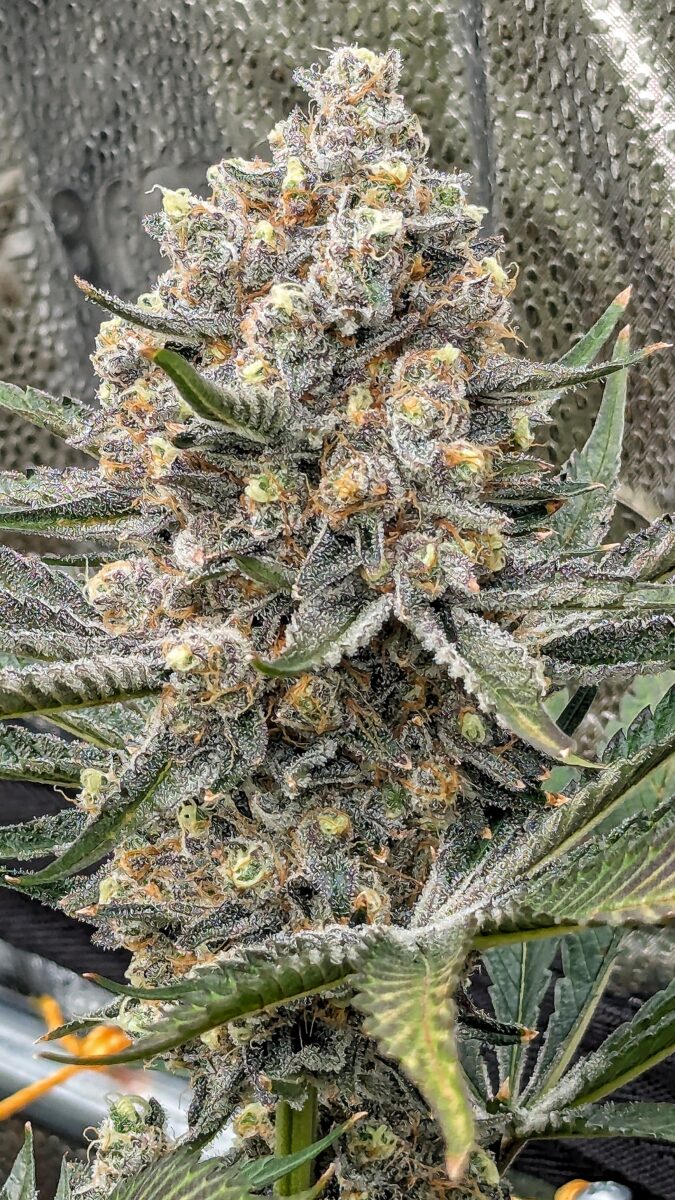
While a formal trichome assessment was not performed this week, visual indicators suggest continued progression toward ripening. Buds remain dense and well-formed, with heavy trichome coverage across calyxes and sugar leaves. Senescence is increasingly evident on older fan leaves, particularly in the mid and upper canopy, consistent with normal nutrient reallocation at this stage. This fade is expected and welcomed as part of the plant’s natural finish.
Aromatically, Granddaddy Purple continues to intensify. Sweet fruit and dark berry notes dominate, with a rich, heavy character that has become more pronounced as the plant advances through late flower. Overall, the plant is transitioning smoothly toward ripening, with current strategies centered on stability, stress avoidance, and preserving resin and terpene quality heading into the final phase of flower.
FLO
11
Week
Week 11: Flowering Granddaddy Purple
Photos (9)
Grow details
Plant height
51.5 in
Air humidity
45 %
Smell intensity
High
Day air temperature
78 °F
Night air temperature
70 °F
Lamp to plant distance
8 in
Pot size
3 gal
Solution pH
6
Nutrient strength (mS/cm)
1.6 mS/cm
Daily water per plant
4 L
Light schedule
12 h
Grower notes
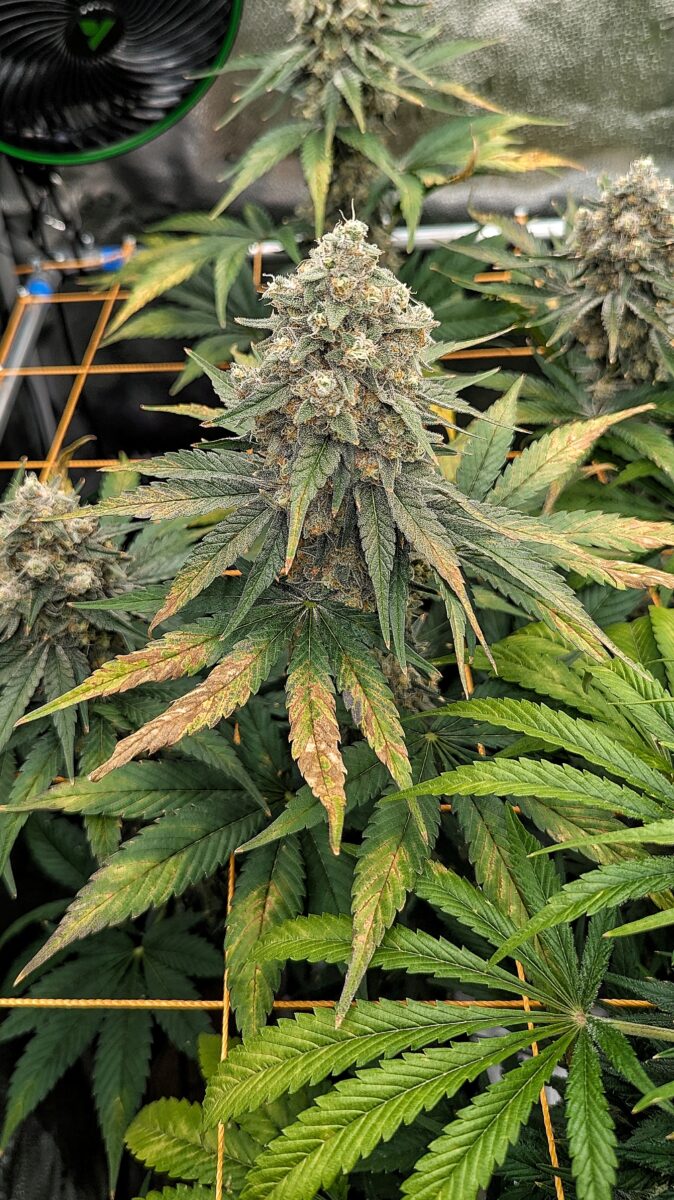
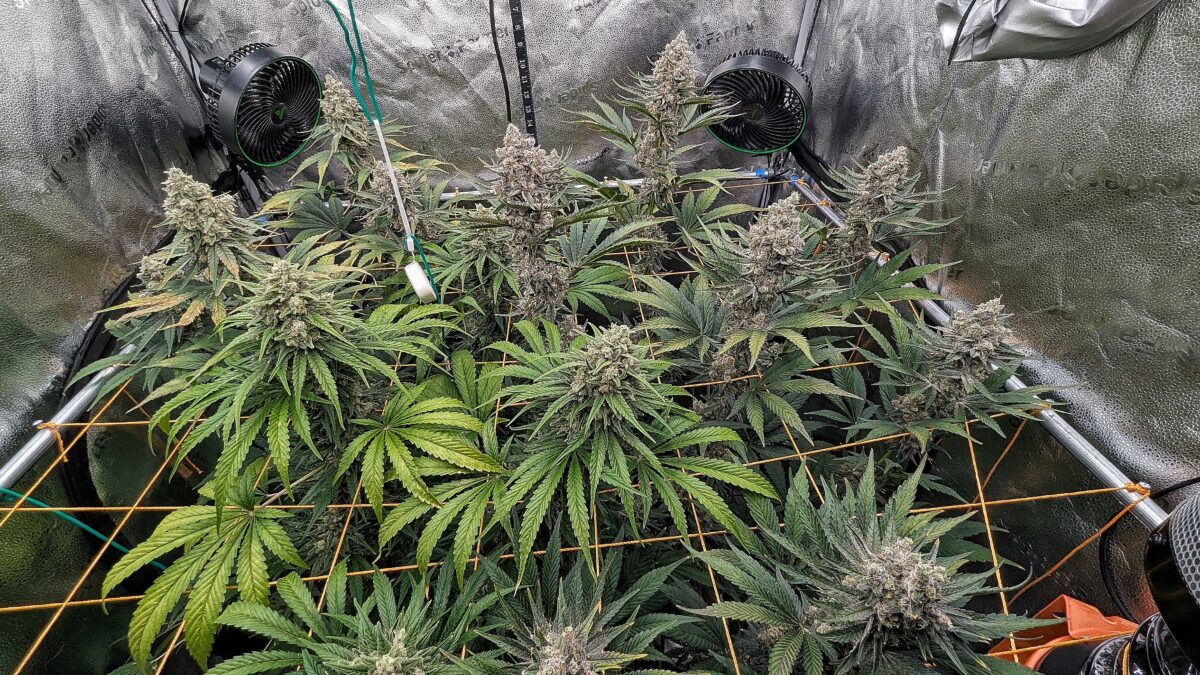
Granddaddy Purple – Week #7 of Flower (Mid to Late Flower Transition)
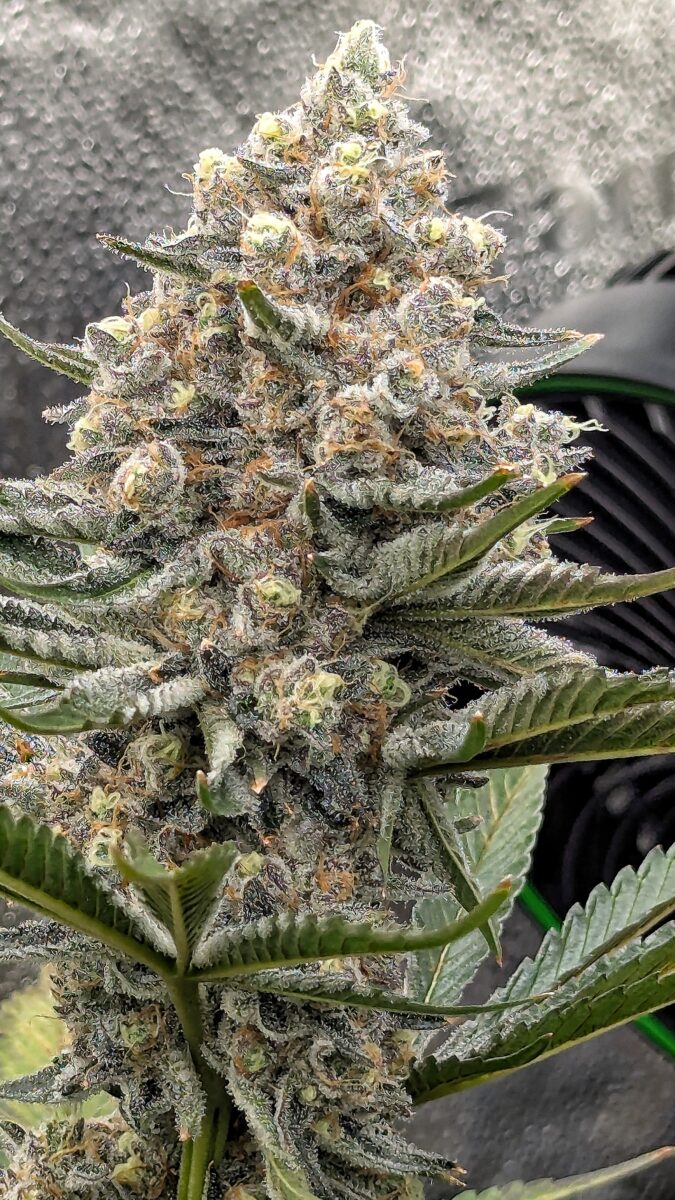
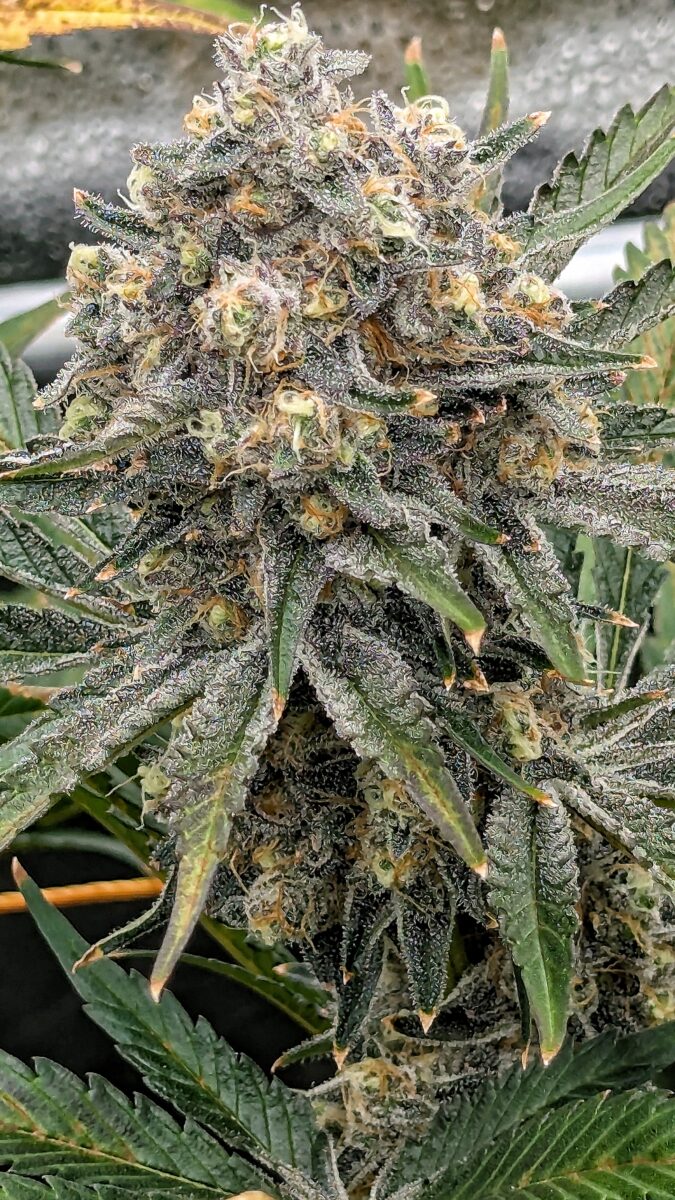
Week seven of flower marked a clear shift in Granddaddy Purple toward late-stage development, with continued bud swelling and increasing resin production across the canopy. Structural support added in earlier weeks continued to hold large spires steady as flower weight increased, requiring only minor adjustments to maintain stability.
Calyxes thickened noticeably throughout the week, particularly along the upper colas, while pistils began to show early signs of maturity with some darkening and recession. Feeding began the week with mid-flower nutrients at approximately 880 ppm and gradually transitioned toward a blended mid- and late-flower regimen, finishing the week near 800 ppm. Nutrient uptake remained consistent, and the plants showed no signs of stress, deficiency, or excess.
Light intensity was eased back slightly to better match this stage of flower. Canopy PPFD was reduced from roughly 1050 at the start of the week to about 950 by the end, bringing DLI down from approximately 45 to around 40. These adjustments were made gradually to support maturation while protecting resin quality. UVA exposure was decreased from 2.5 hours to 2 hours.
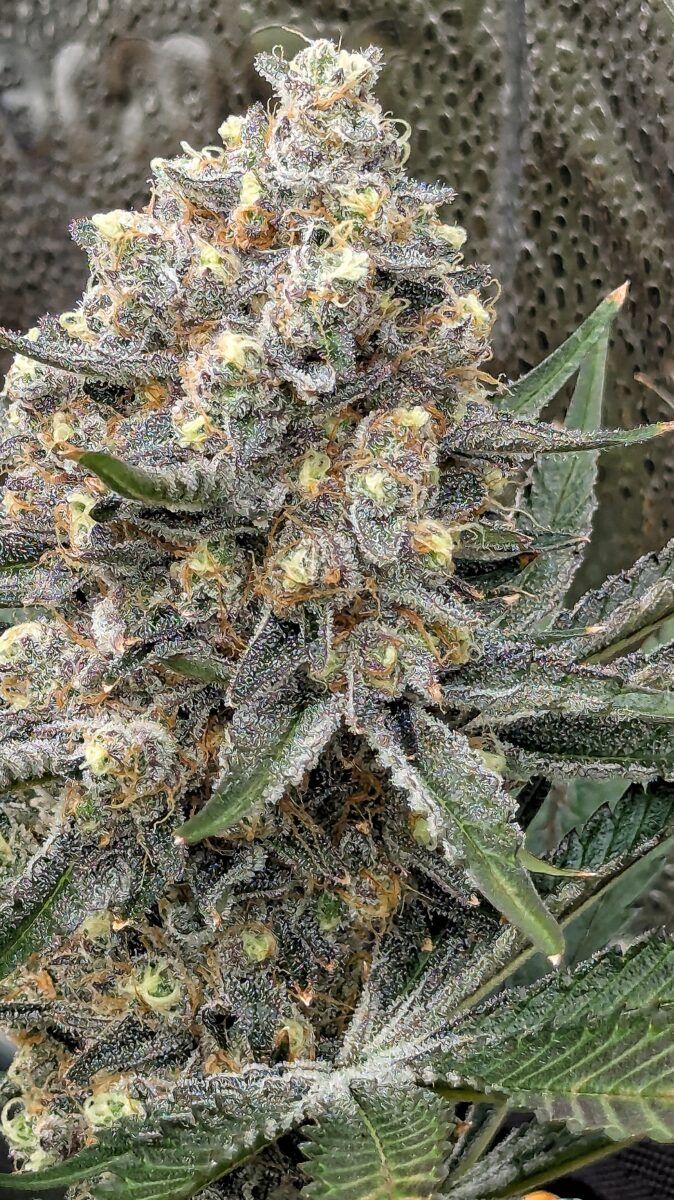
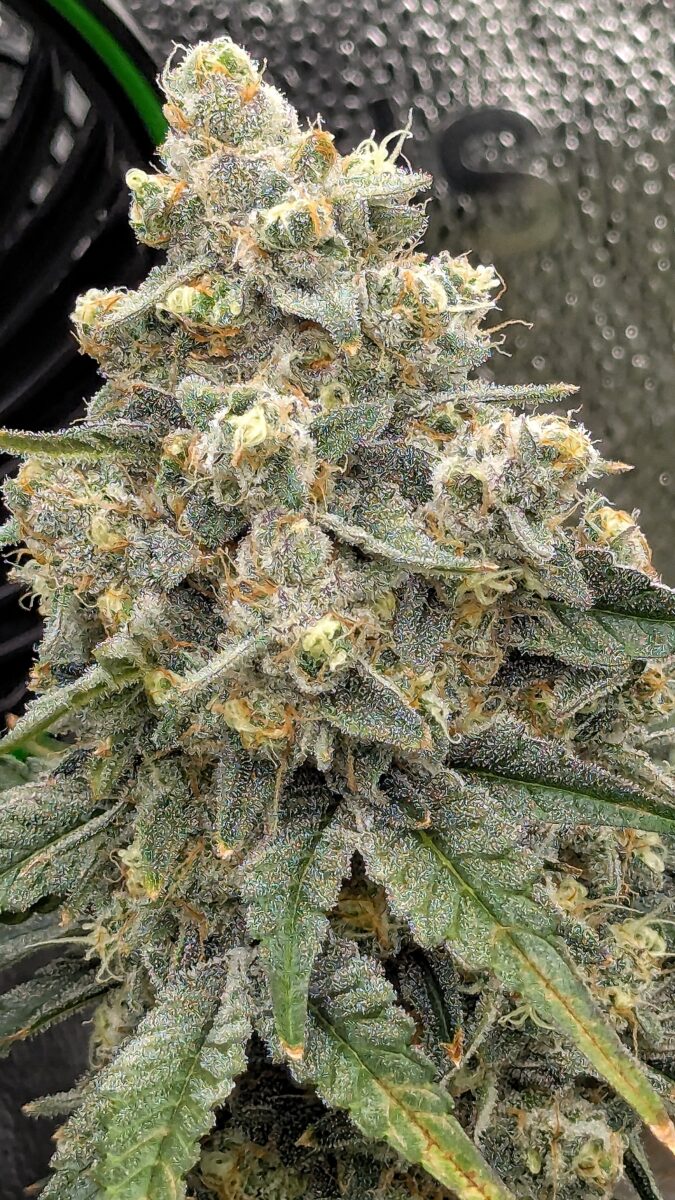
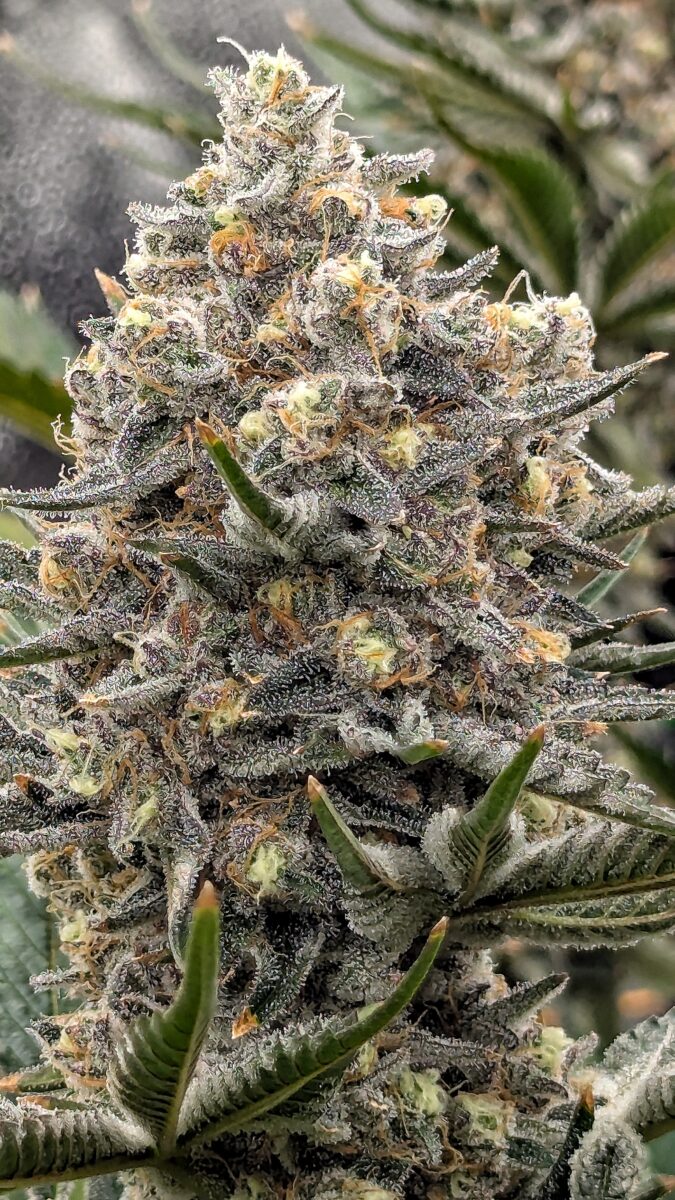
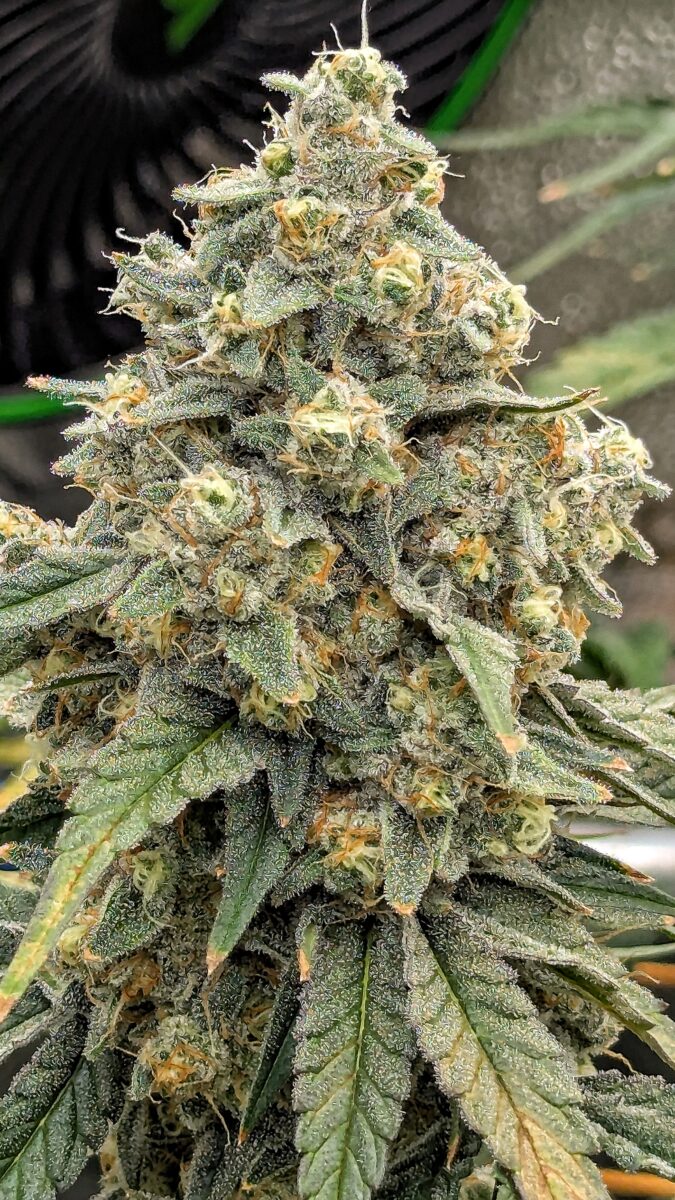
Trichome development advanced steadily. Examination of the upper colas on Day 52 of flower showed an estimated distribution of 15% clear, 80% cloudy, and 5% amber, indicating that Granddaddy Purple is entering the early phase of late flower but still has meaningful time remaining before ripening.
Trichome coverage is dense and well-formed across calyxes and sugar leaves, producing a noticeably tacky resin layer.
Early signs of natural senescence began appearing on select upper fan leaves, consistent with nutrient reallocation at this stage of development. This progression appears localized and expected, with overall plant health remaining strong.
Aromatically, Granddaddy Purple continues to express deep grape and dark berry notes, layered over a persistent skunk undertone (from neighboring God's Gift). By the end of week seven, the plant is transitioning cleanly into late flower, with environmental and nutrient strategies now focused on controlled maturation and preserving resin and terpene quality heading into the final weeks.
FLO
10
Week
Week 10: Flowering Granddaddy Purple
Photos (8)
Grow details
Plant height
51.5 in
Air humidity
48 %
Smell intensity
High
Day air temperature
77 °F
Night air temperature
67 °F
Lamp to plant distance
8 in
Pot size
3 gal
Solution pH
6
Nutrient strength (mS/cm)
1.8 mS/cm
Daily water per plant
4 L
Light schedule
12 h
Grower notes
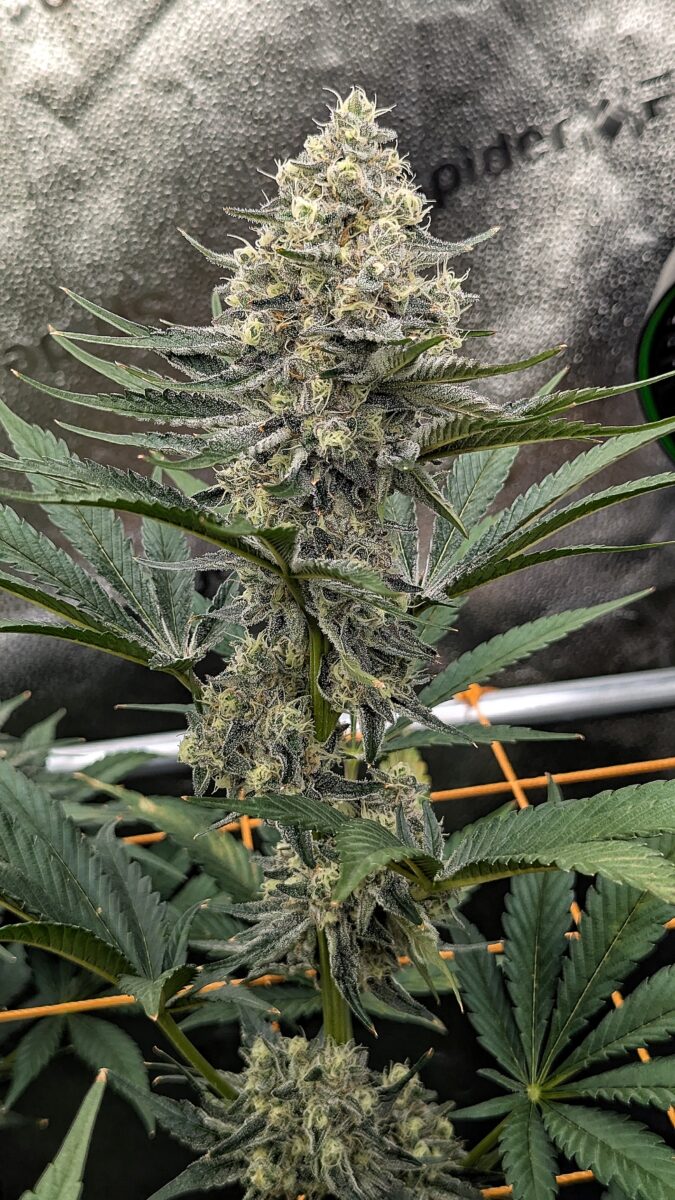
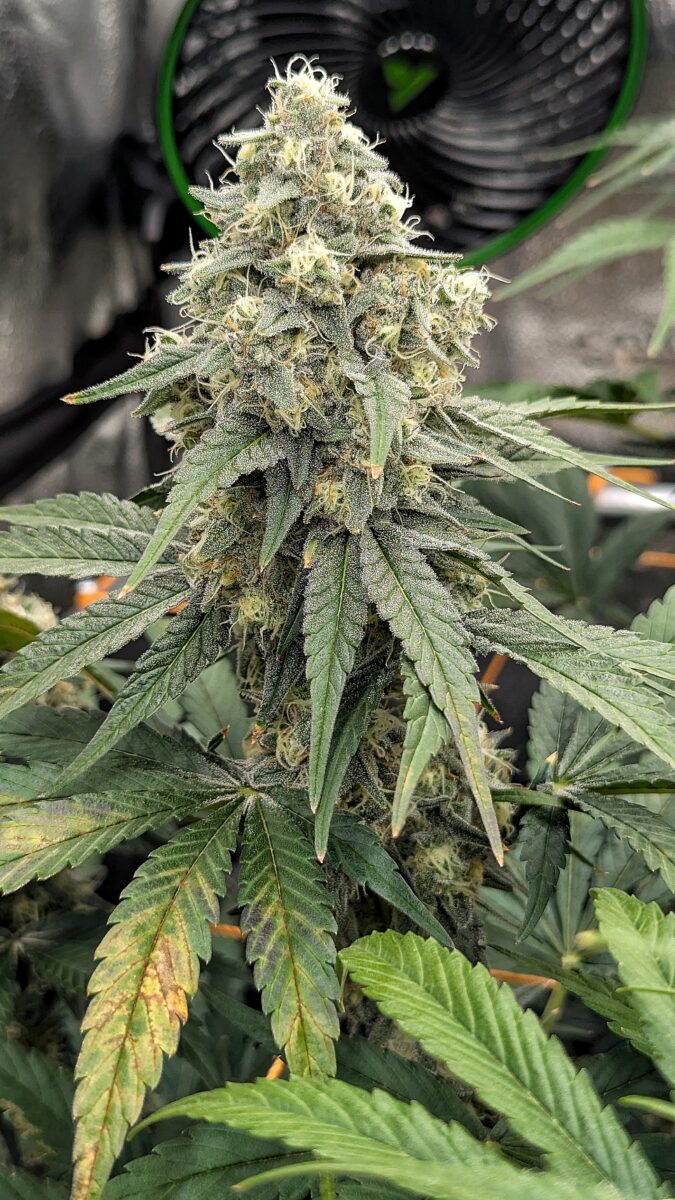
Granddaddy Purple – Week #6 of Flower (Mid Flower)
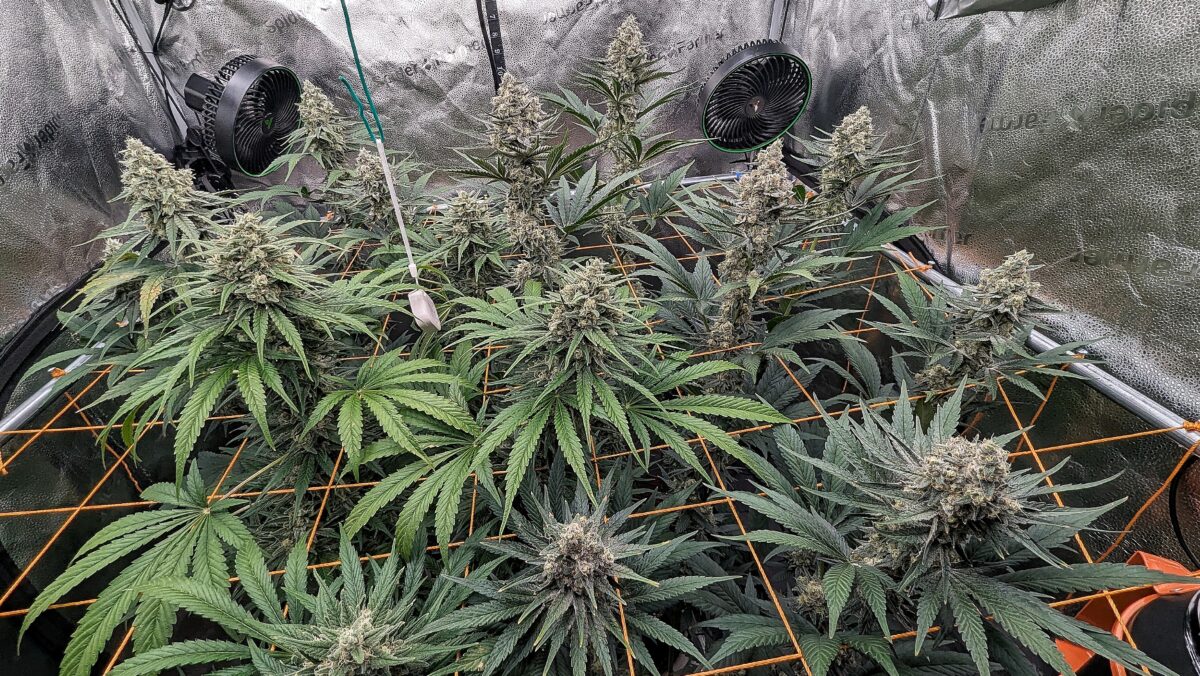
Week six of flower marked a period of rapid structural change and increasing biomass for Granddaddy Purple. As bud weight increased, several large spires began leaning significantly, prompting the installation of a second horizontal support grid. In addition, select small and mid-sized branches required supplemental support using garden wire, securing them gently to the main stems to prevent sagging or mechanical stress. A limited number of large fan leaves were removed where they were directly contacting adjacent colas, primarily to reduce friction points and improve airflow within an increasingly dense canopy.
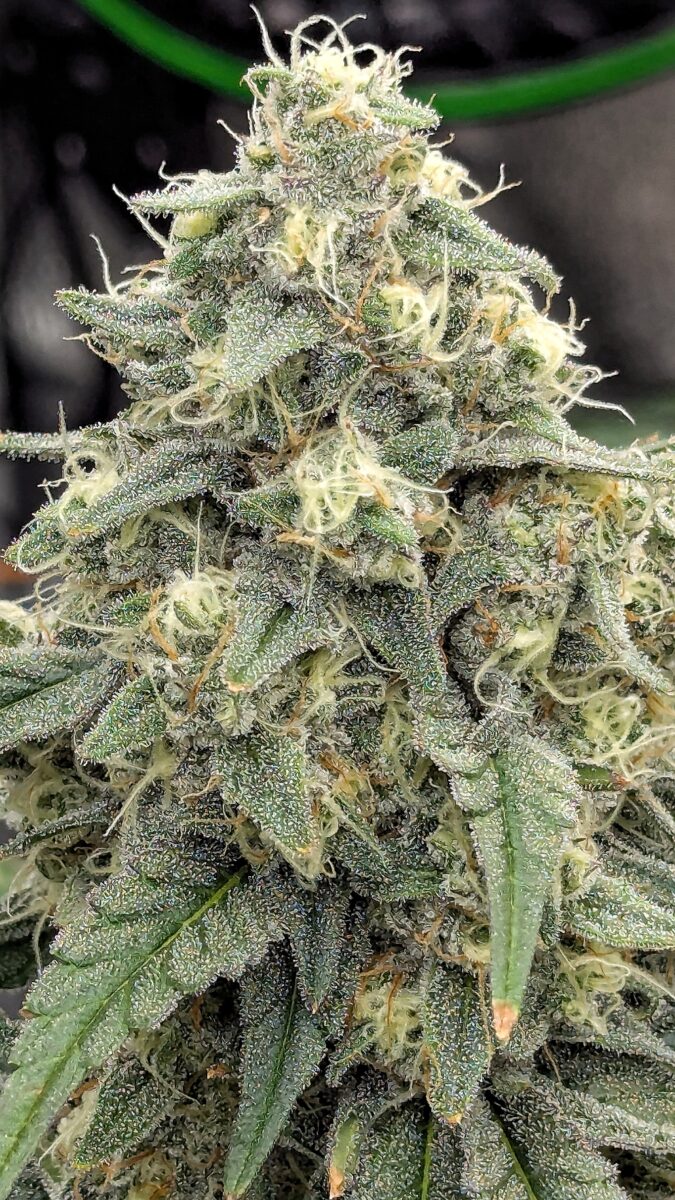
Calyx stacking and swelling continued steadily throughout the week, with the majority of pistils remaining white and extended, confirming that the plant is still firmly in mid-flower. Feeding remained consistent with mid-flower nutrition at a pH of 6.1 and an average solution strength near 900 ppm. Cal-Mag was provided at 5 ml per gallon, and silica was applied once weekly at 1 ml per gallon to support structural integrity. Overall nutrient uptake appears stable, with no signs of toxicity or acute deficiency.
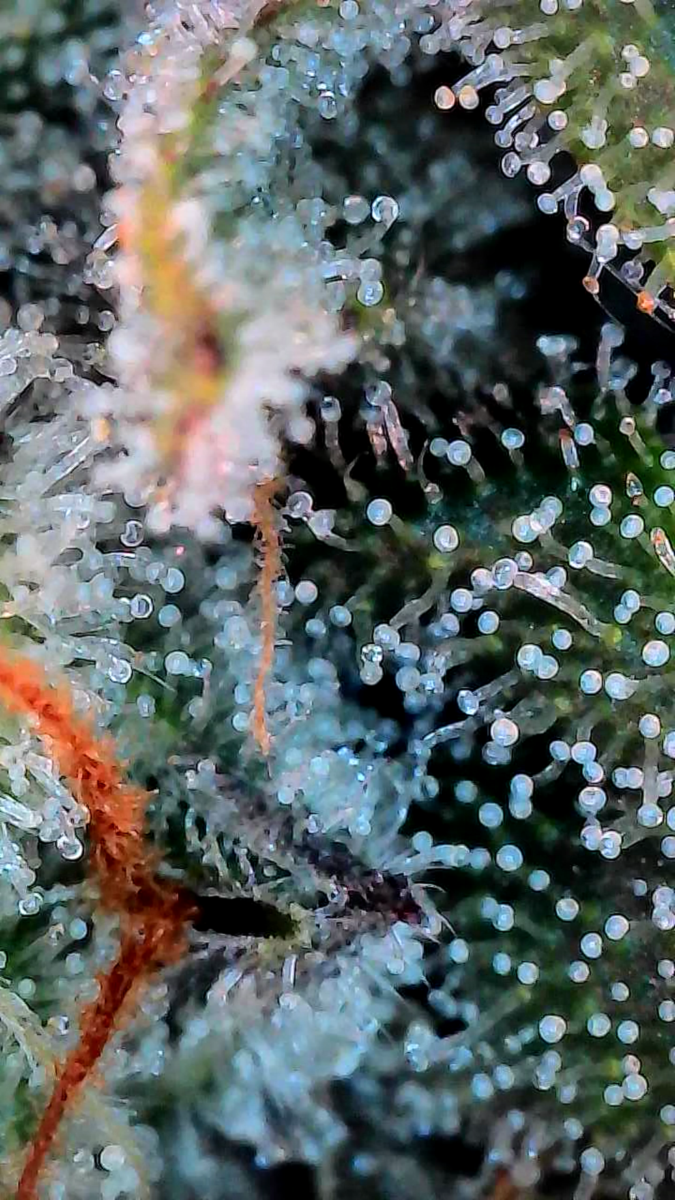
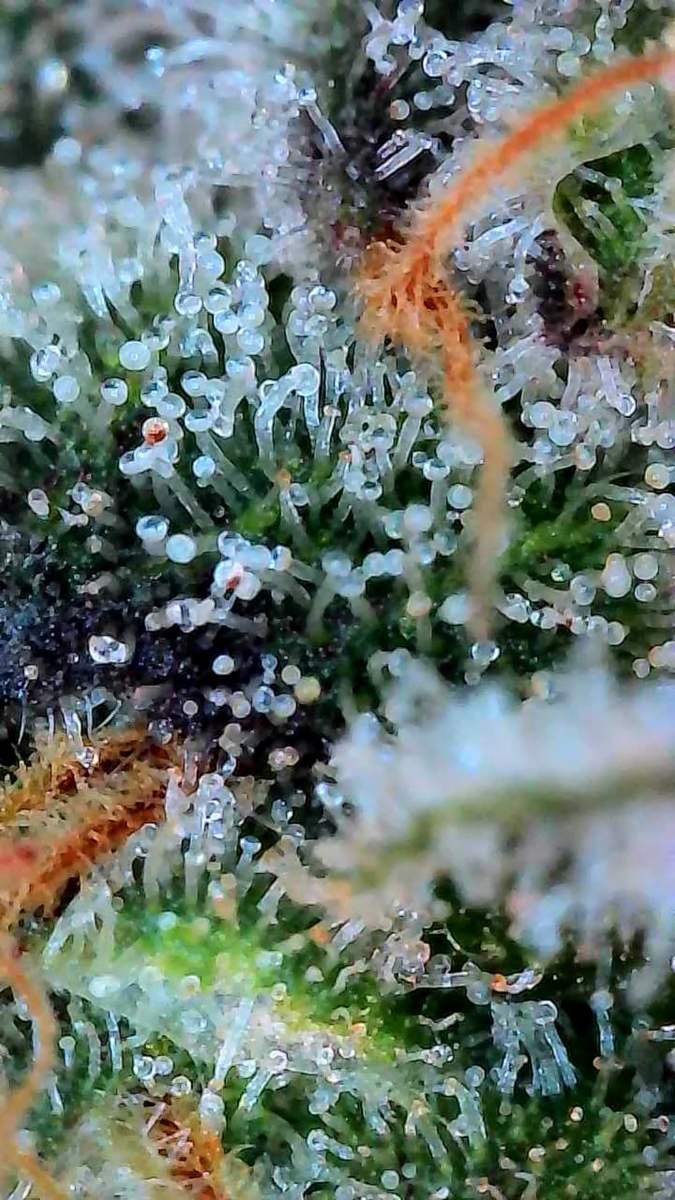
At the end of week six, a digital microscope was used for the first formal trichome assessment. Sampling from multiple upper colas revealed approximately 35–40% clear trichomes, 55–60% cloudy, and little to no amber. This confirms that Granddaddy Purple remains solidly in mid-flower, with an estimated additional week before transitioning toward late-flower nutrient profiles.
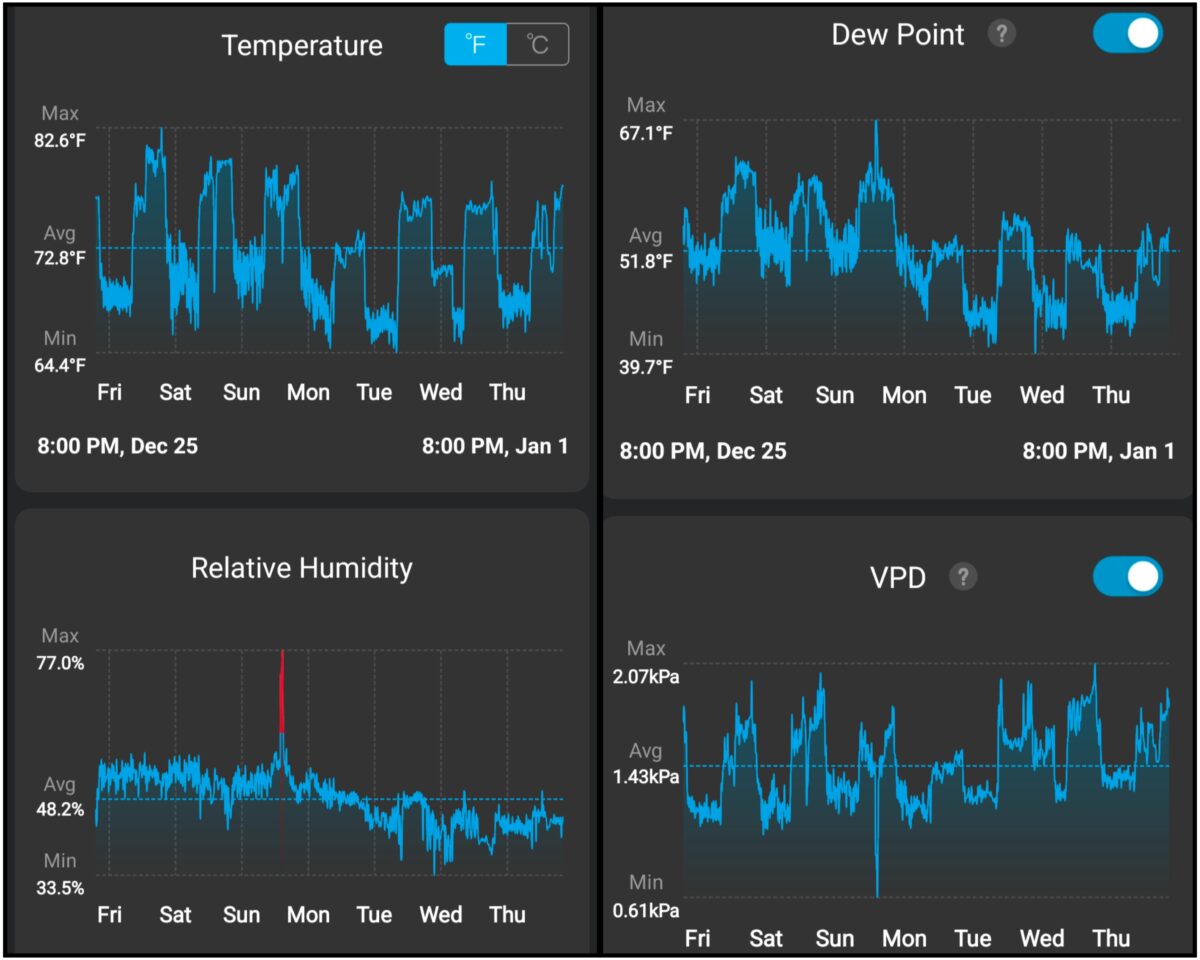
Environmental management was challenged early in the week by unseasonably warm and humid conditions. Multiple mitigation strategies were deployed to control humidity and maintain stable vapor pressure deficit. A wind storm caused a power outage lasting roughly one hour during the middle of the light cycle, resulting in a brief temperature drop and RH spike. No condensation was observed on plant surfaces, tent walls, or flooring, and normal conditions were restored quickly once power returned.
Some early signs of senescence appeared on a small number of upper fan leaves, presenting as localized yellowing and minor necrotic spotting. This is suspected to be related to a previously cool root zone during the humid period, combined with elevated potassium demand at this stage of flower. Root zone temperatures have since stabilized, and the condition does not appear to be spreading.
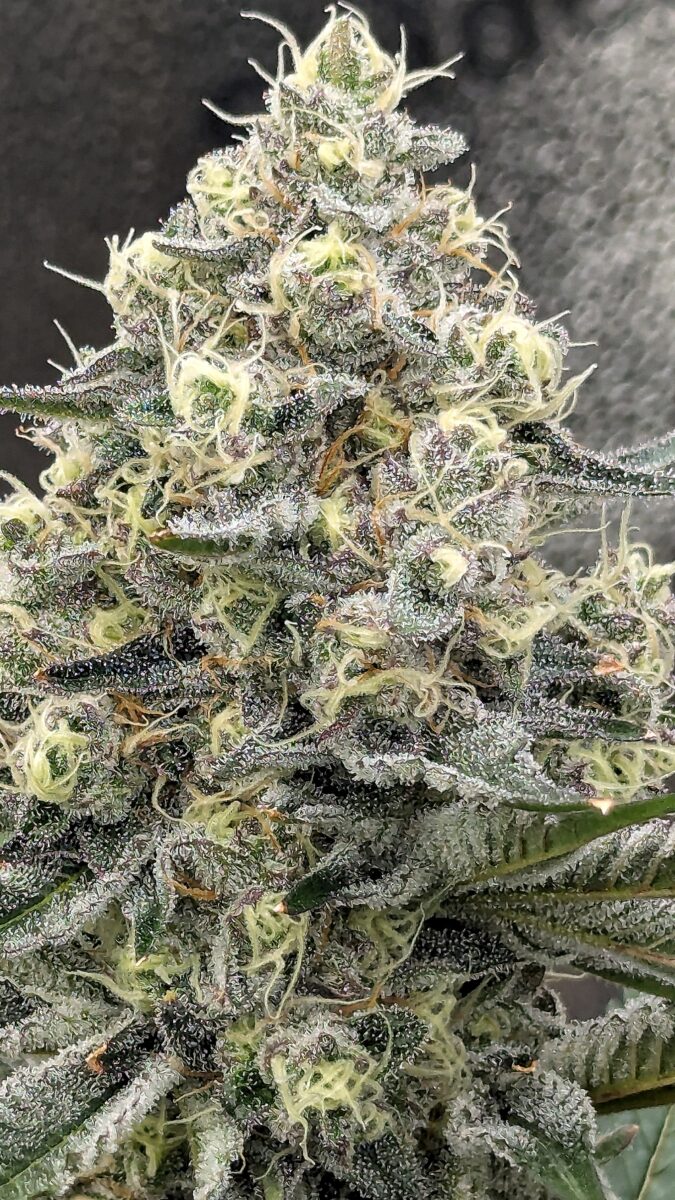
Resin production increased noticeably this week, with dense trichome coverage extending across sugar leaves and calyxes. Gland heads are well-formed and abundant, producing a distinctly tacky surface. Aromatically, Granddaddy Purple is expressing a rich blend of sweet grape and dark berry notes layered over a persistent skunk base (from neighboring "God's Gift"). The aroma has intensified enough to intermittently challenge carbon filtration during tent access, reflecting both terpene density and increasing flower mass. PPFD remains approximately 1050 at the tops, delivering a DLI near 45, with supplemental UVA maintained at 150 minutes per day.
FLO
9
Week
Week 9: Flowering Granddaddy Purple
Photos (7)
Grow details
Plant height
51.5 in
Air humidity
51 %
Smell intensity
High
Day air temperature
75 °F
Night air temperature
65 °F
Lamp to plant distance
10 in
Pot size
3 gal
Solution pH
6
Nutrient strength (mS/cm)
1.8 mS/cm
Daily water per plant
4 L
Light schedule
12 h
Grower notes
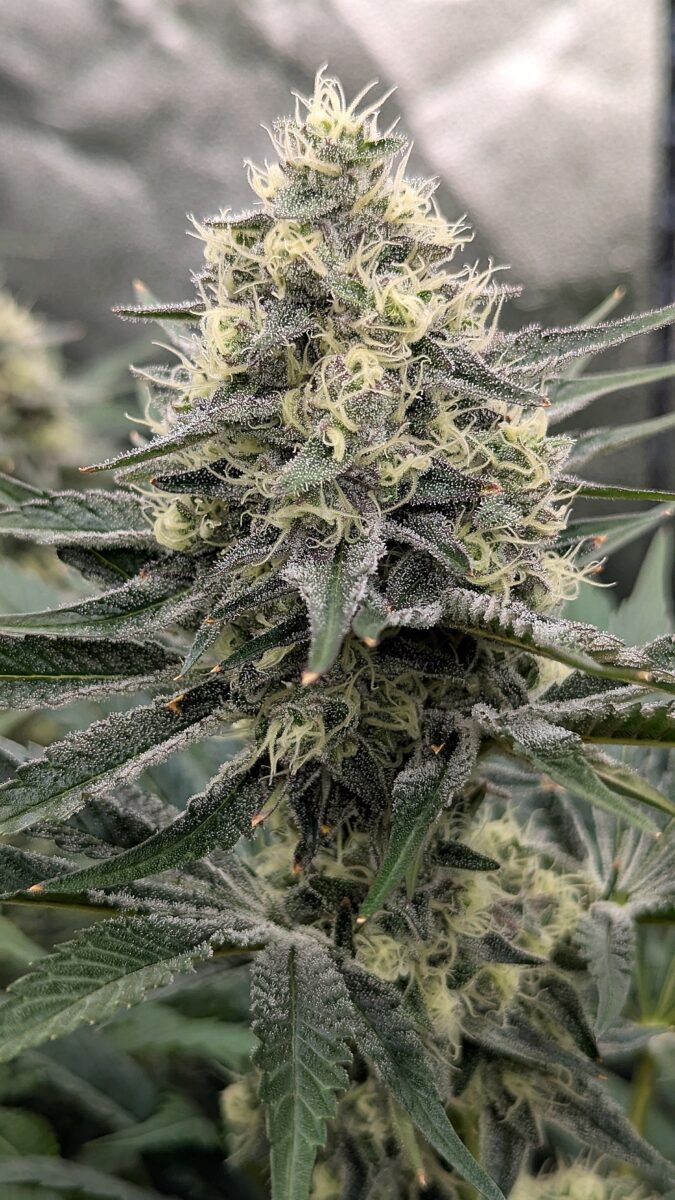
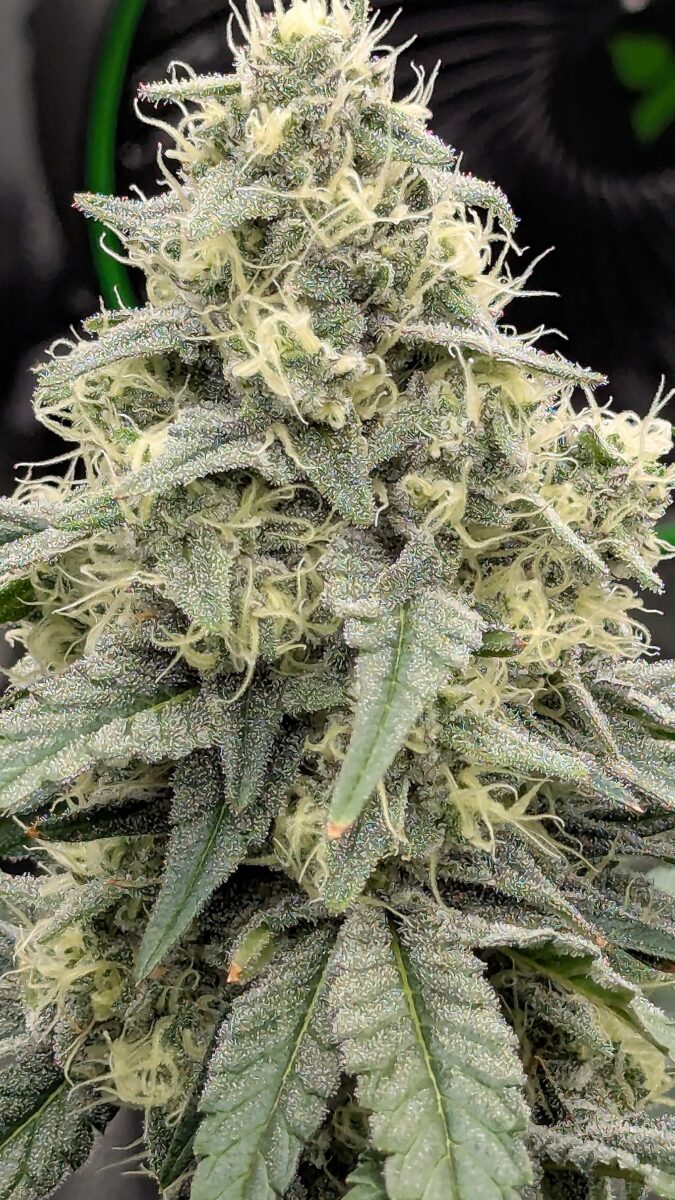
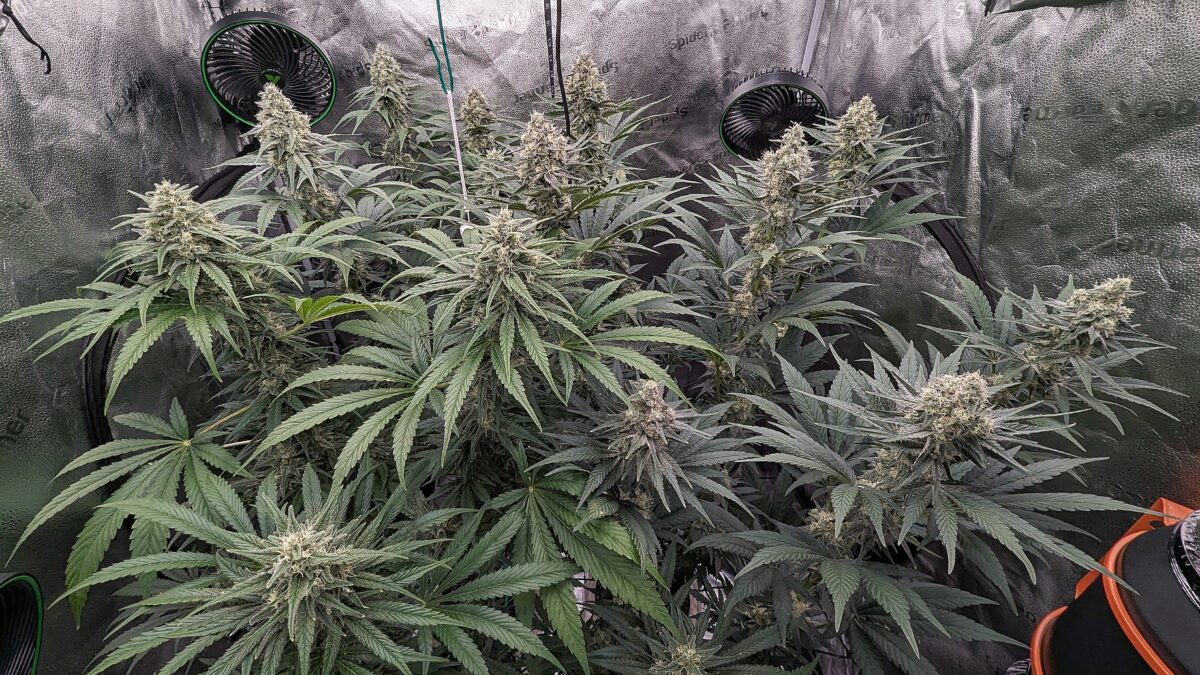
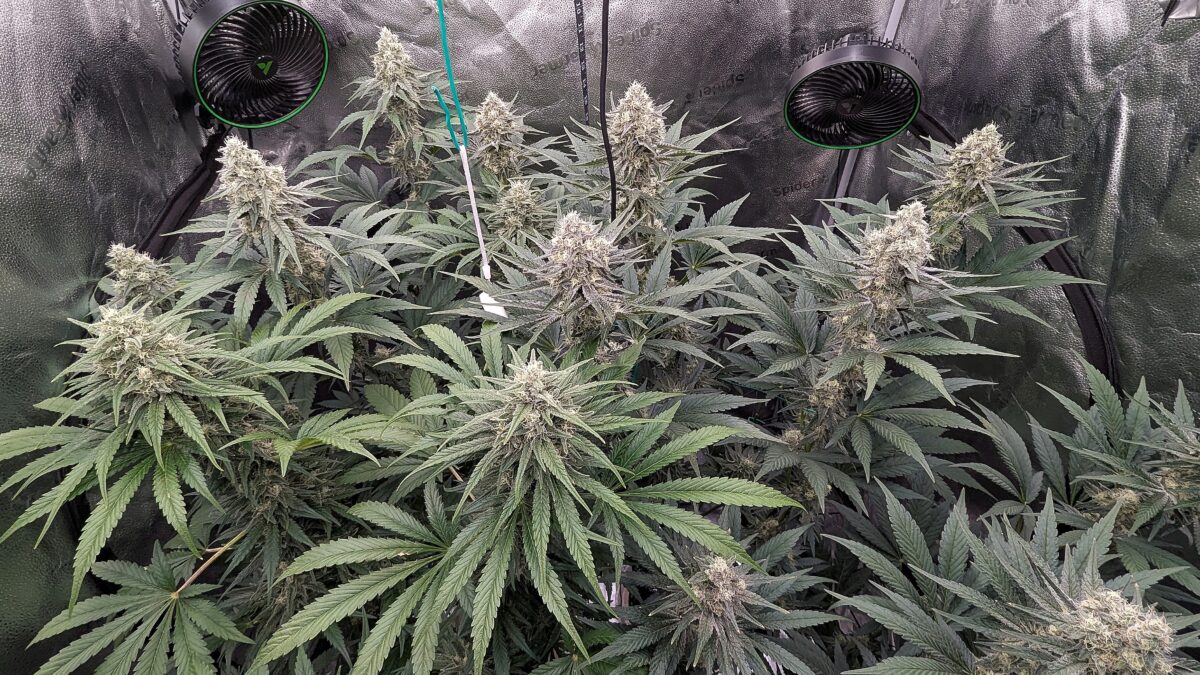
Granddaddy Purple - Week #5 of Flower (Mid Flower)
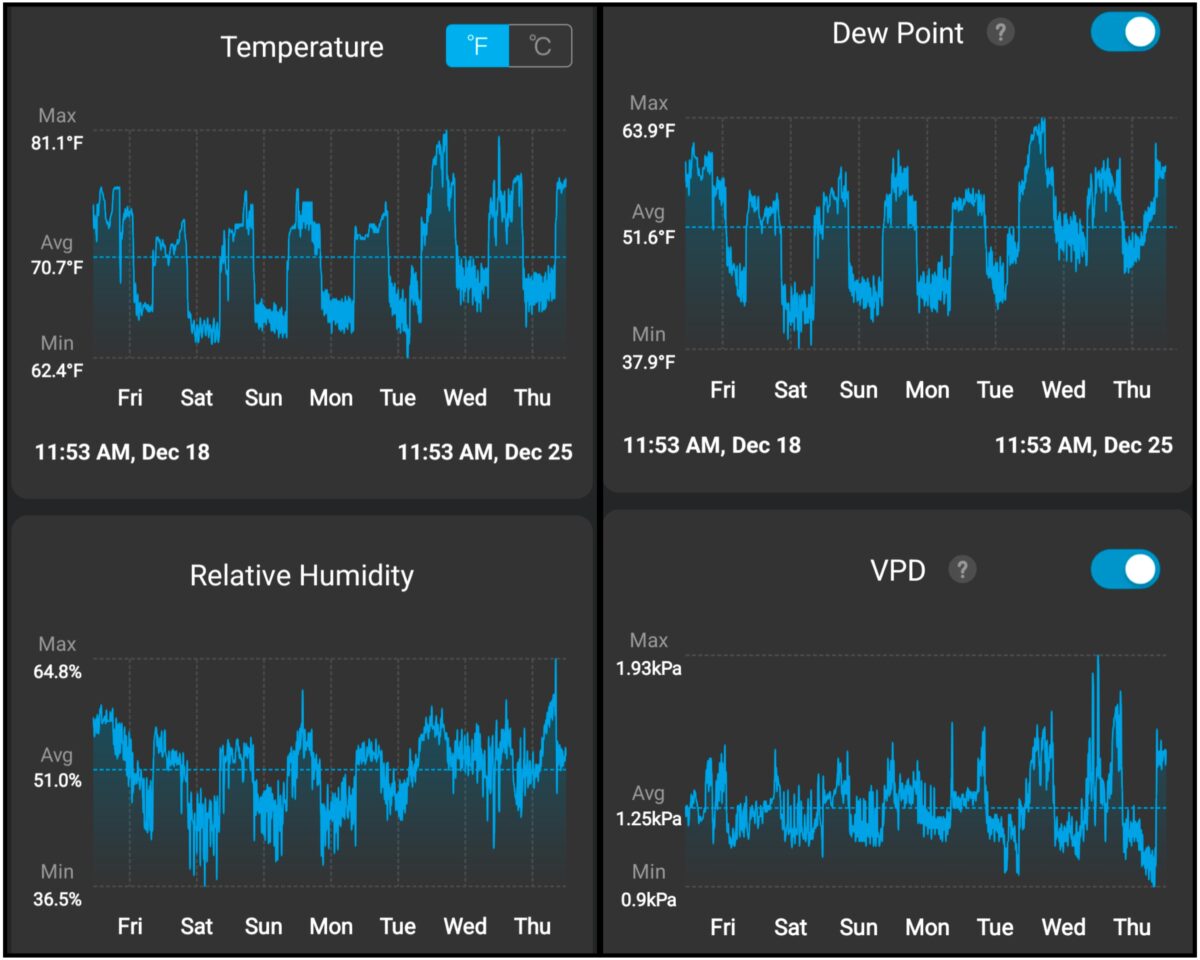
This week was marked by a notable shift in environmental conditions as an unseasonably warm and humid air mass moved into the area. To maintain a stable grow environment, I deployed a portable AC unit outside the tent in dry mode. This allowed cooler, drier air to be pulled into the tent whenever the exhaust system activated due to temperature or humidity increases. This approach proved effective at stabilizing conditions without introducing excessive cooling directly into the canopy.
During lights on, temperatures averaged around 75°F with relative humidity near 53%, maintaining a VPD in the 1.3–1.5 range, occasionally reaching 1.6 later in the light cycle. During lights off, temperatures dropped to roughly 65°F with relative humidity settling in the mid-40s to low-50s, keeping VPD between 1.0 and 1.3. Root zone temperatures were closely monitored and are now stable between 62 and 63°F. Nutrient solution temperature has consistently remained between 62–63°F as well.
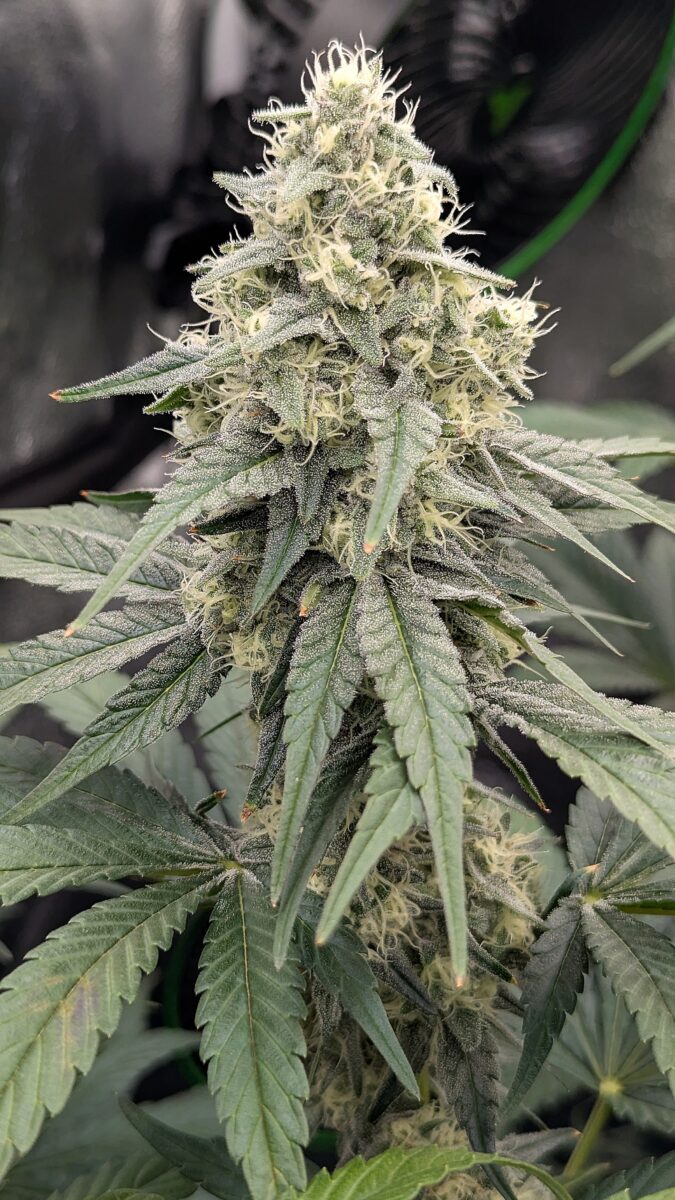
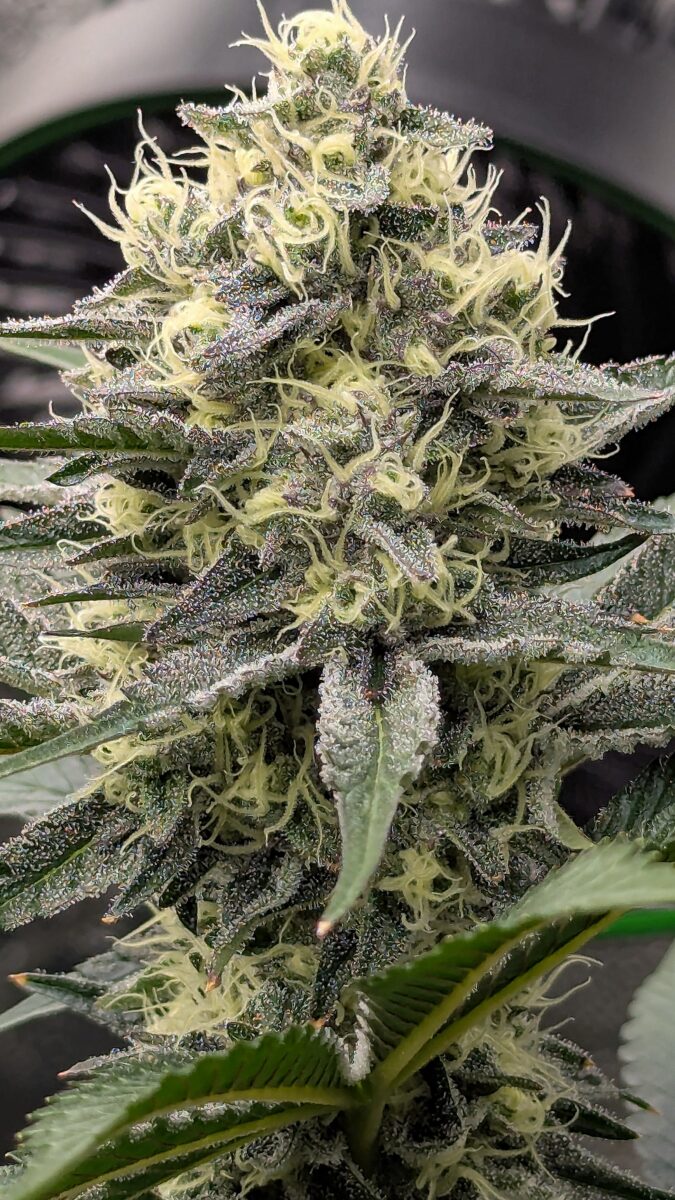
Bud development continues to accelerate. The plants remain firmly in mid-flower, with pistils still fully extended and colas maintaining a pointed structure rather than rounding or swelling prematurely. Trichomes remain mostly clear with only early signs of clouding, indicating the plants are still in an active growth and stacking phase. Bud weight is increasing steadily, and additional structural support will likely be required in the coming weeks. Aroma production has intensified significantly, with a strong blend of skunk and sweet citrus now overpowering the carbon filter at times.
Lighting intensity was increased this week, with PPFD raised from approximately 950 to 1050 and DLI increasing from roughly 41 to 45–46. UVA exposure was also extended from 120 to 150 minutes per day. The plants responded well with no signs of stress. Feeding continued on a consistent schedule of once every 48 hours, with each plant receiving 1–1.25 gallons of nutrient solution per feeding. The solution was maintained at a pH of 6.1 with a medium-strength nutrient mix measuring approximately 850–900 ppm. Silica was applied once this week at 1 ml per gallon, and Cal-Mag was included at 5 ml per gallon.
Earlier in the week, I observed mild potassium uptake issues on a few larger fan leaves. Investigation revealed that root zone temperatures had dipped to approximately 56–58°F due to cool air entering near the base of the tent through the side vents. To correct this, I installed a baffle system around the pots to redirect incoming air toward the heater before reaching the containers. Since making this adjustment, root zone temperatures have stabilized at 62–63°F, and no further progression of the deficiency has been observed. This correction should allow nutrient uptake to normalize going forward.
FLO
8
Week
Week 8: Flowering Granddaddy Purple
Photos (7)
Grow details
Plant height
51.5 in
Air humidity
48 %
Smell intensity
High
Day air temperature
75 °F
Night air temperature
66 °F
Lamp to plant distance
10 in
Pot size
3 gal
Solution pH
6
Nutrient strength (mS/cm)
1.8 mS/cm
Daily water per plant
4 L
Light schedule
12 h
Grower notes
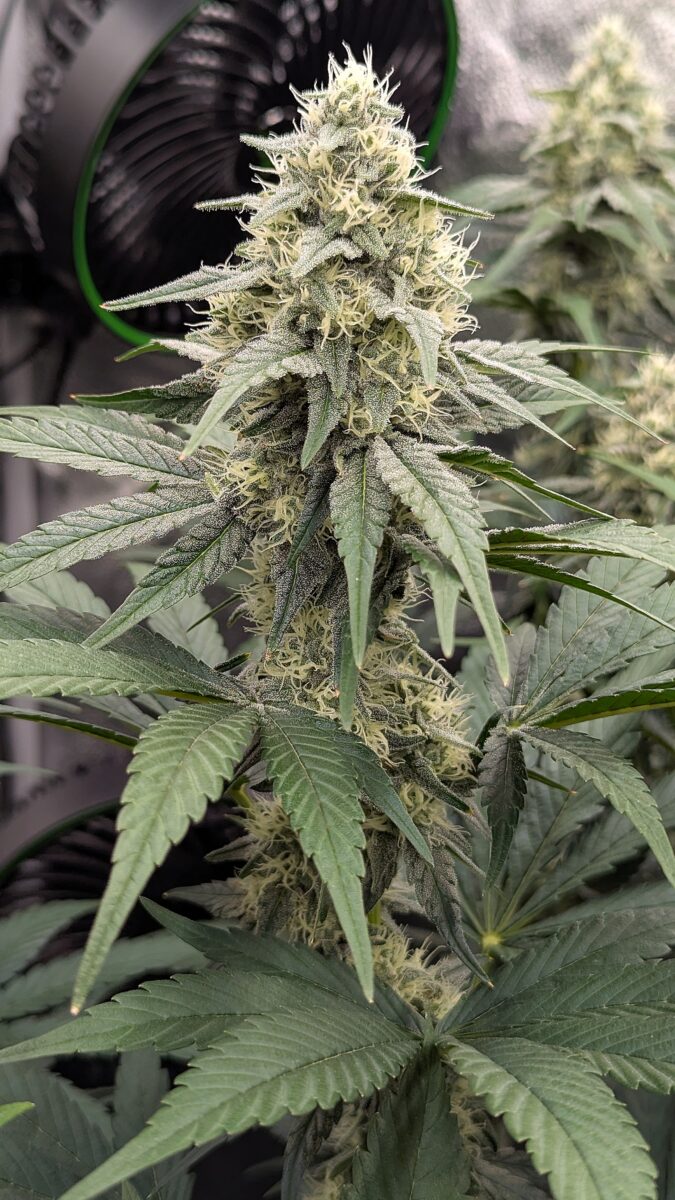
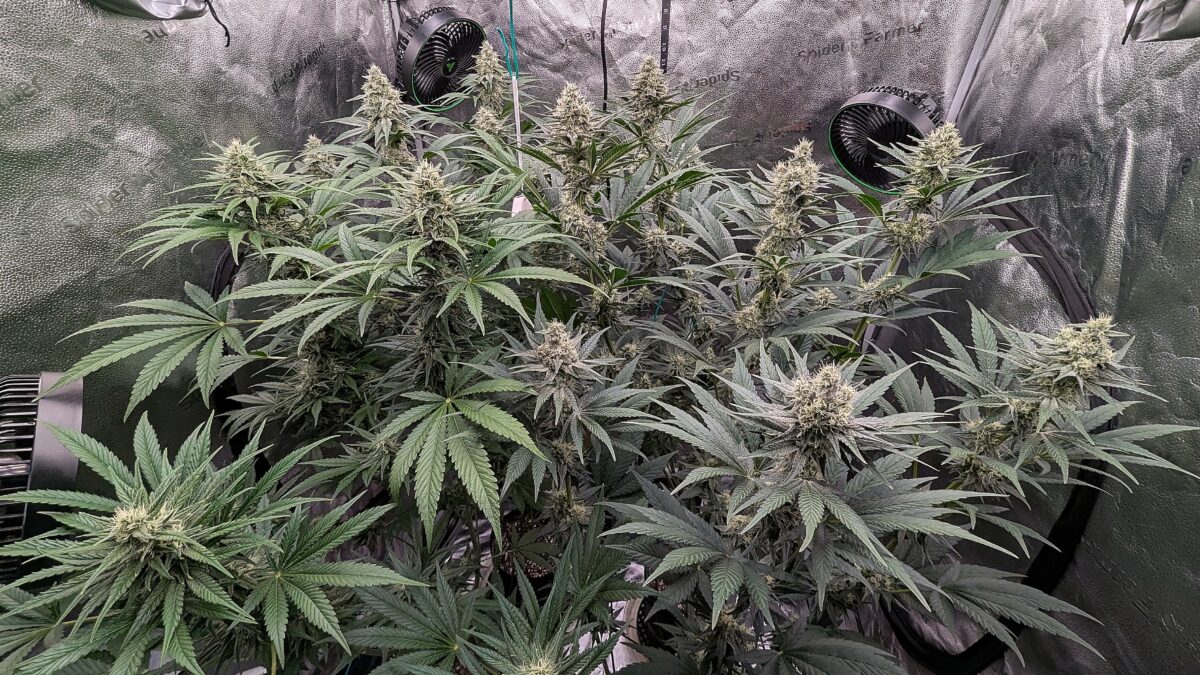
Granddaddy Purple – Week #4 of Flower (Mid Flower)
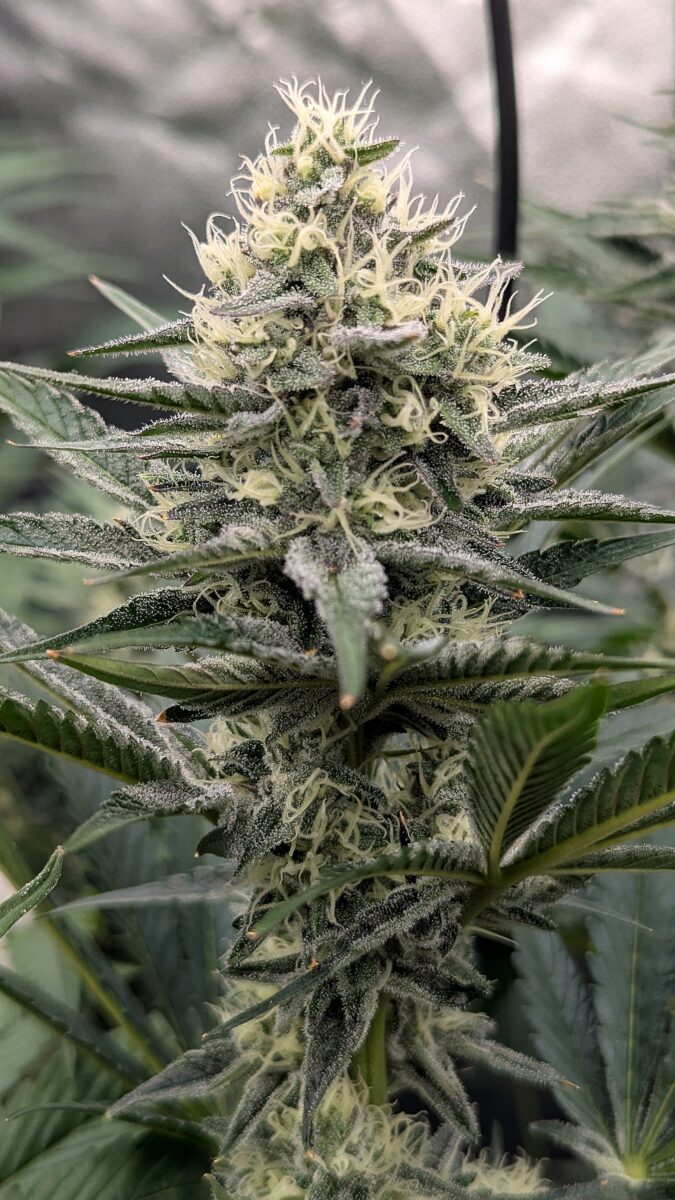
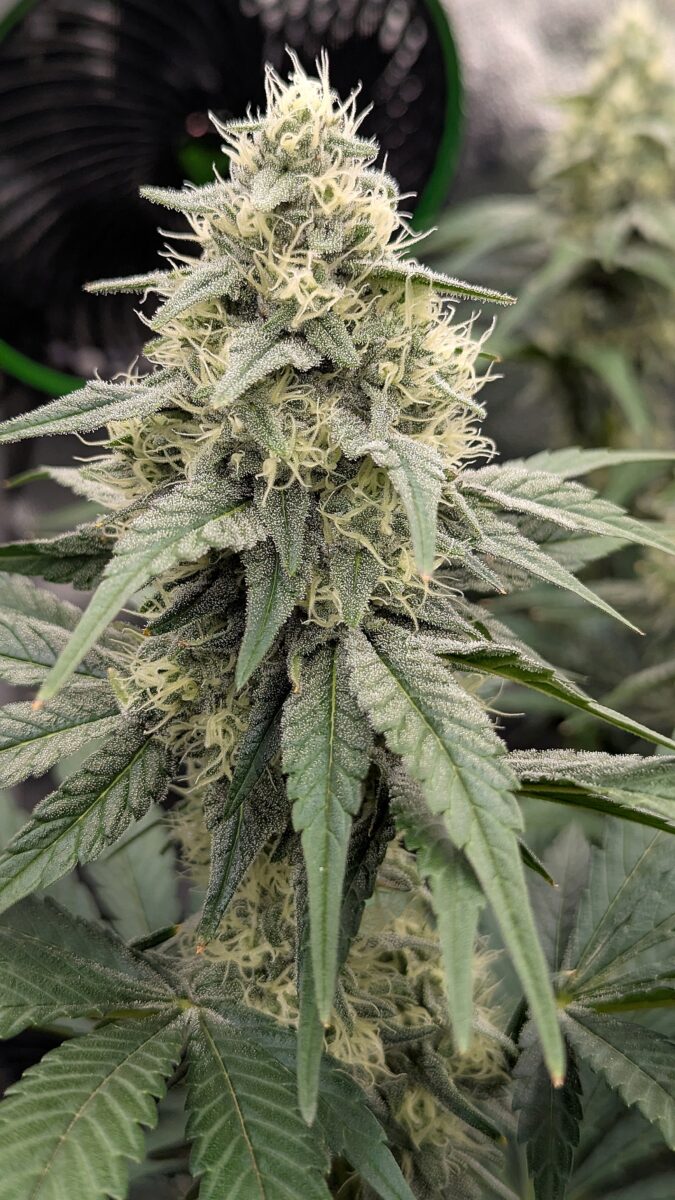
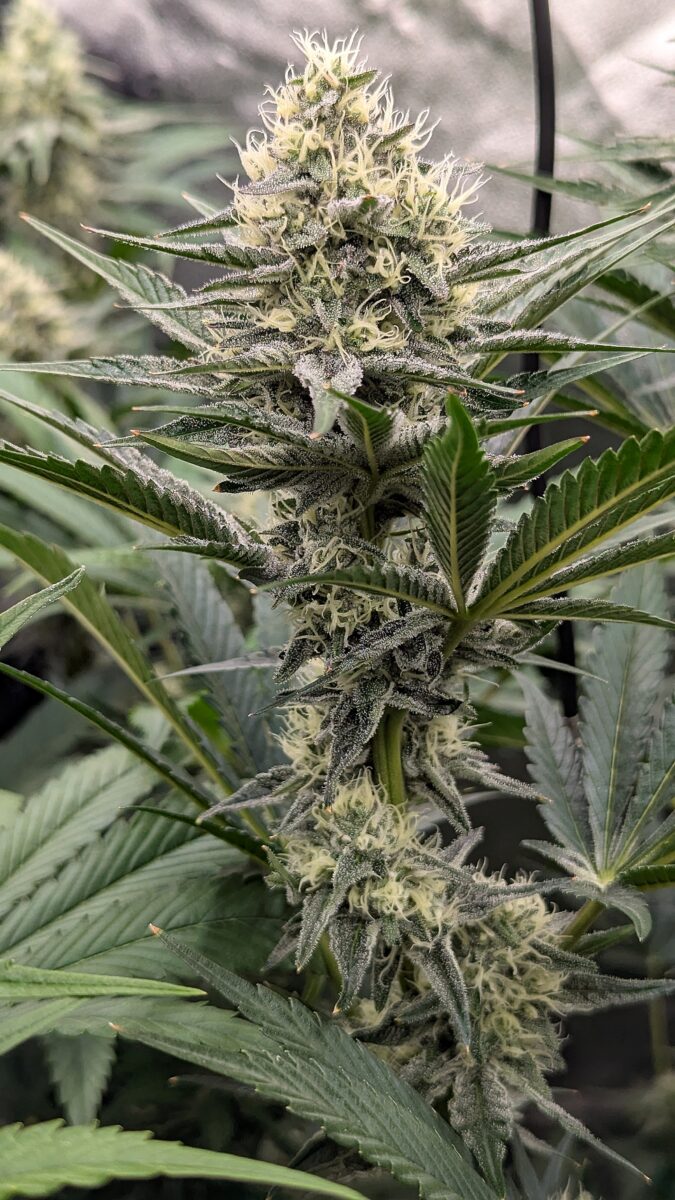
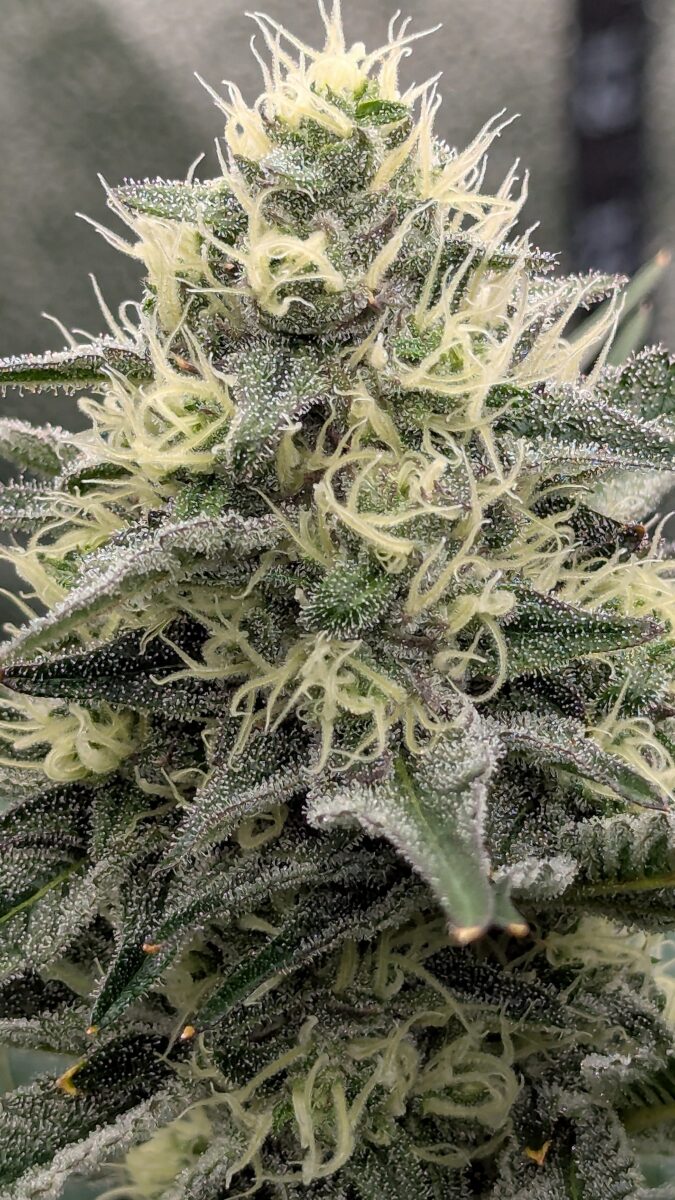
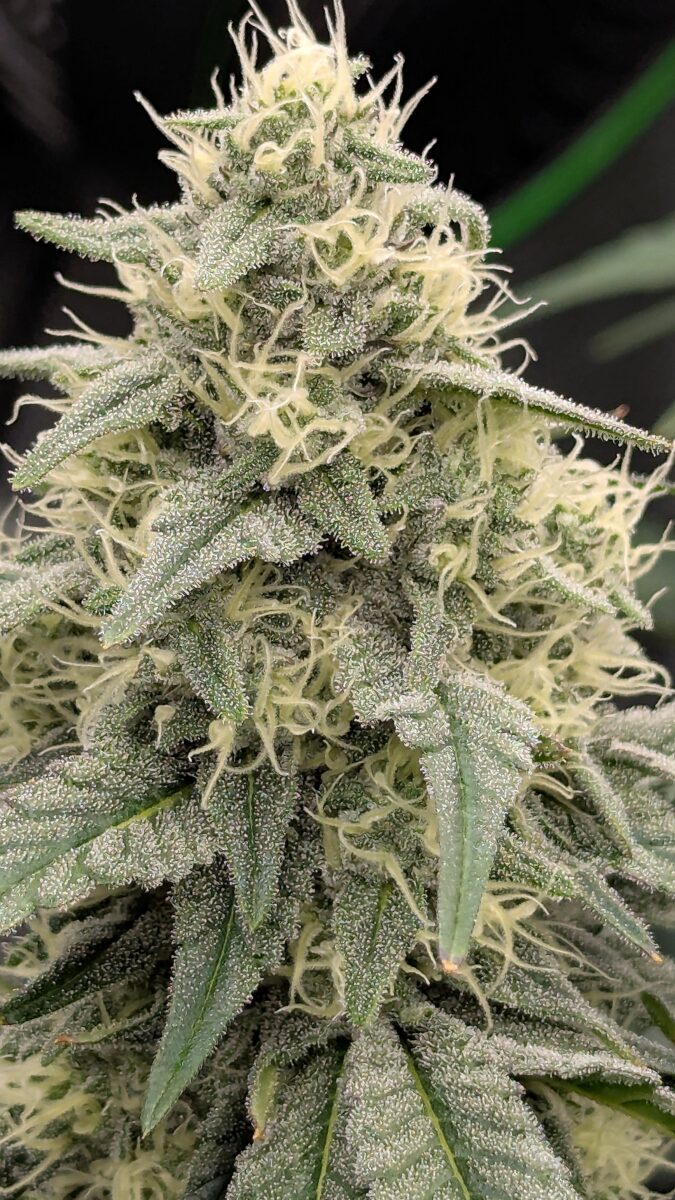
Week #4 marked the first week of mid flower for both GDP plants. Vertical growth fully ceased last week, and energy is now directed toward bud bulking and resin production. Bud mass increased noticeably this week, with tighter stacking across the main colas and secondary branches. Several branches are beginning to lean under weight gain, signaling the start of structural loading earlier than expected.
Light intensity across the canopy is holding steady at 950–975 PPFD with a DLI of 42. UV-A exposure was increased to 2 hours per day, coinciding with a visible uptick in trichome density on sugar leaves and upper bracts. Aroma intensified dramatically this week, progressing to a strong skunky-citrus profile that has begun overpowering the carbon filter and filling the lung room.
Environmental conditions stayed well controlled despite external weather challenges. Daytime temperatures averaged ~75°F with nighttime lows around 66°F, maintaining an average VPD of ~1.3 (range 1.2–1.4). A winter storm earlier this week caused outdoor temperatures to drop below zero, and while tent air temperatures remained stable, part of the root zone of each plant nearest the bottom vents dropped into the mid-50s. No stress responses were observed - water uptake remained strong, leaves stayed turgid, and growth continued uninterrupted.
Feeding continued at 1–1.25 gallons per plant every other day, using strictly mid-bloom nutrients at a medium GH concentration (~900 ppm). pH remained stable at 6.1, with 5 ml/gal Cal-Mag and 1 ml/gal silica applied once weekly. Nutrient response remains clean with no signs of deficiency or imbalance.
Defoliation was minimal this week, limited to a small number of leaves removed only where contact or airflow restriction occurred. Nearly all canopy cleanup was completed prior to mid flower, leaving an open, well-ventilated structure that continues to support even light distribution and healthy bud development.
By the end of Week #4, both GDP plants are firmly established in mid flower: buds stacking and swelling, resin production accelerating, aroma intensifying, and overall plant health remaining excellent despite brief root-zone temperature fluctuations.
FLO
7
Week
Week 7: Flowering Granddaddy Purple
Photos (4)
Grow details
Plant height
51.5 in
Air humidity
50 %
Smell intensity
Medium
Day air temperature
74 °F
Night air temperature
63 °F
Lamp to plant distance
10 in
Pot size
3 gal
Solution pH
6
Nutrient strength (mS/cm)
1.8 mS/cm
Daily water per plant
4 L
Light schedule
12 h
Grower notes
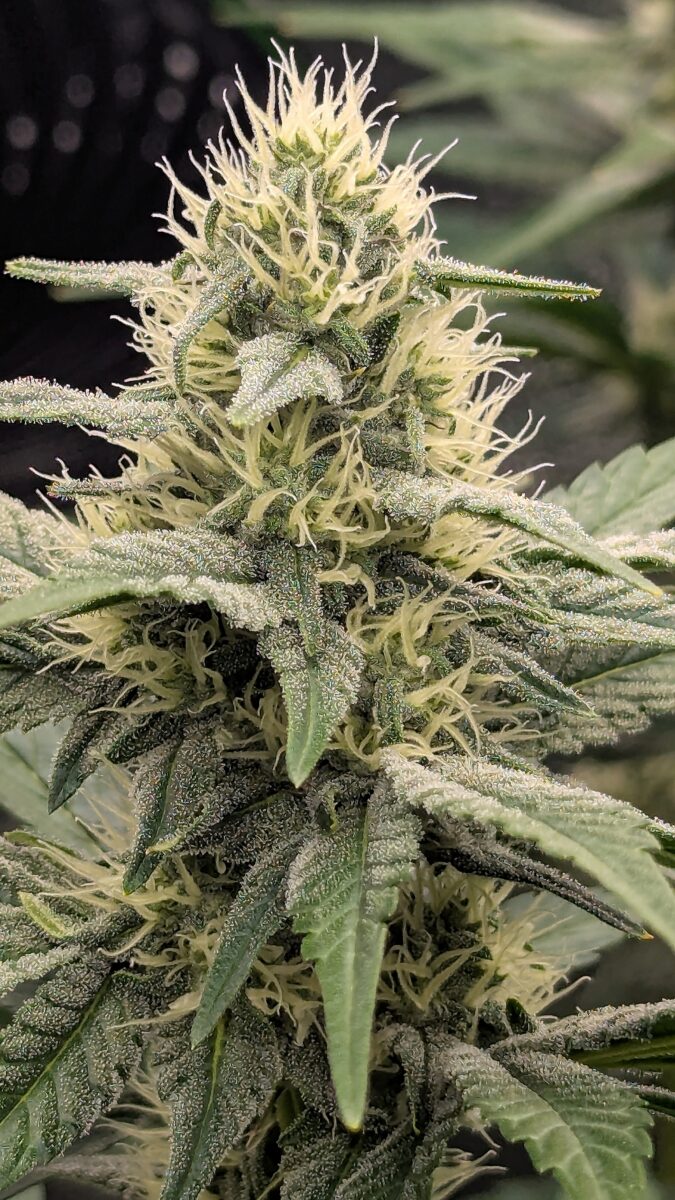
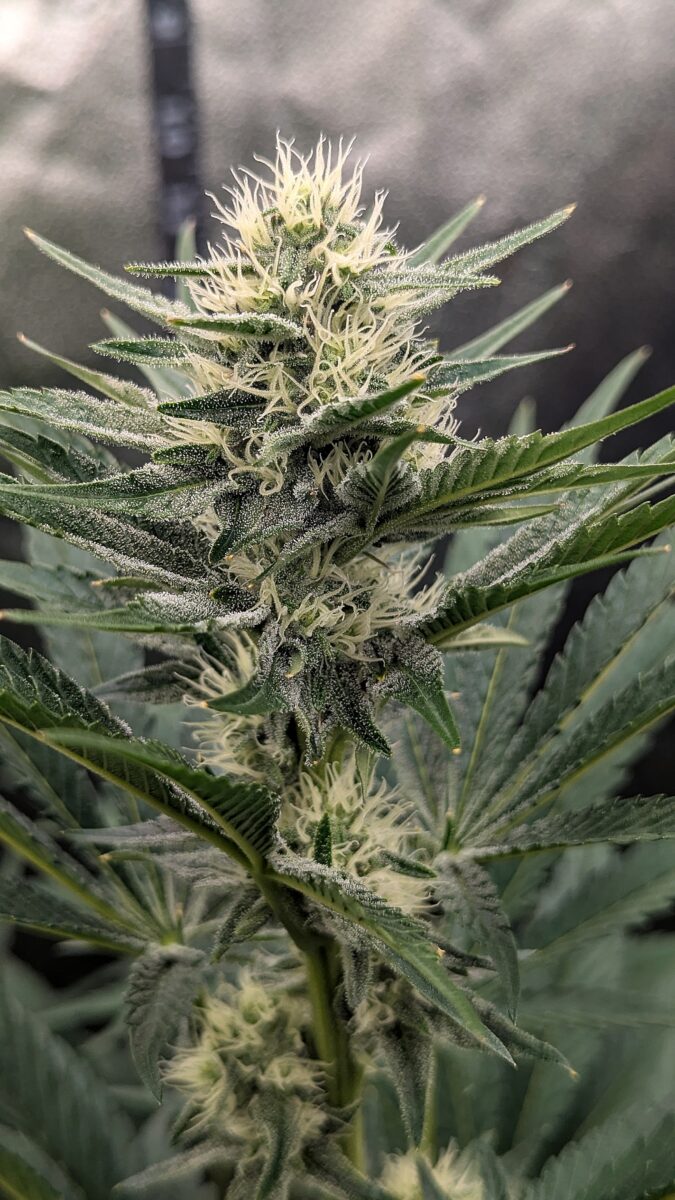
Granddaddy Purple - Week #3 of Flower (Early Flower)
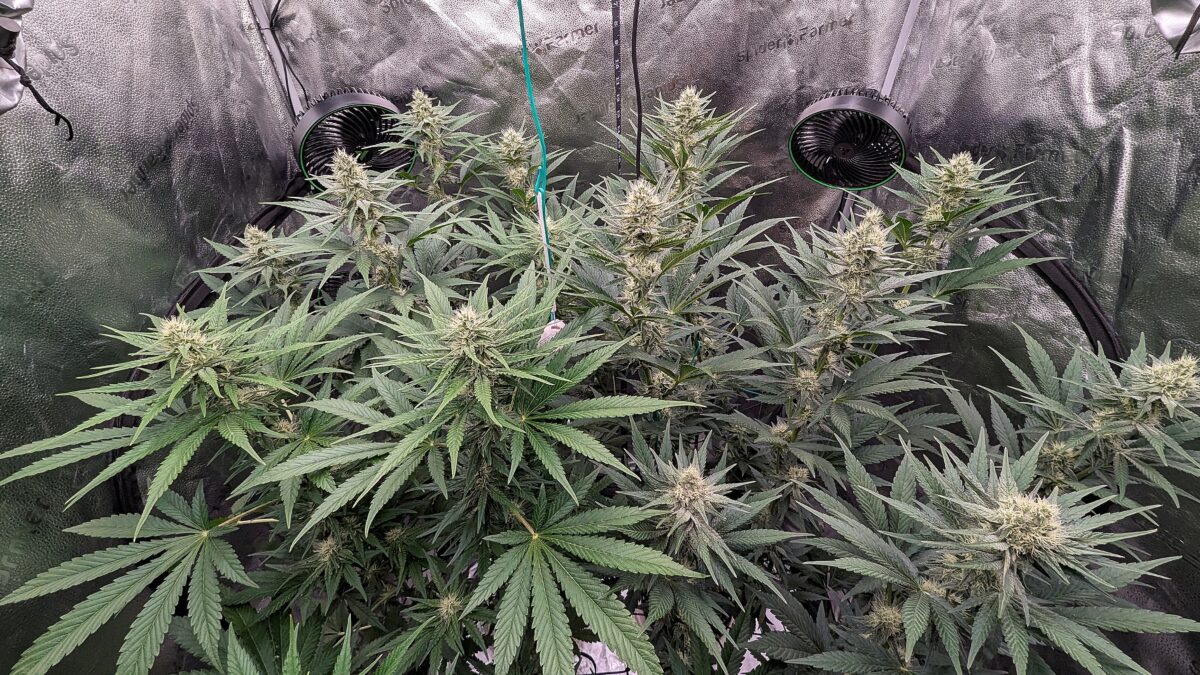
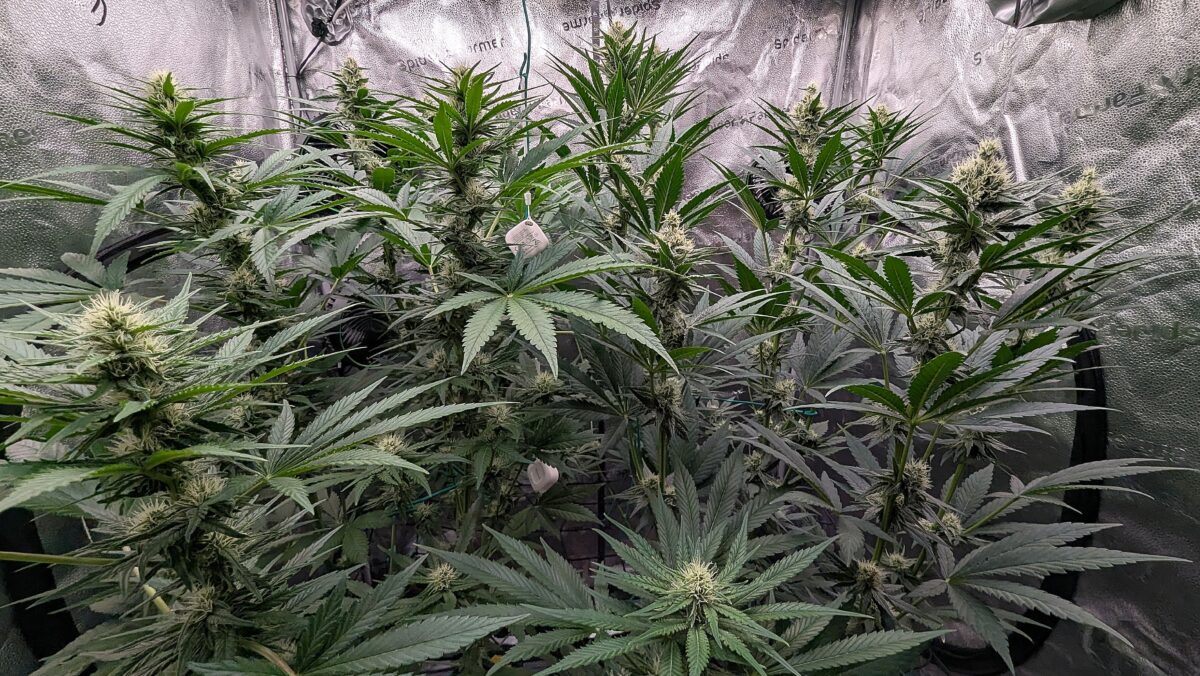
Week 3 marked the end of stretch for both GDP plants, with GDP1 holding at 51" and GDP2 finishing at 52". Once vertical growth stopped, they shifted fully into bud development. Stacking tightened across all colas, early trichomes appeared on the sugar leaves, and the aroma deepened noticeably.
Two moderate defoliation sessions occurred this week which helped clear inward-facing and overlapping foliage, improving airflow and exposing developing bud sites. Light LST adjustments opened the canopy further, allowing even coverage under roughly 925–970 PPFD and DLI 40–42.
Day temps stayed in the low-mid 70s with cooler nights (low-mid 60s), and a stable VPD between 1.1-1.4. Water uptake remains high, and I am currently providing 1 gal of nutrients per plant every other day.
Nutrients transitioned smoothly from early bloom this week to a 50/50 early/mid flower blend at ~880–900 ppm with pH 6.0–6.1 and 5 ml/gal Cal-Mag. Both plants showed clean growth with no tip burn or deficiency.
By the end of Week 3, GDP had clearly entered mid flower: stacking strong, pistils heavy, resin emerging, and the canopy balanced from defoliation and LST. Both plants are primed for bulking going into mid flower.
FLO
6
Week
Week 6: Flowering Granddaddy Purple
Photos (10)
Grow details
Plant height
51 in
Air humidity
50 %
Smell intensity
Medium
Day air temperature
74 °F
Night air temperature
65 °F
Lamp to plant distance
10 in
Pot size
3 gal
Solution pH
6
Nutrient strength (mS/cm)
1.8 mS/cm
Daily water per plant
4 L
Light schedule
12 h
Grower notes
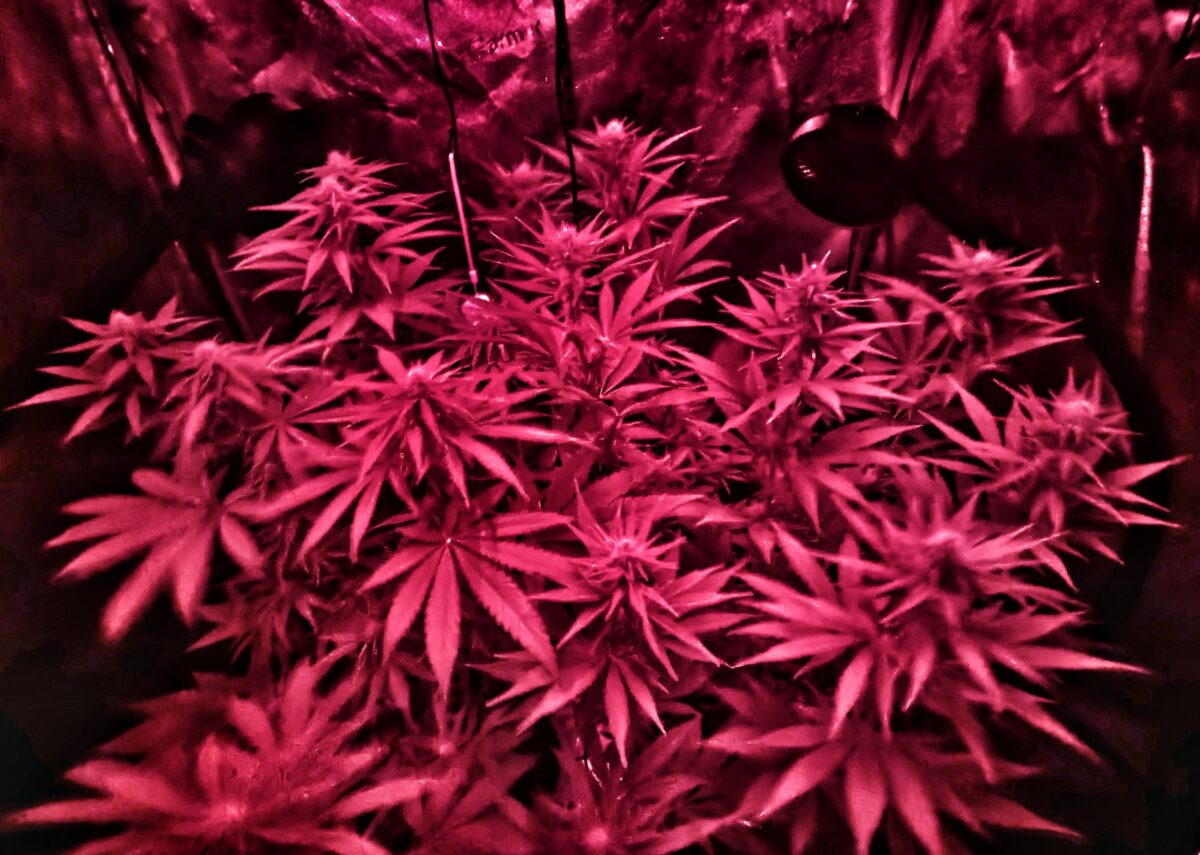
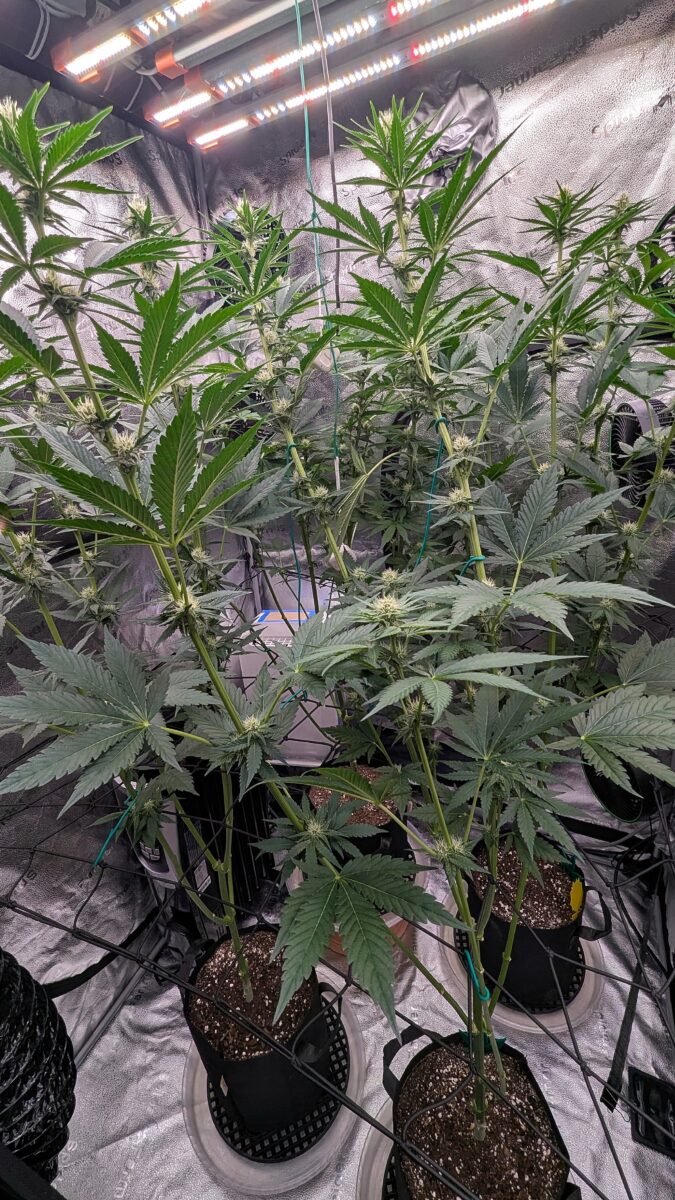
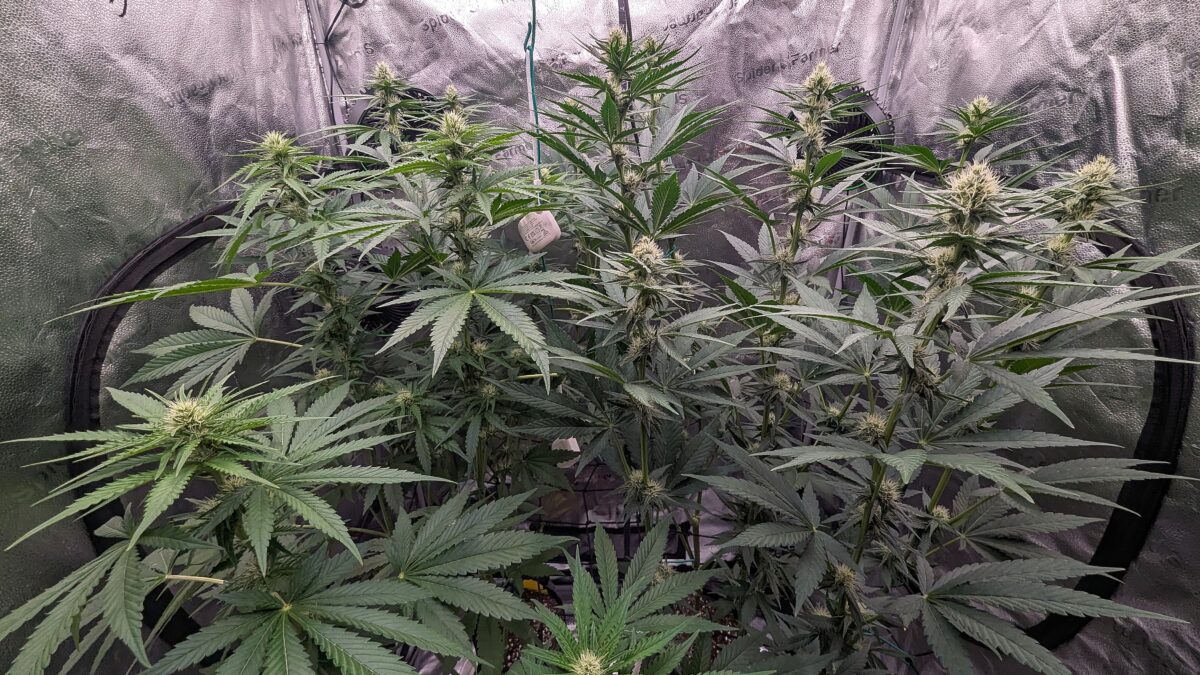
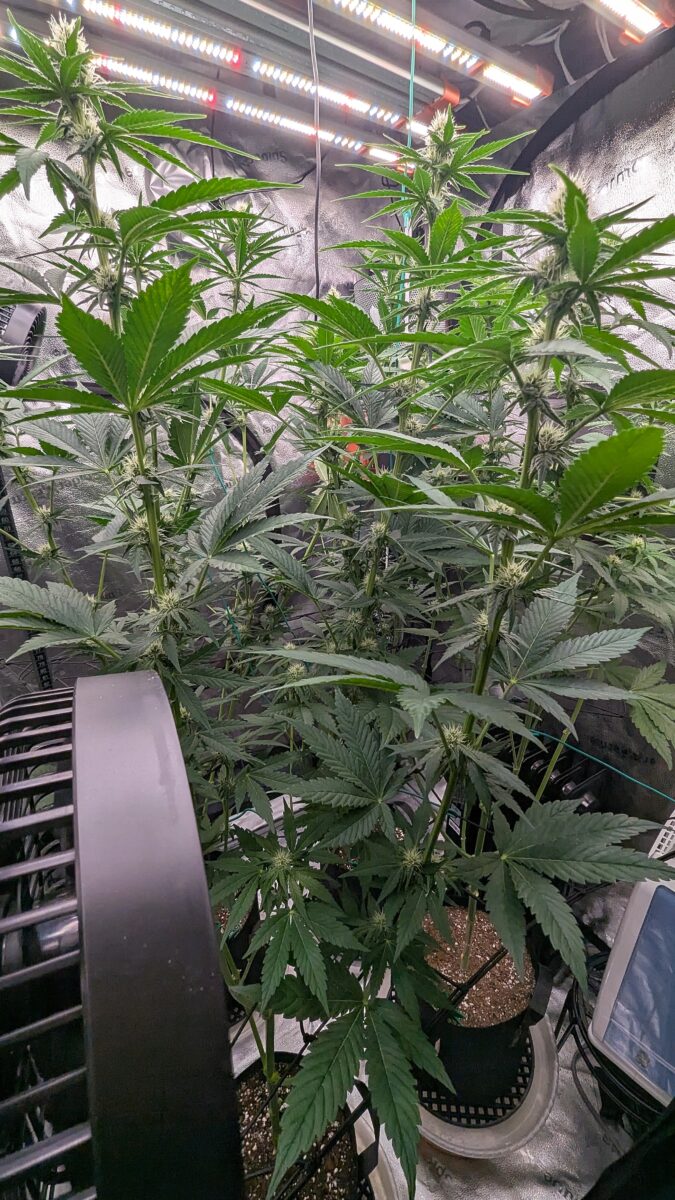
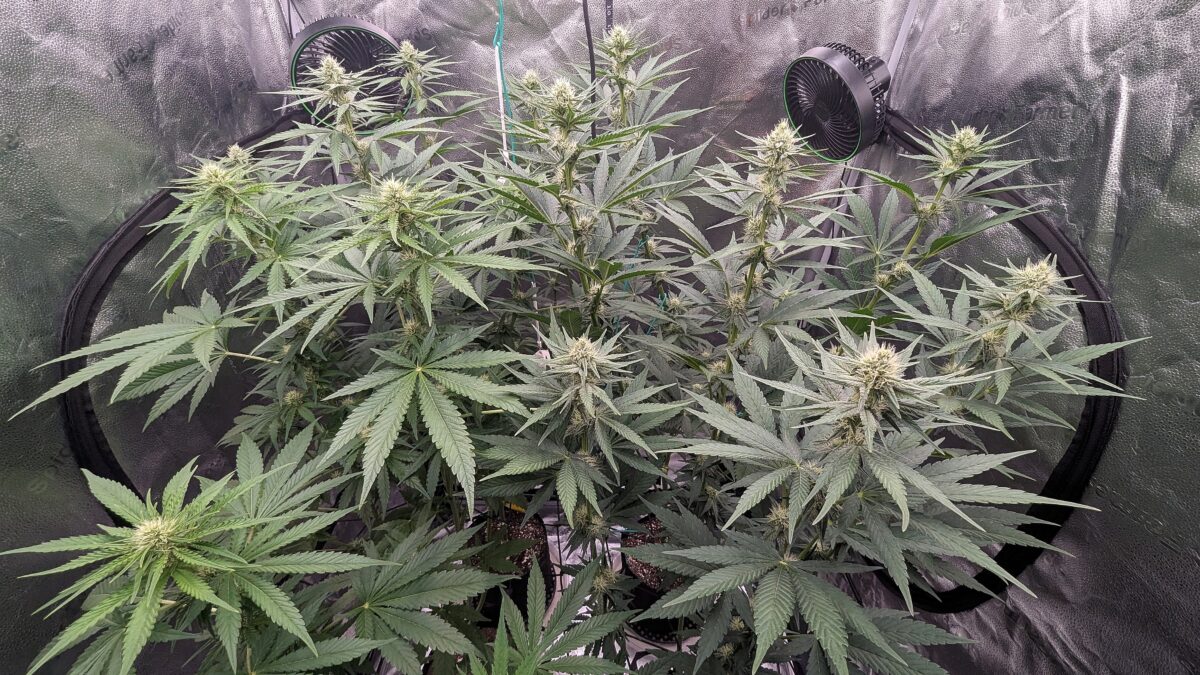
Granddaddy Purple - Week #2 of Flower (Early Flower)
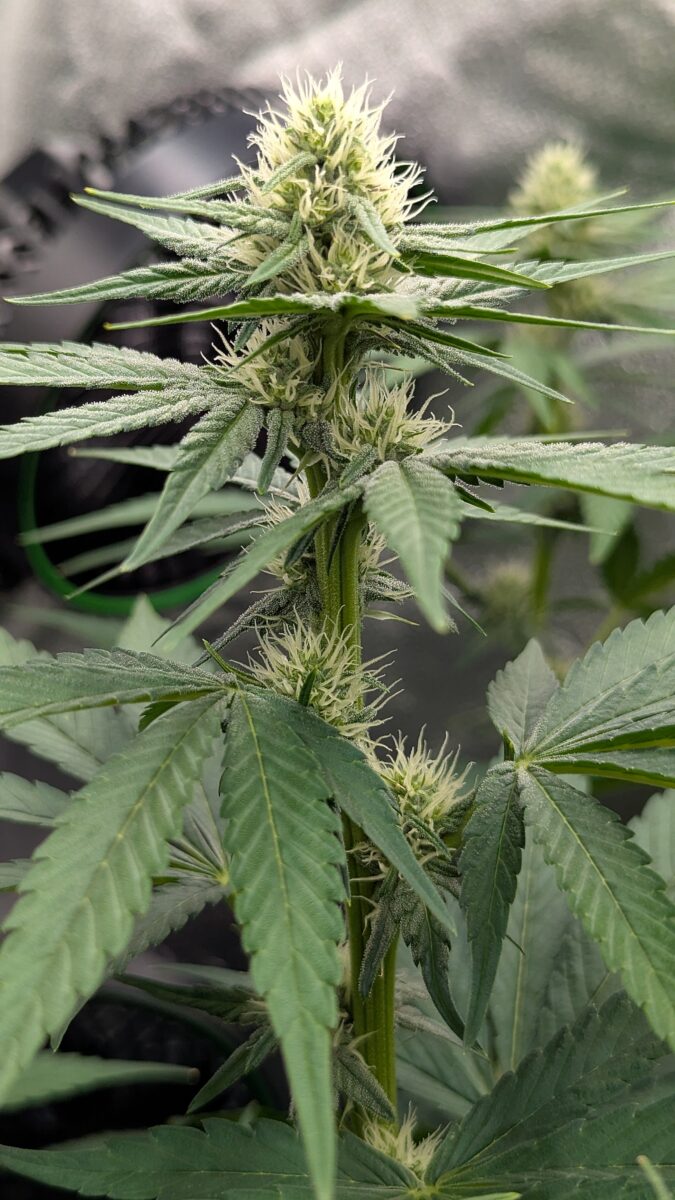
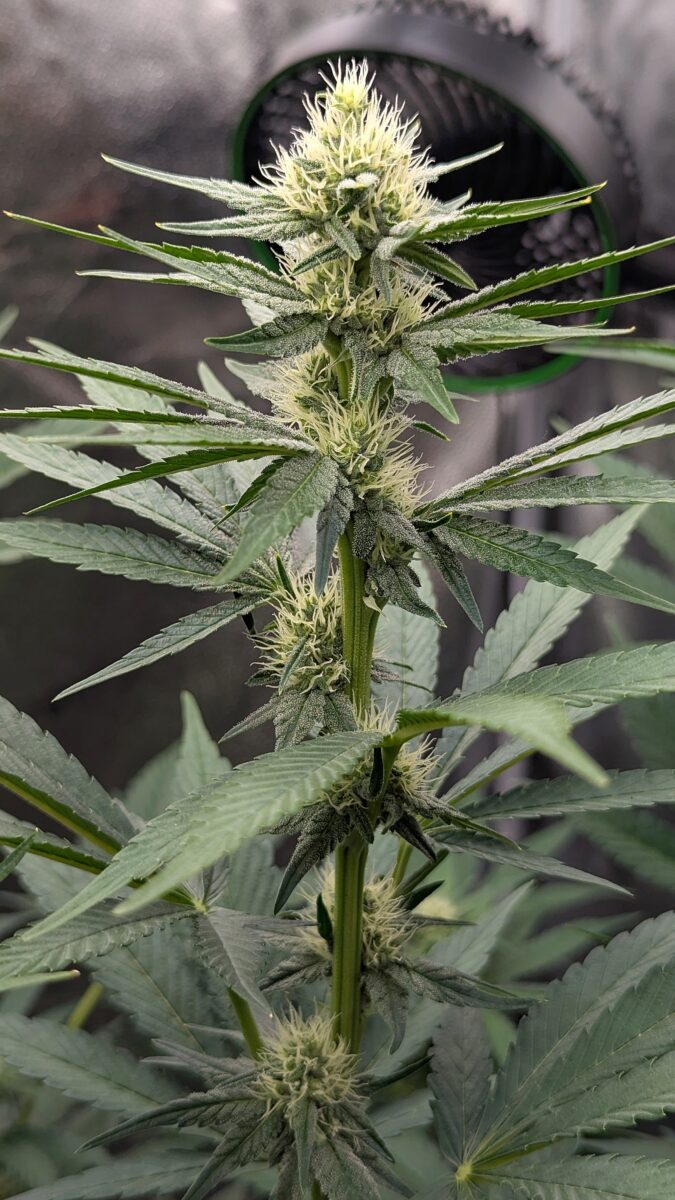
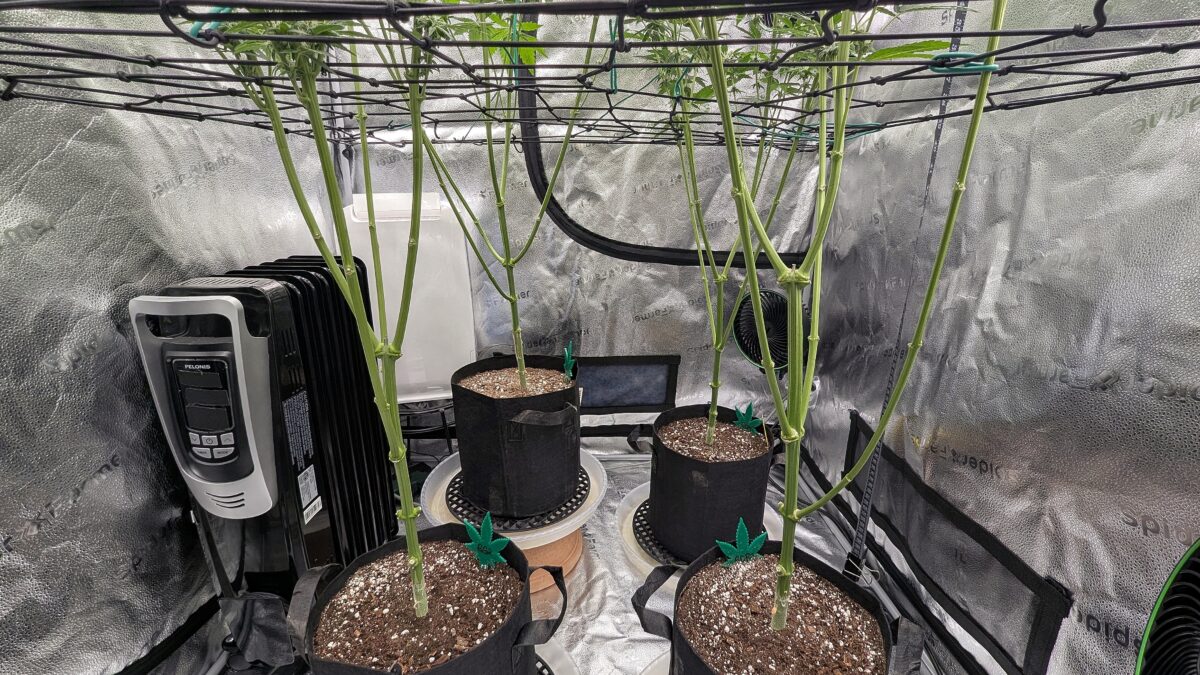
Granddaddy Purple continues to develop beautifully, though with a different growth trajectory from God’s Gift. Whereas God’s Gift closed its stretch early in the week, Granddaddy Purple continued to grow slowly throughout the entire period. Both GDP plants reached 51 inches by Day 47, with daily gains of roughly 0.25–0.50 inches still occurring. Stretch factors sit at roughly 3.0x for GDP #1 and 2.76x for GDP #2, meaning the cultivar has not fully completed its elongation phase yet. This is consistent with GDP’s tendency to stretch longer into early flower despite being an indica-dominant strain. The logistic curve fits confirm that GDP is close to leveling off, but small increments of vertical growth remain possible for a few more days.
The surge in height earlier in the week made it necessary to install a structural grid to maintain canopy control. Once installed, the grid allowed each spear to be pulled outward and horizontally tensioned so that the upper canopy remained flat, even, and fully exposed to high PPFD. Beneath the screen, I performed a full defoliation, removing all lower nodes and branches receiving less than ~250 PPFD. This cleanup dramatically improved airflow and eliminated non-productive sites. Above the screen, I continued strategic leaf removal - mainly inward-facing fans and small leaves wrapping around budlets - to keep light penetration consistent along the entire 25-inch cola length typical for these plants.
I fed Early Bloom nutrients every other day at Medium strength (~900–910 ppm). Silica (0–1.5 mL/gal) and Cal-Mag (5 mL/gal) were included, and pH was maintained at 6.0–6.1 to optimize cation uptake in Pro-Mix HP. The plants have responded extremely well - no burn, no deficiency, and no signs of nutrient stress despite the intense metabolic demands of active stretch. PPFD levels across the tops range from 935–945 (40-41 DLI), which is strong for this stage of development. To accommodate GDP’s height, I had to relocate the exhaust system from the upper tent framing to a vertical side position so that the light could be raised fully to the ceiling, ensuring the critical 10–12 inch buffer from the canopy.
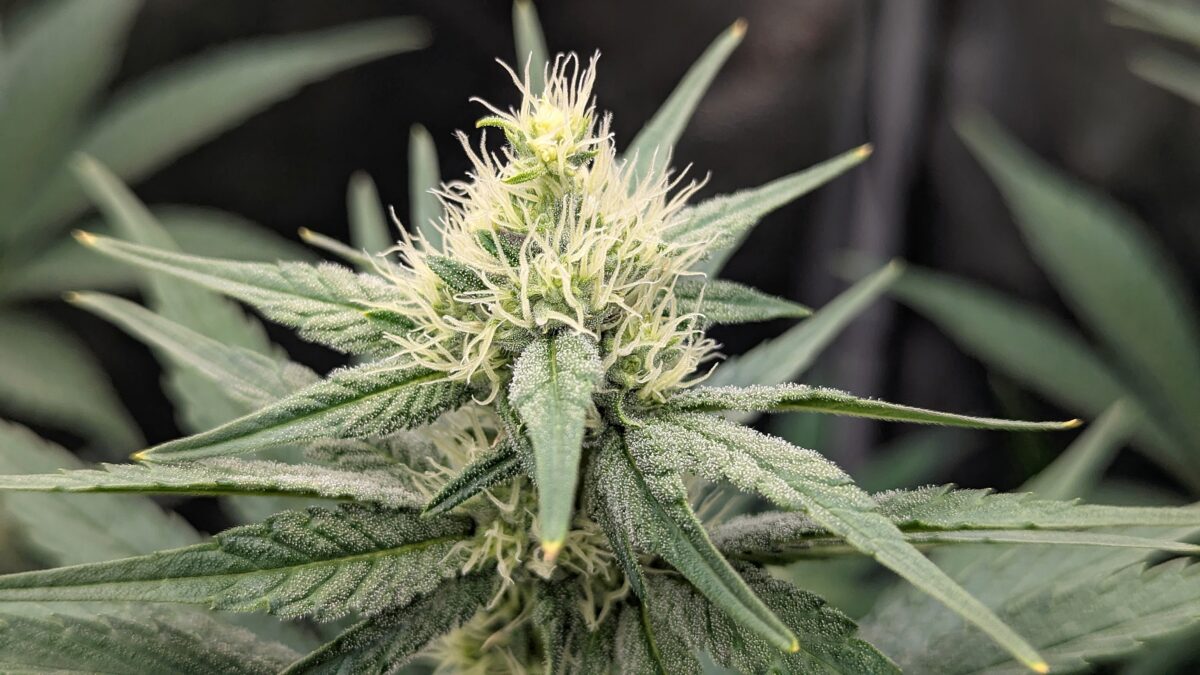
Aromatically, GDP is now becoming loud with hints of grape and citrus. Trichomes are beginning to appear across the sugar leaves in increasing density, signaling the start of resin production. My cooler nighttime temperatures (low–mid 60s), stable VPD, and high but non-stressful PPFD are all deliberate choices to enhance terpene synthesis and preserve volatile compounds.
By the end of the week, GDP stands tall and powerful, with large, well-spaced spears rising above the SCROG grid. The plants are vigorous, aromatic, highly responsive to training, and clearly transitioning into the true flowering stage. Stretch is nearly complete, but not quite finished, and flower expansion is accelerating across all tops.
FLO
5
Week
Week 5: Flowering Granddaddy Purple
Photos (4)
Grow details
Plant height
42.5 in
Air humidity
52 %
Smell intensity
Low
Day air temperature
78 °F
Night air temperature
68 °F
Lamp to plant distance
12 in
Pot size
3 gal
Solution pH
6
Nutrient strength (mS/cm)
1.8 mS/cm
Daily water per plant
4 L
Light schedule
12 h
Grower notes
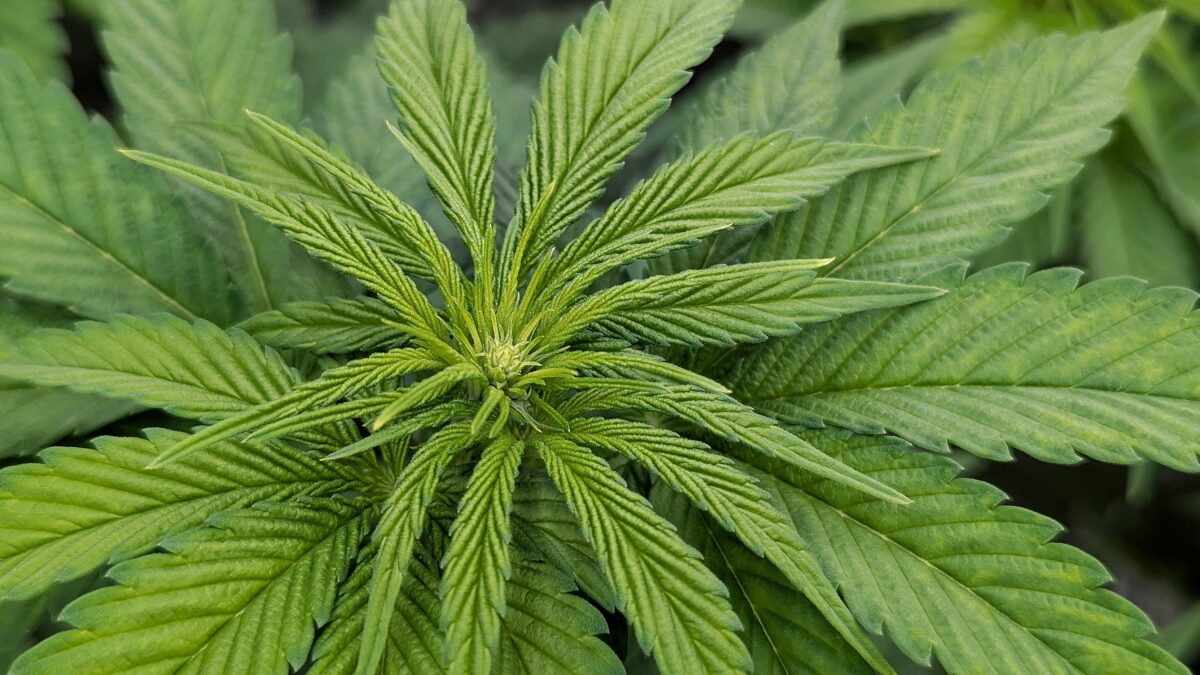
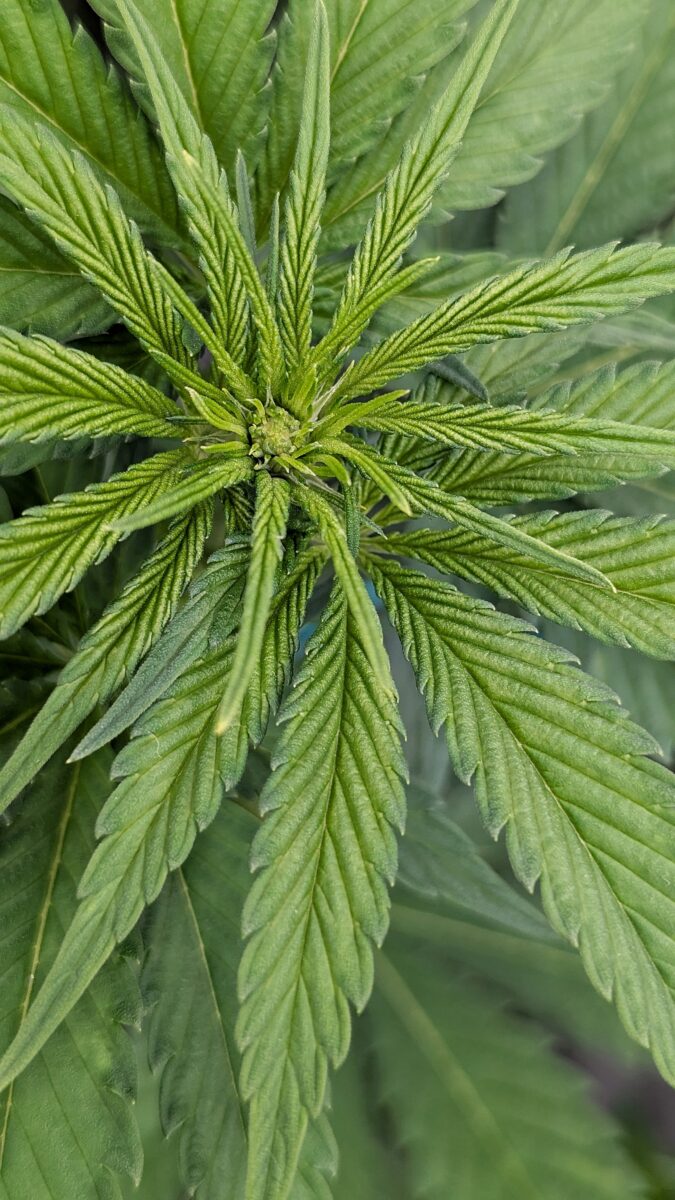
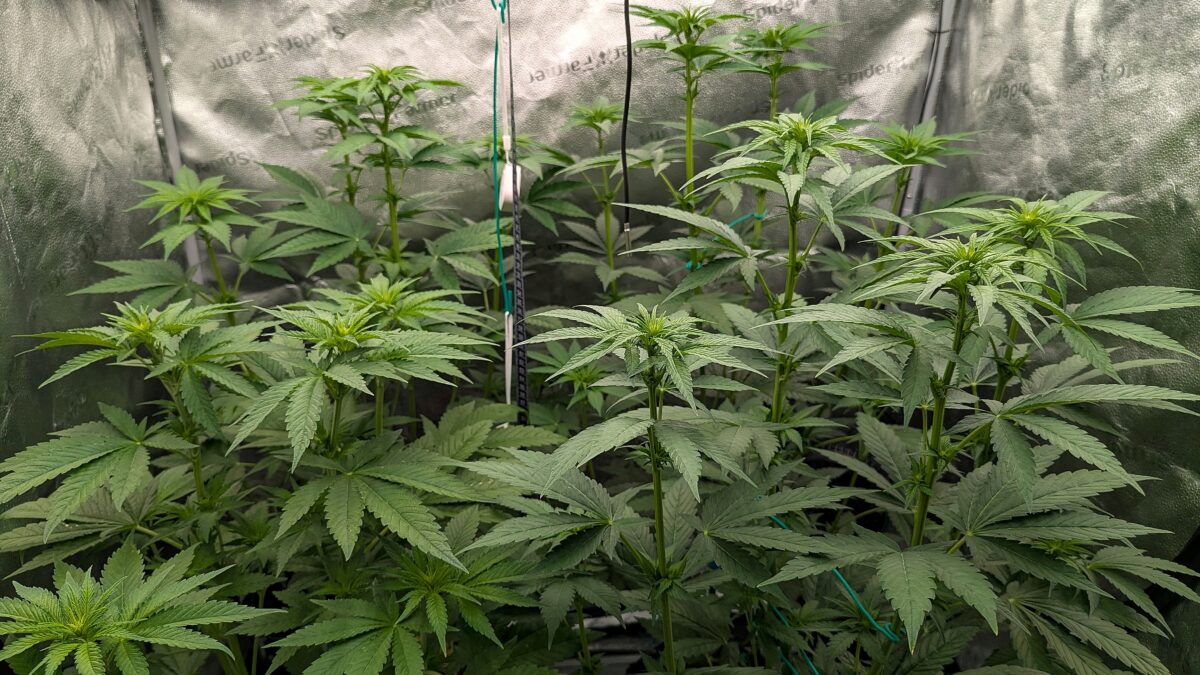
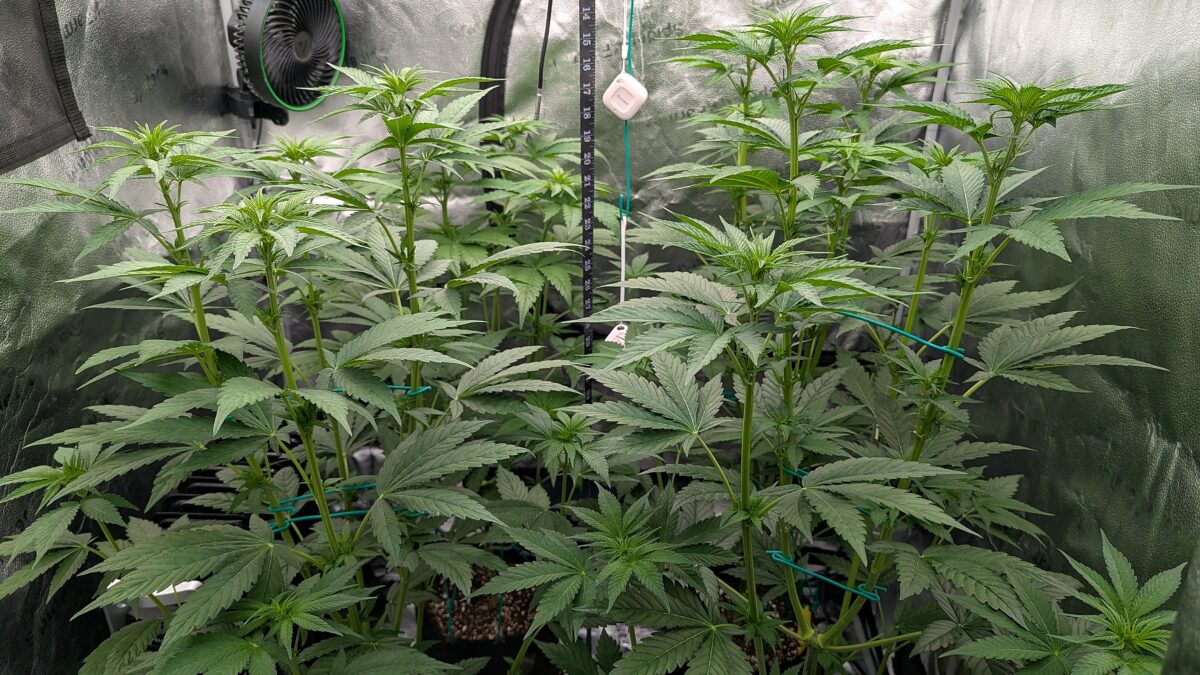
Granddaddy Purple - Transition into Early Flower
This week marked the full completion of Granddaddy Purple’s transition from late vegetative growth into true early flower. Transition lasted a total of 8 days, beginning immediately after the 12/12 flip and ending when pistils became consistently visible across the entire canopy. While the very first pistils appeared on day 30 post-emergence (6 days after flipping to 12/12), they were isolated to the top node or top two nodes. True flowering - defined as pistils emerging on all four branch sets - was confirmed on day 33, which now serves as Flower Day #1. Today is day 36 post-emergence, Flower Day #4, and the first full flower tufts are now forming.
The transition period was dominated by extreme vertical momentum. GDP1 stretched aggressively, but GDP2 was the standout, climbing 2 to 2.5 inches per day at times - even while being bent and tied. Both plants responded exceptionally well to daily low-stress training, widening their structure, opening airflow lanes, and preventing apical dominance from overtaking the canopy. A small amount of lower and mid-canopy defoliation helped remove crowded leaves without sacrificing upper growth, ensuring light penetration and humidity control as stretch peaked.
Nutritionally, the plants were held in a deliberately moderate range while still supporting their explosive growth. Feed strength averaged ~900 PPM using an early-bloom formula, with pH consistently adjusted to 6.0–6.1, the sweet spot for PRO-Mix HP’s peat-based chemistry. Cal-Mag at 5 mL/gal remained essential due to rapid cell expansion, while silica was applied every other feeding to reinforce stems during the heaviest stretch phase. Though runoff readings remained low in pH (5.0–5.3) and surprisingly high in PPM, neither plant showed toxicity or lockout symptoms - likely because their vigor and stretch rate were consuming nutrients at a high pace.
Light management was one of the most critical components of this week. As the canopy surged upward, the light was raised repeatedly until it reached near-maximum height, leaving only a few inches before contacting the filter. PPFD increased from the mid-600s into the 750–900+ range, with short periods where GDP2 briefly exceeded optimal intensity. To regain stretch control without compromising flower formation, the dimmer was adjusted to establish a consistent 850 PPFD ceiling at the highest cola, with the rest of the canopy ranging 650–800 PPFD. This places DLI comfortably between 34–37, a strong but safe target for early flower that encourages bud formation while reducing further vertical acceleration. UVA exposure was also increased from 30 minutes to 60 minutes with no adverse effects.
By the end of the week, both Granddaddy Purple plants entered early flower in excellent condition. Flower initiation is underway across every top, the structure is open and well-trained, and vertical growth - while still present - is beginning to show the first signs of slowing as hormonal priorities shift from elongation to cluster development. Despite a challenging stretch and tight vertical constraints, GDP1 and GDP2 remain healthy, balanced, and poised for a strong flowering run.
GDP1: 40.5"
GDP2: 42.5"
VEG
4
Week
Week 4: Vegetation Granddaddy Purple
Photos (2)
Grow details
Plant height
23 in
Air humidity
55 %
Smell intensity
Low
Day air temperature
78 °F
Night air temperature
71 °F
Lamp to plant distance
12 in
Pot size
3 gal
Solution pH
6
Nutrient strength (mS/cm)
1.79 mS/cm
Daily water per plant
4 L
Light schedule
12 h
Grower notes
Granddaddy Purple – Week 4
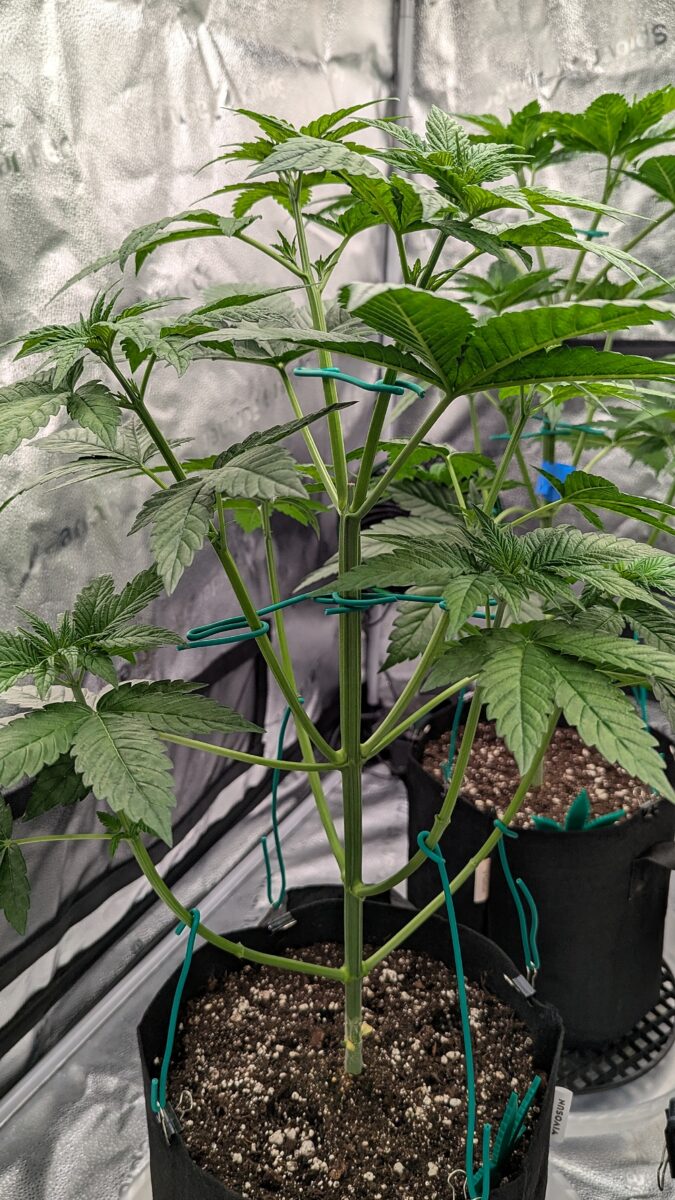
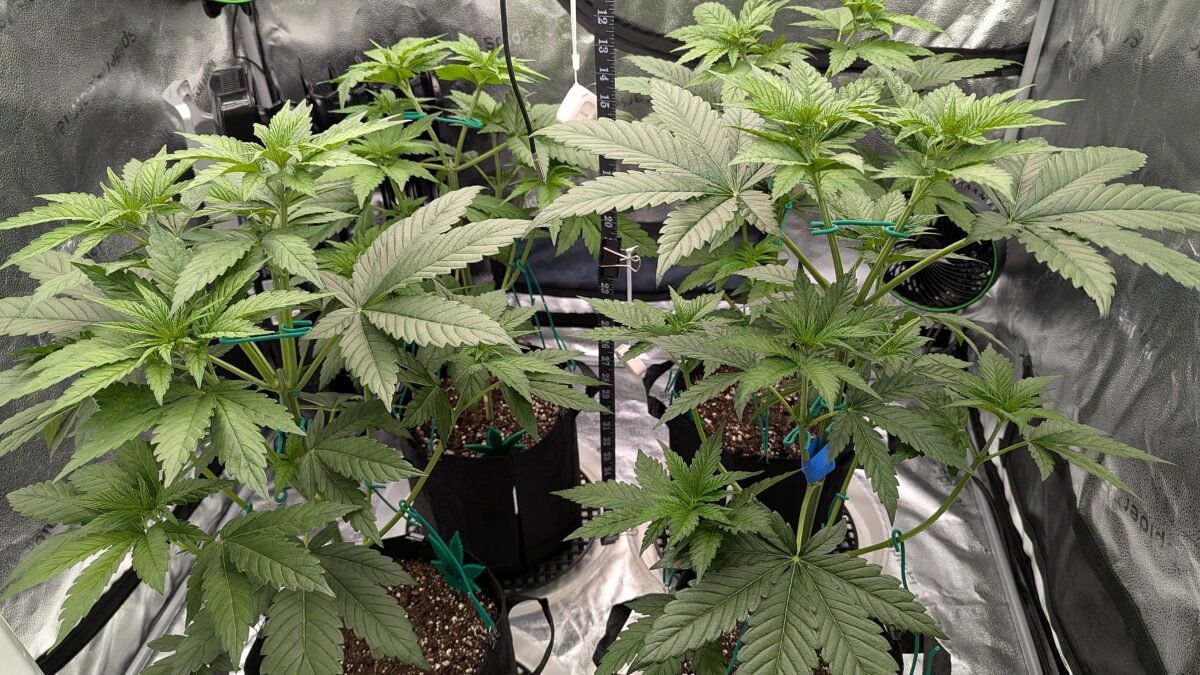
Today marks day 26 since emergence, and both Granddaddy Purple plants have officially entered their transition period after the 12/12 flip. They were given four full days to recover after being topped above the fifth node, and both responded with explosive growth. We're now two days into transition with no pistils yet, which is completely normal as the plants shift hormonally before flower initiation.
This week brought massive vertical gains. GDP1 grew from 11.25 inches to 21.5 inches, and GDP2 jumped from 12.5 inches to 23 inches. The stretch has been fast but controlled, with tight internodes and strong lateral growth. Every node is now being actively trained outward to create width and airflow before the real stretch begins. The structure is balanced, and the canopy is wide and even, which is exactly what I wanted going into flower.
Nutrient strength remained moderate throughout the week. Each plant received a blend of late-veg and early-bloom food at around 895 PPM, with the solution pH adjusted to 6.1 for optimal uptake in PRO-Mix HP. Silica was increased to 2 mL per gallon to help fortify the stems ahead of stretch, along with Cal-Mag at 4 mL per gallon. The plants handled the nutrients perfectly with no tip burn or signs of overfeeding, and the leaf color remains rich, uniform, and healthy.
Low-stress training expanded significantly this week. All nodes are being spread outward - first the lower branches, then the mid-tier, and now even the developing top colas are beginning to receive gentle directional training to prepare for stretch. During this process, one branch on GDP2 suffered a small split near the node. I stabilized it with tape and plant ties, leaving airflow around the wound. It hasn’t wilted or leaked sap, which would mean the vascular tissue is intact and it should heal over the upcoming week.
Lighting remained steady and controlled. I didn’t change the dimmer at all this week; instead, I raised the light incrementally as the plants grew so that they moved naturally into the 600–650 PPFD range. DLI stayed stable at 26–29 throughout the week. Before topping, the plants were receiving stronger light as they grew upward, but after topping the light was raised to reduce stress, and then brought back down to transition intensity once stretch began.
UVA was increased from 30 minutes to 45 minutes daily with no signs of stress.
Overall, Week 4 was a dramatic and successful transition. The plants recovered beautifully from topping, took to training without issue, and are now building the structure they need for strong flowering. Stretch is underway, vigor is high, and everything is positioned perfectly for pistils to appear soon as the transition ends and true flower begins.
VEG
3
Week
Week 3: Vegetation Granddaddy Purple
Photos (6)
Grow details
Plant height
12 in
Air humidity
58 %
Smell intensity
Low
Day air temperature
83 °F
Night air temperature
70 °F
Lamp to plant distance
14 in
Pot size
3 gal
Solution pH
6
Nutrient strength (mS/cm)
1.63 mS/cm
Daily water per plant
2 L
Light schedule
18 h
Grower notes
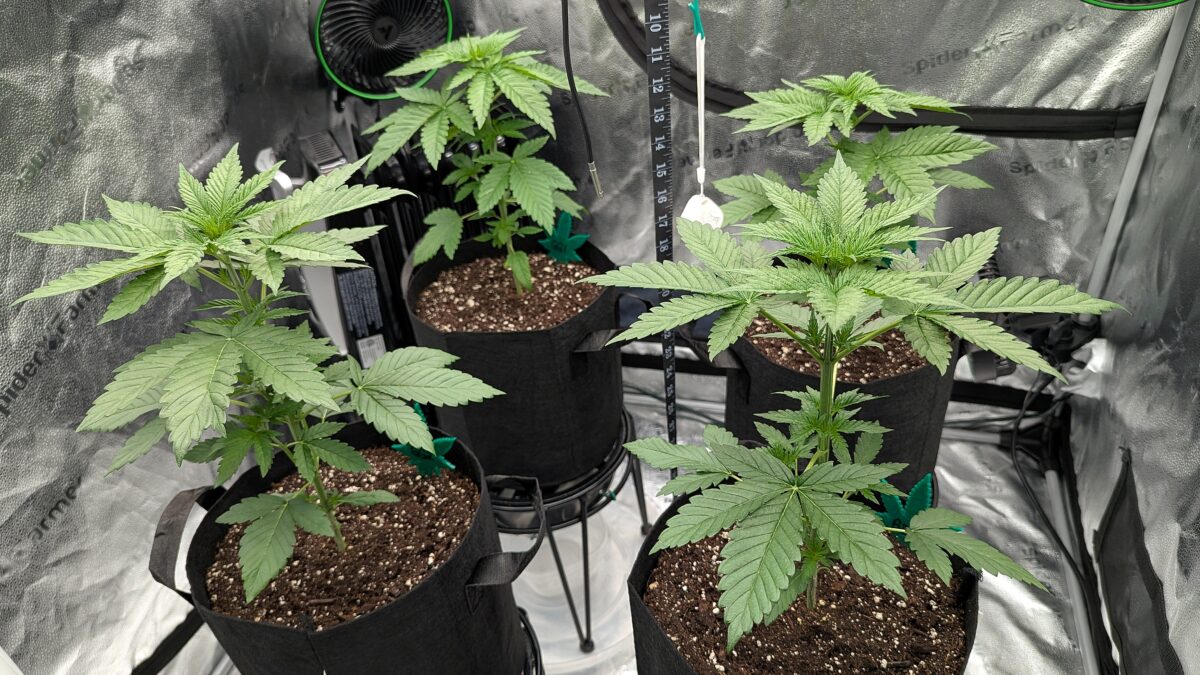
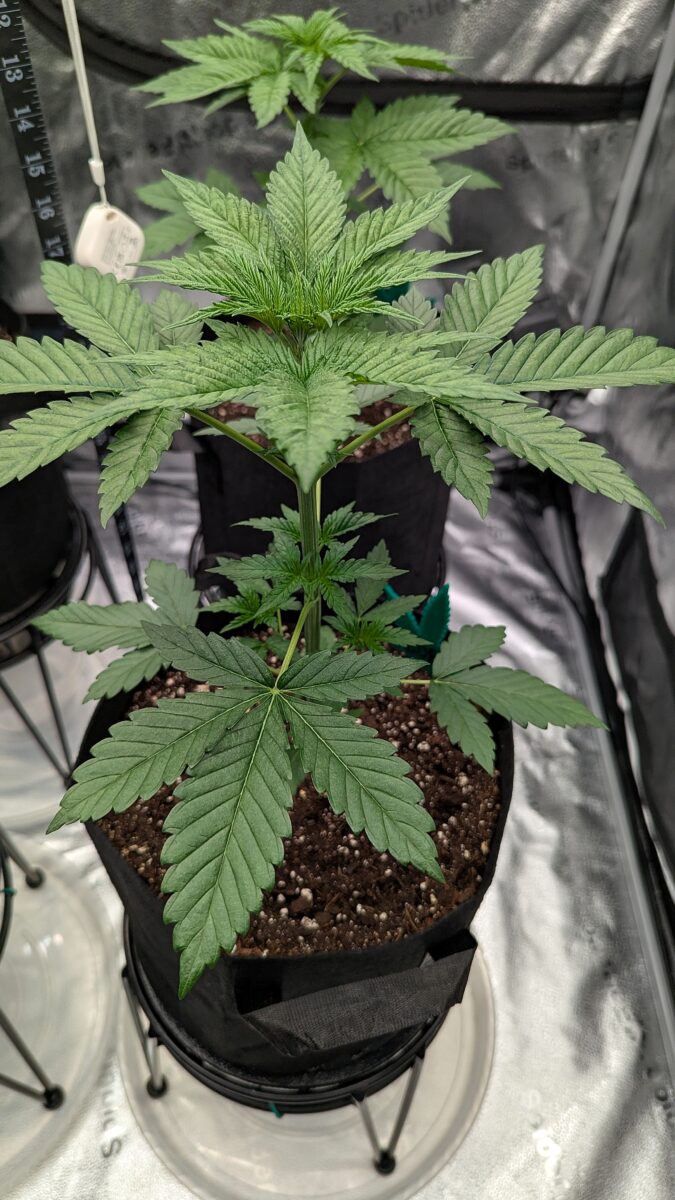
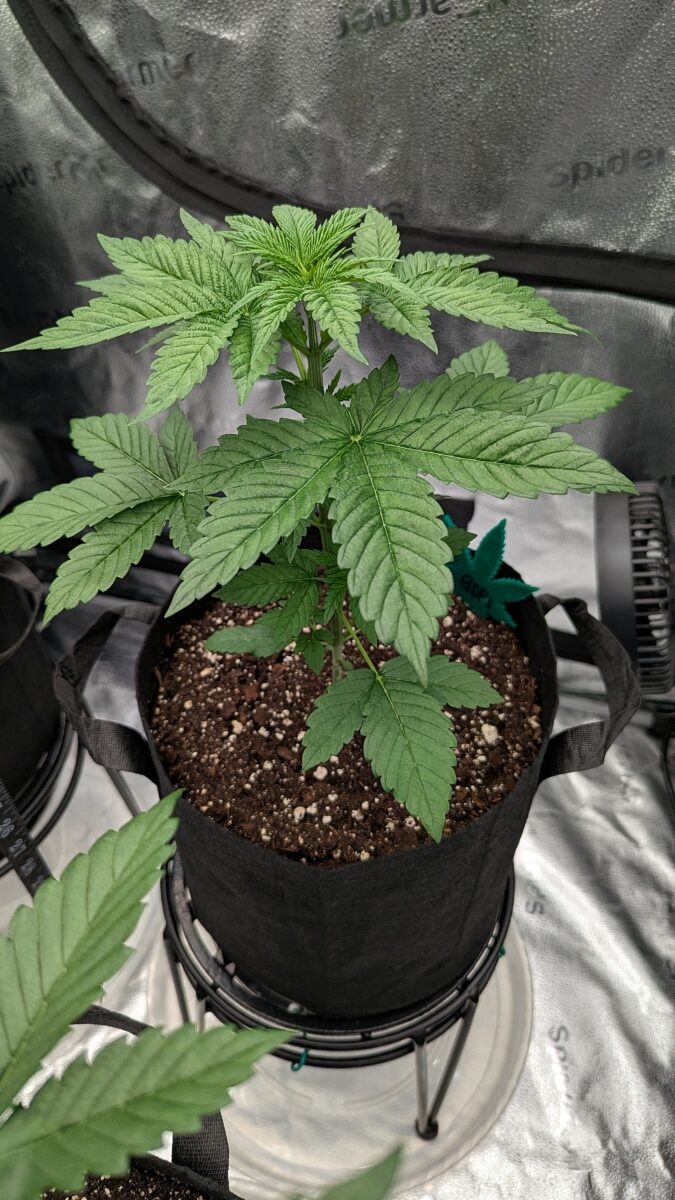
Granddaddy Purple – Week 3 of Vegetative Stage
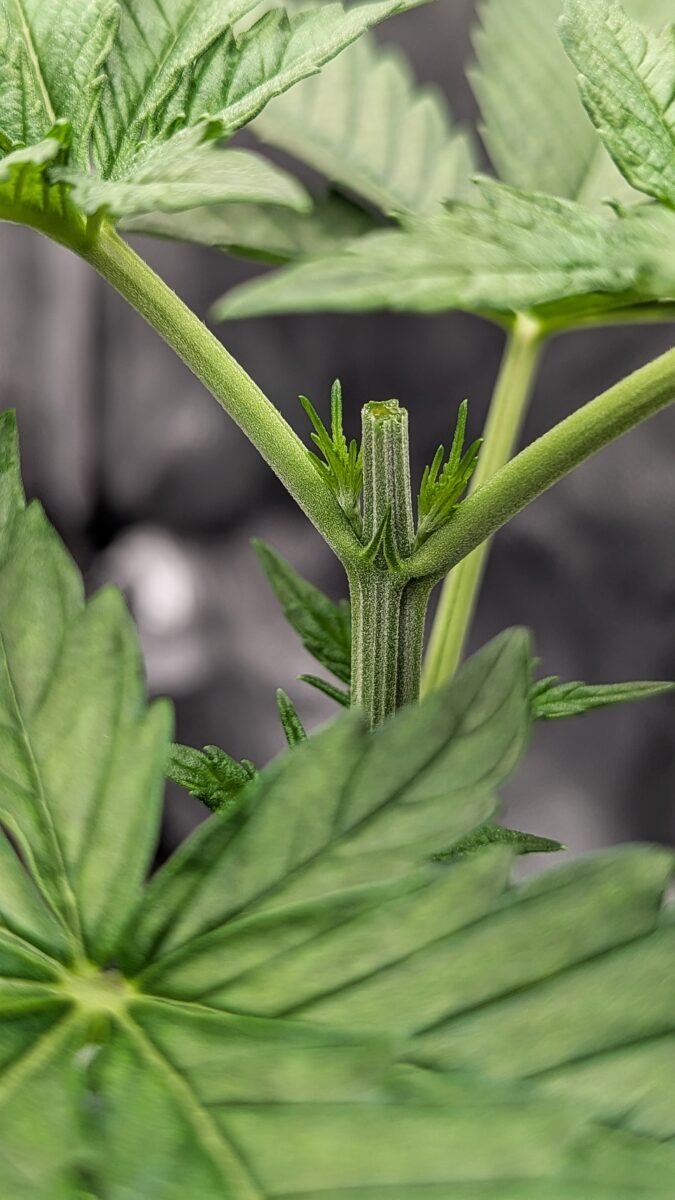
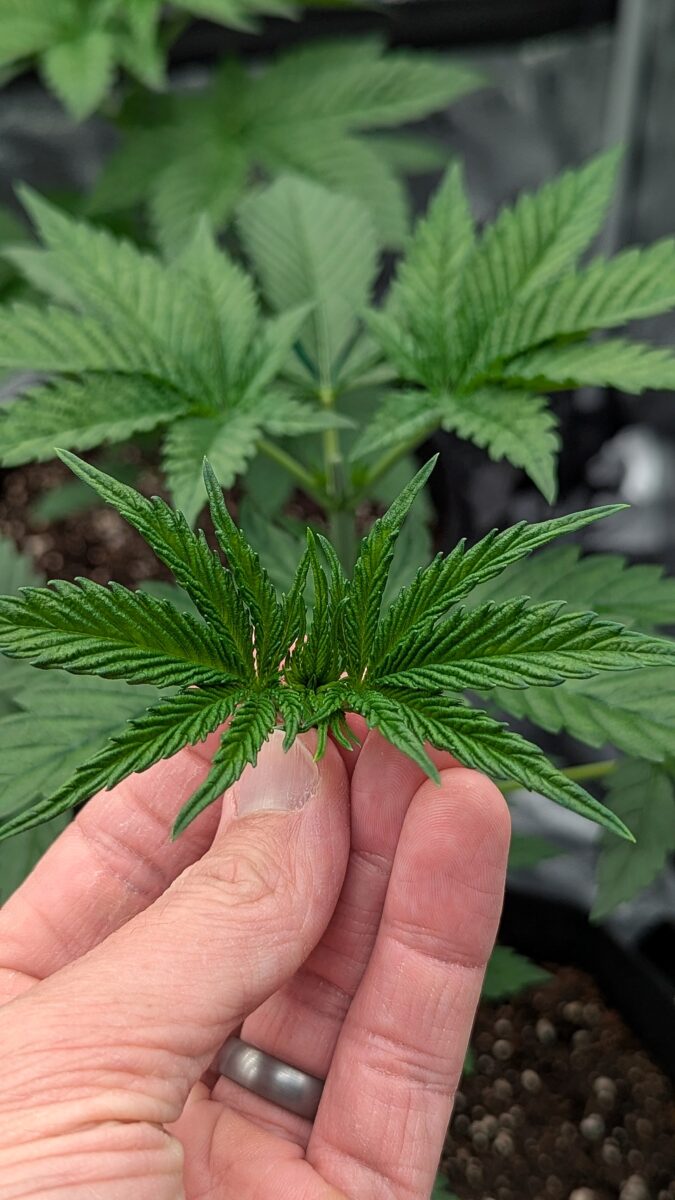
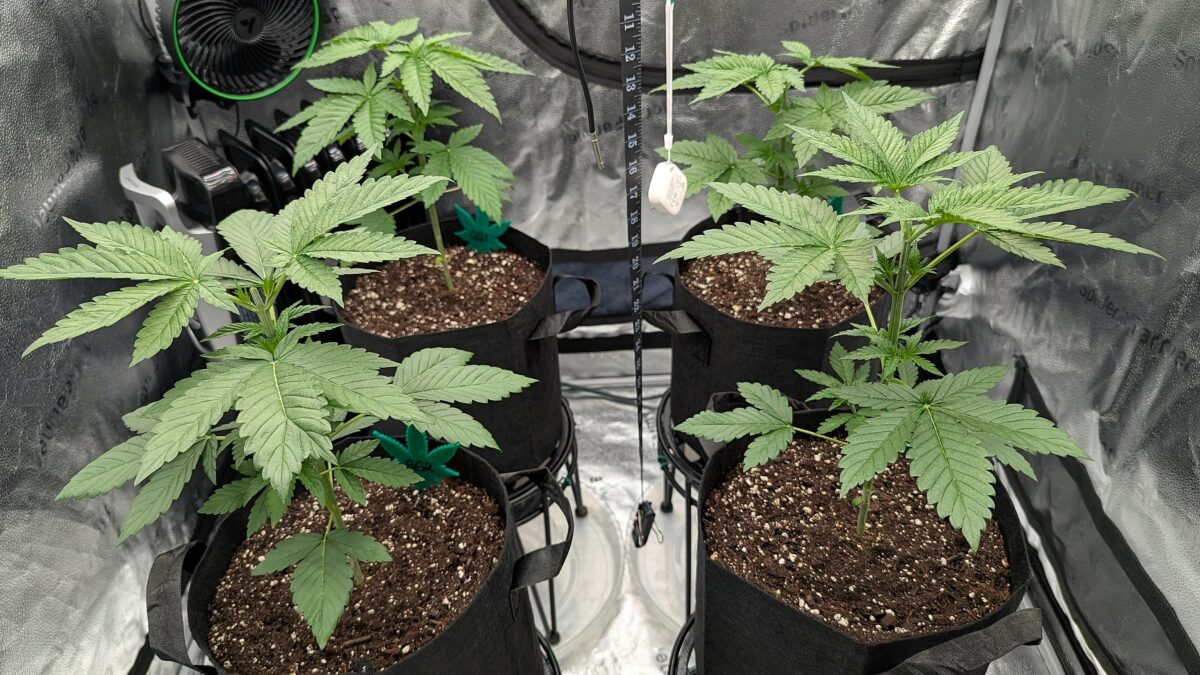
Today marks day 19 post-emergence, and both Granddaddy Purple plants have completed their vegetative progression - 5 days in early veg, 2 days in mid veg, and 2 days in late veg prior to topping. Growth has been steady and balanced throughout, with strong stems and tight internodal spacing.
Light intensity was gradually increased from the mid-400 PPFD range to a consistent 575–600 PPFD, producing a DLI of 36–39. The light sits 13–15 inches above the canopy, maintaining compact structure and uniform development across both plants.
Each plant was topped above the fifth node and node 1 removed, leaving four well-positioned branch sets to form the main canopy. Before topping, GDP1 stood 12 inches and GDP2 13 inches; after topping, heights range 10–12 inches.
Feeding strength increased from approximately 500 PPM to 800 PPM this week as the plants transitioned into late vegetative growth. The solution was maintained at pH 6.0, ensuring optimal uptake in the inert PRO-Mix HP medium. The plants absorbed the higher concentration smoothly, with no signs of nutrient stress or tip burn. Leaves remain richly colored and firm, showing balanced hydration and excellent vigor.
Following topping, PPFD was temporarily reduced to 575-600 to moderate transpiration and stress. Over the next five days, the plants will recover, redirect energy to new growth tips, and then begin low-stress training before the 12/12 light flip.
Granddaddy Purple continues to display textbook structure and stability heading into transition.
VEG
2
Week
Week 2: Vegetation Granddaddy Purple
Photos (3)
Grow details
Plant height
3.8 in
Air humidity
58 %
Smell intensity
None
Day air temperature
82 °F
Night air temperature
73 °F
Lamp to plant distance
16 in
Pot size
3 gal
Solution pH
6
Nutrient strength (mS/cm)
0.88 mS/cm
Light schedule
18 h
Grower notes
Granddaddy Purple – Week 1 of Vegetative Stage
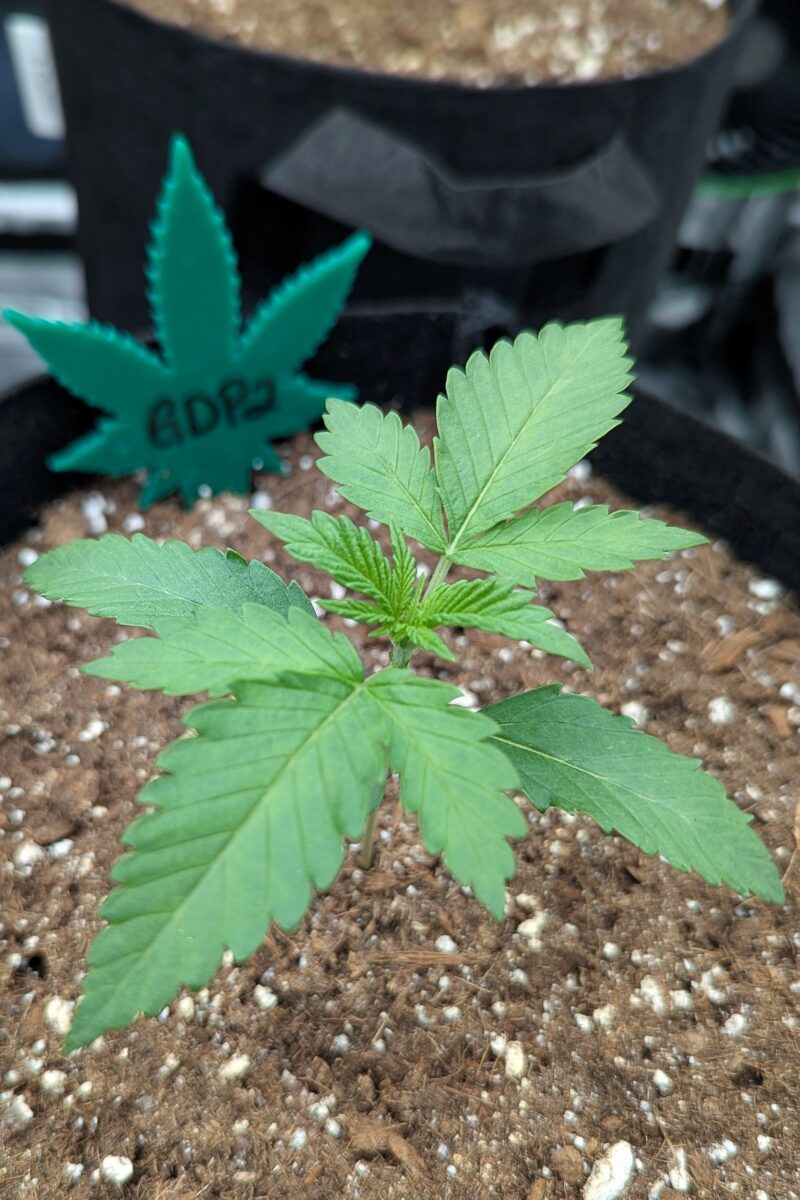
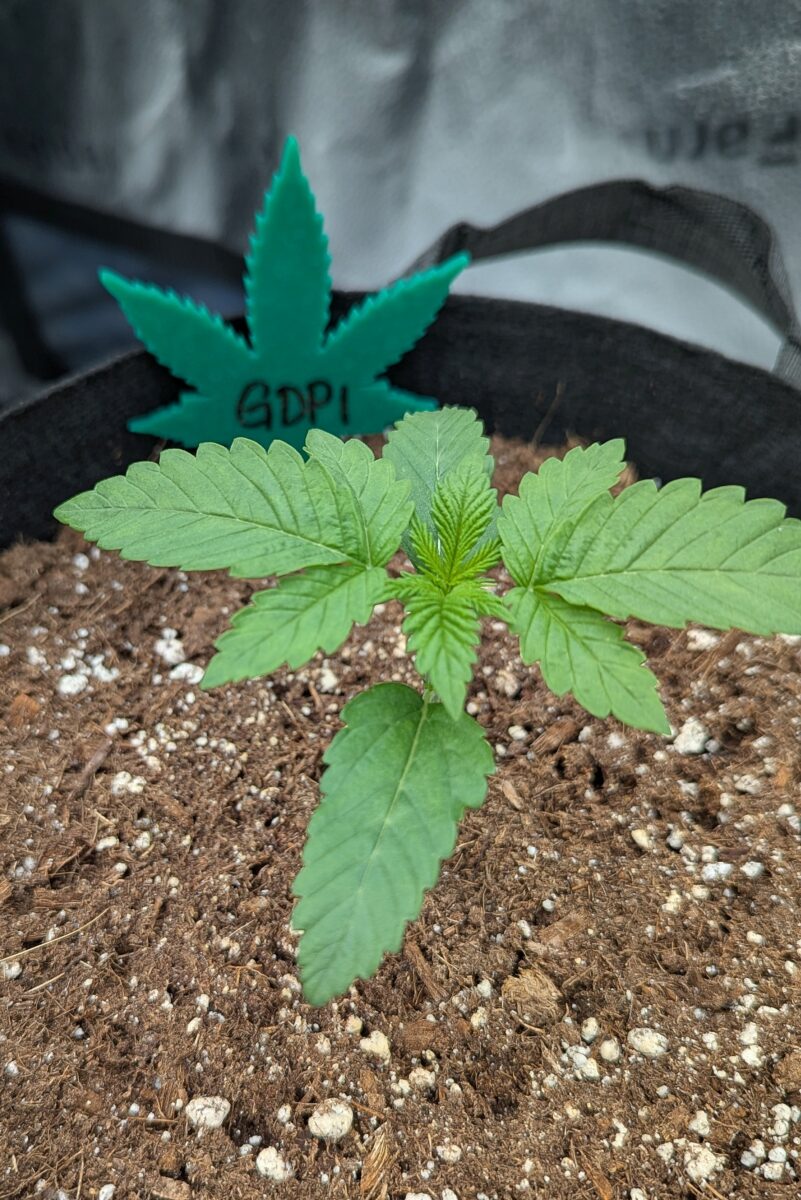
With two fully developed nodes and a third beginning to expand, both Granddaddy Purple plants have officially entered early vegetative growth. Each spent about nine days in the seedling stage, and today marks day 11 post-emergence - day 2 of early veg.
Because I’m growing in an inert medium (PRO-Mix HP-CC Mycorrhizae High Porosity), I’ve been feeding with every watering to ensure steady nutrient availability. Water is applied in a ring around each plant to promote lateral root expansion, and I’m maintaining an every-other-day watering schedule.
As of today, GDP1 stands 3.5 inches tall and GDP2 is 3.75 inches tall, both showing strong posture and tight internodal spacing. I’m running 445–460 PPFD (DLI 29–30) with the light positioned 16.25 - 16.5 inches above the canopy to keep the plants compact and structurally sound.
Both plants are responding well to the current environment and light intensity, showing healthy color and even development.
GER
0
Week
Germination Granddaddy Purple
Photos (4)
Grow details

Germination method
Paper Towel
Grower notes
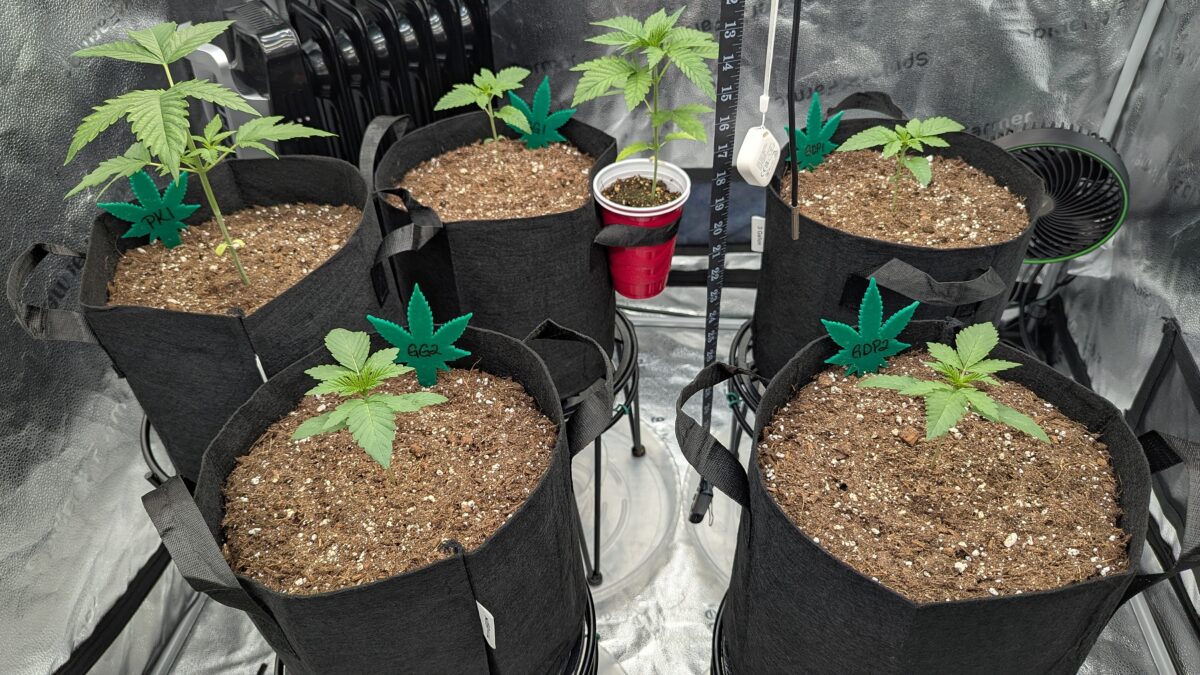
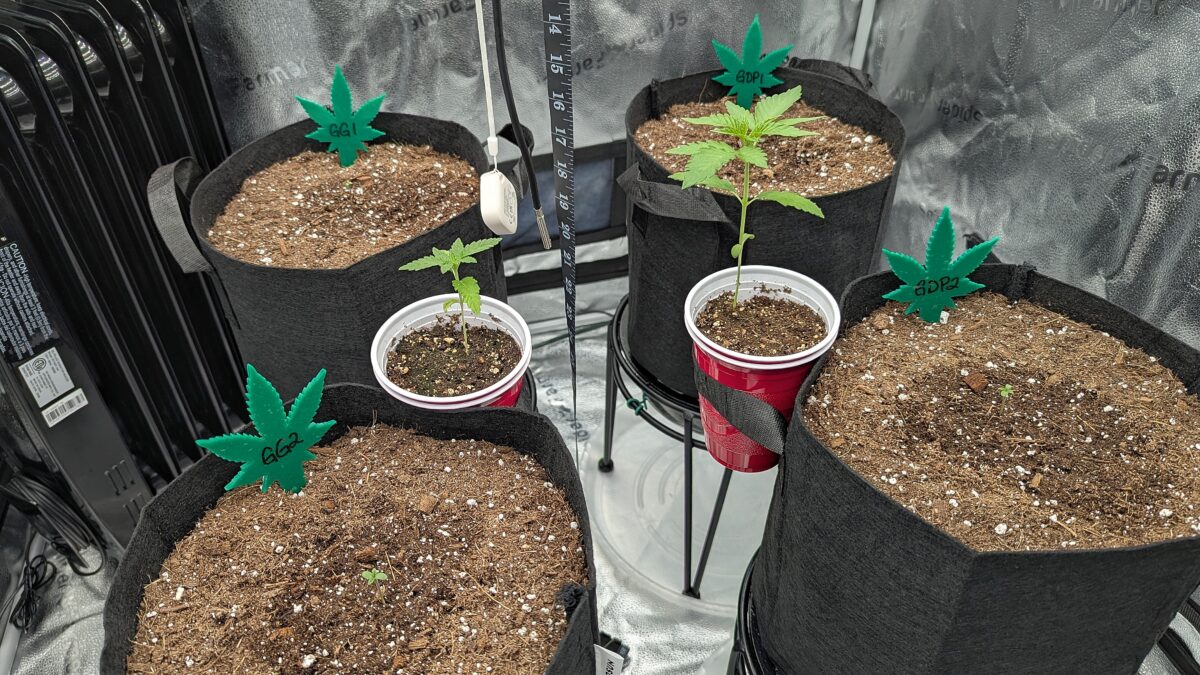
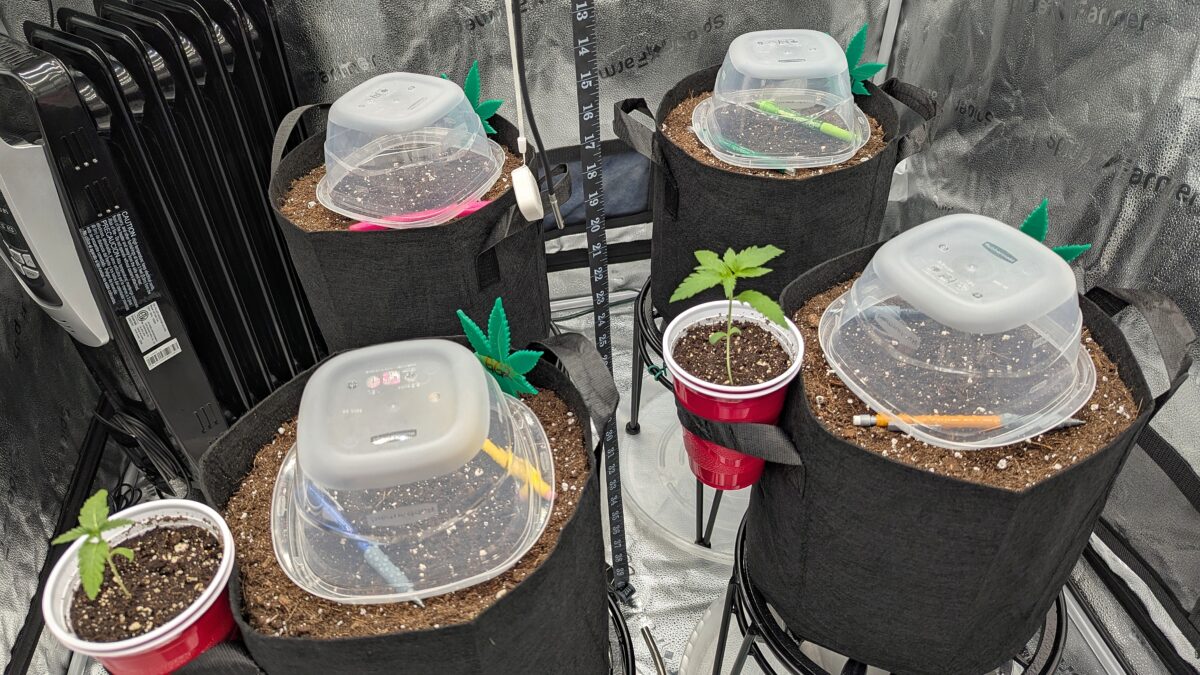
This run features God’s Gift (2) and Granddaddy Purple (2) grown in 3-gallon fabric pots with PRO-Mix HP-CC Mycorrhizae High Porosity Grower Mix. Lighting is provided by a Spider Farmer SE-5000 with supplemental UV-A and Near-Infrared, and the environment is stabilized with a radiant heater, desiccant dehumidifier, and a 6" carbon-filter fan system with multiple oscillating fans for consistent airflow.
Seeds were soaked in distilled water for 12–15 hours at 78–82°F, then sown ¼ inch deep into pre-moistened medium. A humidity dome maintained stable conditions until emergence, which occurred within 48 hours.
Light intensity started at 300 PPFD (DLI 19) and was increased to 340 PPFD (DLI 22) by day 3 post-emergence to keep growth compact. During these first days, the medium was kept evenly moist through 2–4 daily mistings, maintaining a moisture depth of about ½–1 inch.
On day 4, seedlings received their first light feeding:
- 0.5 ml/gal Cal-Mag
- 0.5 ml/gal each of the Flora Series base nutrients
Water was applied in a ring around the seedlings to encourage lateral root expansion.
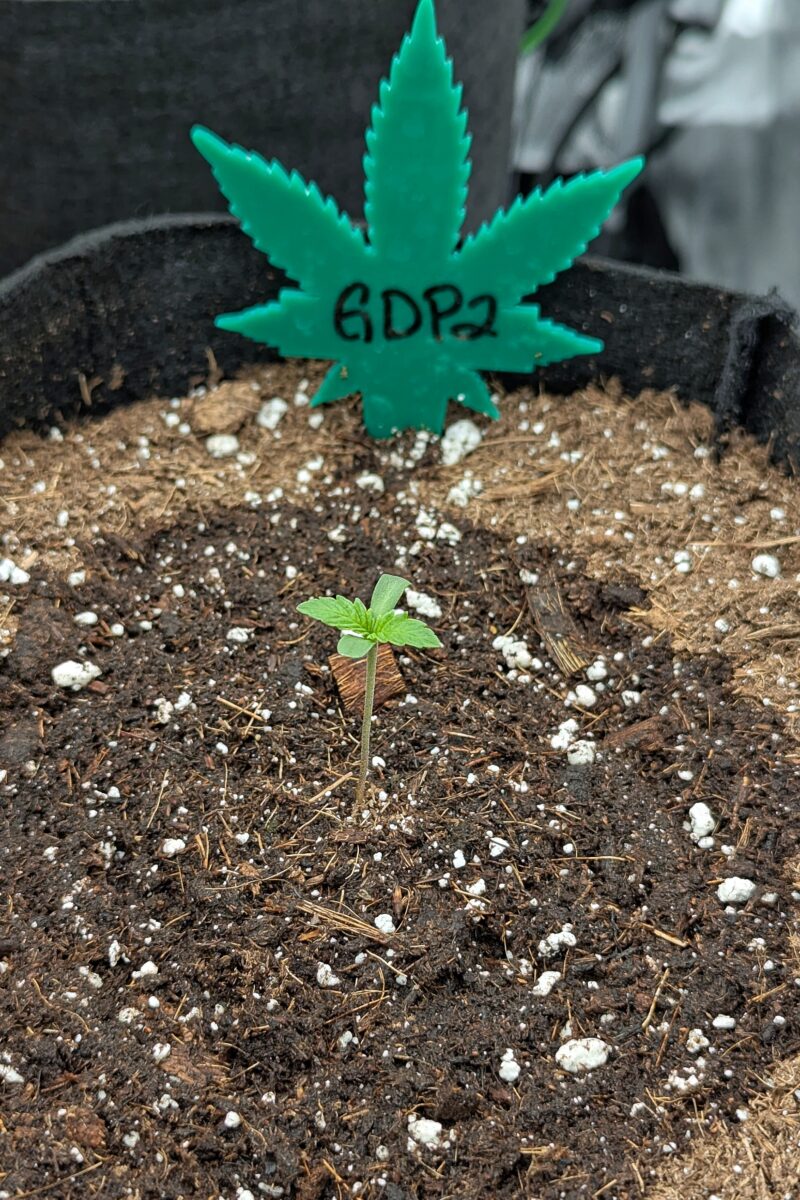
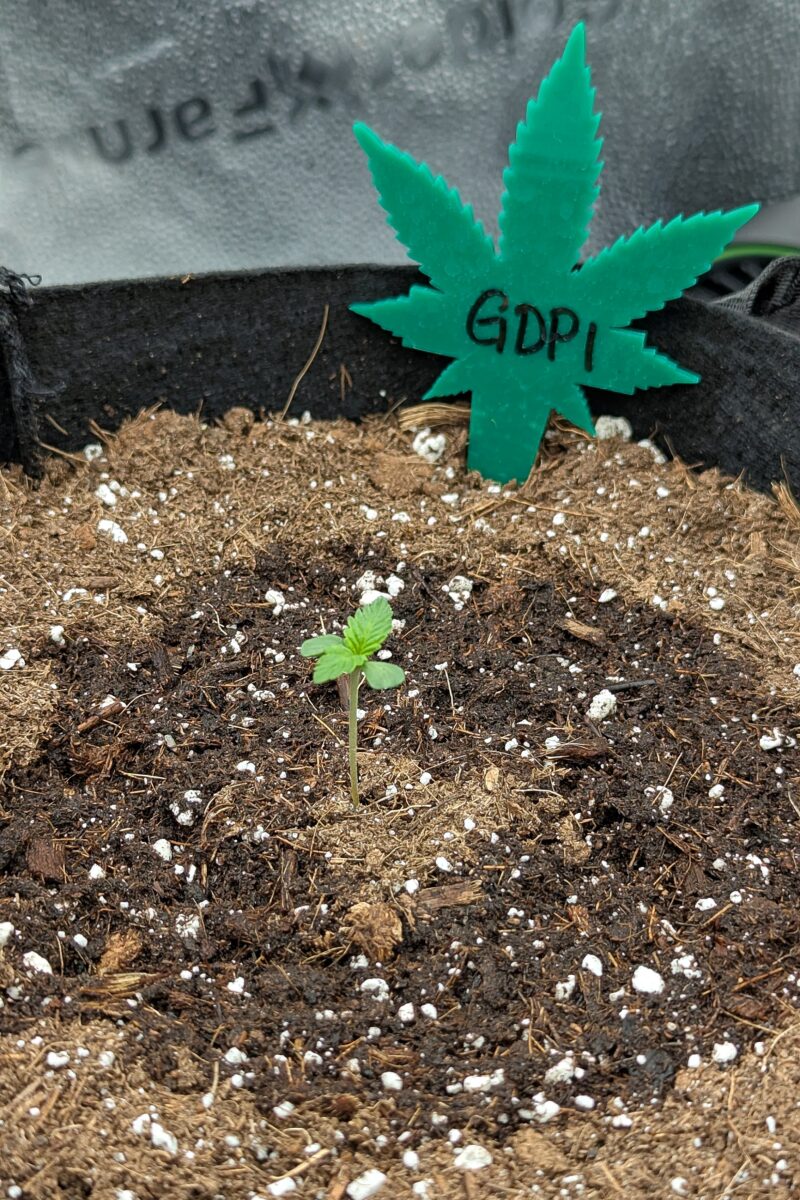
Photos: Germination through Day #4 of the Seedling stage.